

[2025] CPC All-in-One Exam Guide Practice To your CPC Exam!
Preparations of CPC Exam 2025 Certified Professional Coder Unlimited 197 Questions
AAPC CPC Exam Syllabus Topics:
| Topic | Details |
|---|---|
| Topic 1 |
|
| Topic 2 |
|
| Topic 3 |
|
| Topic 4 |
|
| Topic 5 |
|
| Topic 6 |
|
| Topic 7 |
|
| Topic 8 |
|
| Topic 9 |
|
| Topic 10 |
|
| Topic 11 |
|
| Topic 12 |
|
| Topic 13 |
|
| Topic 14 |
|
| Topic 15 |
|
| Topic 16 |
|
| Topic 17 |
|
NEW QUESTION # 47
Ten-year-old boy has a painful felon abscess of the deep tissues of the palmar surface of his right thumb. The provider makes an incision on one side of the nail and then across the fingertip parallel to the end of the nail.
He identifies the area of abscess and drains it. A drainage tube is inserted.
What CPTand ICD-10-CM is reported?
- A. 10140-F5, L02.511
- B. 10061-F5, L03.011
- C. 26011-F5, L03.011
- D. 26010-F5, L02.511
Answer: D
Explanation:
1. Procedure and CPTCode Selection:
The procedure involves an incision and drainage (I&D) of a deep abscess (felon) on the palmar surface of the right thumb. A felon is an abscess in the pulp of the fingertip, often involving deep tissue.
Code 26010 is specific for incision and drainage of a finger abscess, which includes the thumb. This code applies to cases where the abscess is drained from a deep tissue level.
Code 26011 is similar but involves the use of extensive drainage or debridement, which is not indicated in this case. Therefore, 26011 is not appropriate here.
Code 10061 refers to incision and drainage of abscesses at different locations on the body but not for specific areas such as the thumb, making it inappropriate in this context.
Code 10140 pertains to the evacuation of hematoma, seroma, or fluid but does not apply to abscesses, so it is not suitable for this scenario.
2. Modifier:
Modifier F5 is added to specify that the procedure was performed on the right thumb.
3. Diagnosis and ICD-10-CM Code Selection:
ICD-10-CM Code L02.511 is appropriate for cutaneous abscess of the right finger, as it accurately describes the diagnosis of a felon on the thumb.
L03.011 would represent cellulitis but does not specify an abscess, making it less precise for this case.
4. AAPC and CPTCoding Guidelines:
The AAPC guidelines for coding finger abscess drainage emphasize the selection of specific codes for deep tissue drainage procedures in extremities. Additionally, correct laterality should be included with the use of modifiers and specific ICD-10-CM codes for an accurate representation of the site and nature of the condition.
Thus, based on the coding standards and guidelines, the verified answer is B. 26010-F5, L02.511.
NEW QUESTION # 48
An interventional radiologist performs an abdominal paracentesis in his office utilizing ultrasonic imaging guidance to remove excess fluid. What CPT coding is reported?
- A. 49082, 76942-26
- B. 0
- C. 49082, 76942
- D. 49083, 76942-26
Answer: B
Explanation:
CPT code 49083 describes an abdominal paracentesis with imaging guidance, such as ultrasound. This code includes the imaging guidance as part of the procedure, so it is not necessary to separately report the ultrasonic guidance.
References:
* AMA's CPT Professional Edition (current year), Code 49083
NEW QUESTION # 49
A 3-day-old died in her sleep. The pediatrician determined this was the result of crib death syndrome. The parents give permission to refer the newborn for a necropsy. The pathologist receives the newborn with her brain and performs a gross and microscopic examination. The physician issues the findings and reports they are consistent with a normal female newborn.
What CPT code is reported?
- A. 0
- B. 1
- C. 2
- D. 3
Answer: B
Explanation:
* Procedure: Gross and microscopic examination of a newborn autopsy.
* CPT Code:
* 88028: This code is for the autopsy, gross and microscopic examination of a stillborn or newborn.
* Code Selection Justification: The procedure described matches the comprehensive postmortem examination of a newborn.
References:
* AMA CPT Professional Edition (current year)
* ICD-10-CM (current year)
* HCPCS Level II (current year)
NEW QUESTION # 50 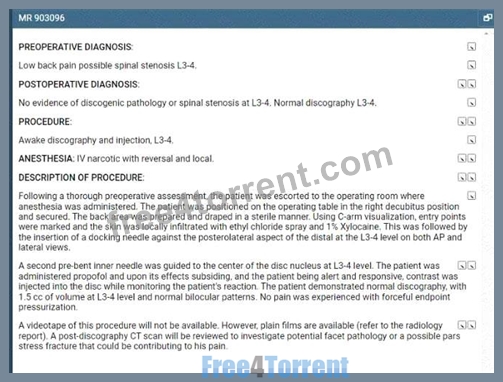
Refer to the supplemental information when answering this question:
View MR 903096
What CPTand ICD-10-CM coding is reported?
- A. 62290, M48.061, M54.50
- B. 62292, M48.07, M54.50
- C. 62292, M54.50
- D. 62290, M54.50
Answer: D
Explanation:
* CPT Code 62290: Discography, lumbar, single or multiple levels, radiological supervision and interpretation
* This code accurately describes the procedure performed. The documentation indicates a lumbar discography was performed at a single level (L3-4) with radiological supervision (C-arm visualization).
* ICD-10-CM Code M54.50: Low back pain, unspecified
* This code is the most appropriate diagnosis based on the documentation. The preoperative diagnosis states "Low back pain possible spinal stenosis L3-4." While spinal stenosis was considered, it was not confirmed. The postoperative diagnosis indicates no evidence of spinal stenosis or discogenic pathology. Therefore, the definitive diagnosis is low back pain.
Why other options are incorrect:
* 62292: This code is for a discography with injection of contrast and/or medication for therapeutic purposes. The documentation doesn't indicate any therapeutic injection was performed.
* M48.061 and M48.07: These codes represent spinal stenosis, which was not confirmed in the postoperative diagnosis.
References:
* CPT Code 62290: Discography, lumbar, single or multiple levels, radiological supervision and interpretation
* ICD-10-CM Code M54.50: Low back pain, unspecified
* AAPC Coder's Desk Reference: This resource provides detailed information on coding guidelines and procedures.
NEW QUESTION # 51
View MR 099407
MR 099407
Emergency Department Visit
Chief Complaint: VOMITING.
This started just prior to arrival and is still present. He has had nausea and vomiting. No diarrhea, black stools, bloody stools or abdominal pain. Pt is diabetic and has been having elevated blood sugars (320 mg/dL).
REVIEW OF SYSTEMS: Unobtainable due to patient's altered mental status.
PAST HISTORY: Poorly controlled diabetes mellitus, with history of poor compliance.
Medications: See Nurses Notes.
Allergies: PCN.
SOCIAL HISTORY: Nonsmoker. No alcohol use or drug use.
ADDITIONAL NOTES: The nursing notes have been reviewed.
PHYSICAL EXAM
Appearance: Lethargic. Patient in mild distress.
Vital Signs: Have been reviewed-tachycardic.
Eyes: Pupils equal, round and reactive to light.
ENT: Dry mucous membranes present.
Neck: Normal inspection. Neck supple.
CVS: Tachycardia. Heart sounds normal. Pulses normal.
ED. Course: Insulin IV drip per protocol, at 10 units/hr.
Zofran 8 mg 01:33 Jul 13 2008 IVP.
Phenergan 25 mg IVP. 07:52. Discussed case with physician. Dr. X. Reviewed test results. Agreed upon treatment plan. Physician will see patient in hospital.
Total critical care time: 45 min.
Disposition: Admitted to Intensive Care Unit. Condition: stable.
Admit decision based on need for monitoring and IV hydration and medications.
CLINICAL IMPRESSION: Vomiting, diabetic ketoacidosis, probable diabetes insipidus.
What E/M code is reported for this encounter?
- A. 0
- B. 1
- C. 99291, 99292
- D. 2
Answer: C
Explanation:
* 99291: This code is used for the first 30-74 minutes of critical care, evaluation, and management of the critically ill or critically injured patient.
* 99292: This code is used for each additional 30 minutes of critical care service beyond the first 74 minutes.
* The documentation indicates that the patient received a total of 45 minutes of critical care, which involves continuous IV insulin for diabetic ketoacidosis, administration of antiemetics, and admission to the ICU. The critical care time documented justifies the use of 99291 for the first 30-74 minutes and
99292 for each additional 30 minutes.
References:
* CPT Professional Edition, AMA
NEW QUESTION # 52
View MR 006399
MR 006399
Operative Report
Preoperative Diagnosis: Chronic otitis media in the right ear
Postoperative Diagnosis: Chronic otitis media in the right ear
Procedure: Eustachian tube inflation
Anesthesia: General
Blood Loss: Minimal
Findings: Serous mucoid fluid
Complications: None
Indications: The patient is a 2-year-old who presented to the office with chronic otitis media refractory to medical management. The treatment will be eustachian tube inflation to remove the fluid. Risks, benefits, and alternatives were reviewed with the family, which include general anesthetic, bleeding, infection, tympanic membrane perforation, routine tubes, and need for additional surgery. The family understood these risks and signed the appropriate consent form.
Procedure in Detail: After the patient was properly identified, he was brought into the operating room and placed supine. The patient was prepped and draped in the usual fashion. General anesthesia was administered via inhalation mask, and after adequate sedation was achieved, a medium-sized speculum was placed in the right ear and cerumen was removed atraumatically using instrument with operative microscope. The tube is dilated, an incision is made to the tympanum and thick mucoid fluid was suctioned. The patient was awakened after having tolerated the procedure well and taken to the recovery room in stable condition.
What CPT coding is reported for this case?
- A. 69436-RT
- B. 69421-RT
- C. 69433-RT
- D. 69420-RT
Answer: B
Explanation:
The procedure involves eustachian tube inflation to remove serous mucoid fluid in the right ear of a 2-year-old patient with chronic otitis media.
* Procedure Description:
* Eustachian tube inflation to remove fluid.
* General anesthesia.
* Incision to the tympanum and suctioning of thick mucoid fluid.
* CPT Coding:
* 69421-RT: Eustachian tube inflation, transnasal or transoral; with catheterization, including general anesthesia. The modifier -RT indicates the right ear.
References:
* AMA's CPT Professional Edition (current year).
* CPT Assistant for detailed coding guidelines on eustachian tube procedures.
NEW QUESTION # 53
A 58-year-old with type 1 diabetes mellitus comes in for comprehensive eye examination. She is diagnosed with diabetic retinopathy with macular edema in the right eye. What ICD-10-CM coding is reported?
- A. E10.3519
- B. E10.311
- C. E10.3211
- D. E10.3511
Answer: D
Explanation:
For a patient with type 1 diabetes mellitus and diabetic retinopathy with macular edema in the right eye, the correct ICD-10-CM code is E10.3511. This code specifically captures:
E10: Type 1 diabetes mellitus.
35: Diabetic retinopathy with macular edema.
1: Right eye.
Each choice addresses different severities or eye specifications:
A: E10.3211: Indicates mild nonproliferative diabetic retinopathy with macular edema in the right eye, not the general diabetic retinopathy category.
B: E10.3519: Refers to diabetic retinopathy with macular edema without specification to the right eye.
D: E10.311: Refers to nonproliferative diabetic retinopathy without macular edema in the right eye.
Thus, the correct answer is C. E10.3511, as it fully captures type 1 diabetes with diabetic retinopathy with macular edema in the right eye.
NEW QUESTION # 54
According to the Application of Cast and Strapping CPT guidelines, what is reported when an orthopedic provider performs initial fracture care treatment for a closed scaphoid fracture of the wrist, applies a short arm cast, and the patient will be returning for subsequent fracture care?
- A. 25622, 29075
- B. 29075-22
- C. 0
- D. 1
Answer: D
NEW QUESTION # 55
A 10-year-old had a cochlear implant in his left ear few weeks ago. Today he sees the audiologist to initialize and program the implant.
What CPTcode is reported?
- A. 0
- B. 1
- C. 2
- D. 3
Answer: D
Explanation:
1. Procedure and CPTCode Selection:
The patient had a cochlear implant placed in the left ear and is now seeing the audiologist for initialization and programming of the implant.
CPTCode 92603 is specific for initial programming of a cochlear implant for patients younger than 12 years old. This includes the setup and initial adjustments required for the cochlear implant, making it the correct code.
2. Rationale for Excluding Other Options:
Code 92626 is used for evaluating auditory function with the cochlear implant, focusing on assessment rather than programming, and is therefore incorrect for this programming session.
Code 92630 is for aural rehabilitation following cochlear implant, which does not apply to the programming
/initiation stage.
Code 92604 is for subsequent programming sessions after the initial programming and is therefore not applicable for the first-time programming.
3. AAPC and CPTCoding Guidelines:
According to AAPC guidelines, 92603 is the appropriate code for initial programming of a cochlear implant in children under 12 years of age.
Therefore, the correct answer is D. 92603.
NEW QUESTION # 56
According to the Application of Cast and Strapping CPT guidelines, what is reported when an orthopedic provider performs initial fracture care treatment for a closed scaphoid fracture of the wrist, applies a short arm cast, and the patient will be returning for subsequent fracture care?
- A. 0
- B. 25622, 29075
- C. 1
- D. 29075-22
Answer: C
Explanation:
For initial fracture care of a closed scaphoid fracture, code 25622 is used, which includes treatment and initial casting. The application of the cast is part of the fracture care and is not reported separately. CPT guidelines specify that casting or strapping performed as part of the fracture care is included in the fracture care code.References: AMA's CPT Professional Edition (current year), Surgery section, Musculoskeletal System.
NEW QUESTION # 57
The human shoulder is made of which three bones?
- A. Olecranon, radius, ulna
- B. Carpal, radius, humerus
- C. Metatarsal, tibia, navicular
- D. Clavicle, scapula, humerus
Answer: D
Explanation:
The human shoulder is composed of three main bones: the clavicle (collarbone), scapula (shoulder blade), and humerus (upper arm bone). These bones form the shoulder joint, which is one of the most flexible and mobile joints in the human body, allowing for a wide range of motion.References: AMA's CPT Professional Edition (current year), Musculoskeletal System section.
NEW QUESTION # 58
Patient is diagnosed with dacryocystitis, which is the inflammation of?
- A. Eardrum
- B. Cornea
- C. Lacrimal sac
- D. Fingernail
Answer: C
Explanation:
Dacryocystitis is the inflammation of the lacrimal sac, which is part of the tear drainage system located in the inner corner of the eye. The lacrimal sac is connected to the nasolacrimal duct, which drains tears into the nasal cavity. Inflammation in this area can cause pain, redness, and swelling near the inner corner of the eye.References: ICD-10-CM, medical dictionaries
NEW QUESTION # 59
A patient who is 37 weeks' gestation is admitted to labor and delivery for a cesarean delivery. An external cephalic version was performed successfully several days ago and she now presents in labor, fully dilated, and the fetus has returned to a footling presentation.
What anesthesia code is reported?
- A. 01967
- B. 01961
- C. 01960
- D. 01958
Answer: B
Explanation:
To determine the correct anesthesia code for a cesarean delivery with specific conditions, we review the following codes:
01961 is defined as "Anesthesia for cesarean delivery only," which aligns with this scenario, as the patient is admitted for a cesarean section.
01960 refers to anesthesia for a vaginal delivery, which does not apply here as the delivery is via cesarean.
01967 is for "Anesthesia for planned vaginal delivery," which also does not apply due to the cesarean route.
01958 is used for planned vaginal delivery that may involve a complicated scenario, but since the procedure is a cesarean section, this code is not appropriate.
Given that the patient is in labor for a cesarean section and has had a previous external cephalic version,
01961 is the correct answer.
NEW QUESTION # 60
A patient with multiple atypical lesions on the face and trunk is in the office to perform a biopsy. A punch tool was used to obtain a full-thickness tissue sample for two lesions on the trunk.
Partial-thickness tissue sample was taken from one lesion on the forehead using a curette.
What CPTcoding is reported?
- A. 11104, 11105, 11103
- B. O11104, 11102 x 2
- C. 11104, 11103 x 2
- D. 11104 x 2, 11102
Answer: D
Explanation:
The CPTcodes for skin biopsies depend on the method used and the location of each lesion. Here, the scenario includes:
1. Two punch biopsies on the trunk: CPTcode 11104 is used for a full-thickness punch biopsy of the skin, and 11104 x 2 is appropriate since two lesions on the trunk were sampled.
2. One partial-thickness shave biopsy on the forehead: CPTcode 11102 is used for a tangential (shave) biopsy, which captures a partial-thickness sample, appropriate for the forehead lesion.
Explanation of other options:
B: 11104, 11105, 11103: Incorrect, as 11105 is an add-on for additional punch biopsies at separate sites but not used here.
C: 11104, 11103 x 2: 11103 is an add-on code for additional shave biopsies, which does not apply to the punch biopsies on the trunk.
D: 11104, 11102 x 2: Incorrect, as 11102 is only used for the shave biopsy, not for the punch biopsies.
NEW QUESTION # 61
When a patient has ESRD, which system is affected?
- A. Respiratory
- B. Neurologic
- C. Cardiovascular
- D. Genitourinary
Answer: D
NEW QUESTION # 62
A 55-year-old patient was recently diagnosed with an enlarged goiter. It has been two years since her last visit to the endocrinologist. A new doctor in the exact same specialty group will be examining her. The physician performs a medically appropriate history and exam. The provider reviewed the TSH results and ultrasound. The provider orders a fine needle aspiration biopsy which is a minor procedure.
What E/M code is reported?
- A. 0
- B. 1
- C. 2
- D. 3
Answer: A
NEW QUESTION # 63
Which place of service code is submitted on the claim for a service that is performed in an outpatient surgical floor?
- A. 0
- B. 1
- C. 2
- D. 3
Answer: C
NEW QUESTION # 64
......
Focus on CPC All-in-One Exam Guide For Quick Preparation: https://validdumps.free4torrent.com/CPC-valid-dumps-torrent.html