

[2025] Verified 1Z1-591 Dumps Q&As - 1 Year Free & Quickly Updates
Latest 2025 Realistic Verified 1Z1-591 Dumps - 100% Free 1Z1-591 Exam Dumps
Certification Path
There is no prerequisite for this Oracle 1Z0-591 exam.
NEW QUESTION # 35
Security Manager is used for______.
- A. Setting permissions for individual objects in the Presentation Layer
- B. Setting permissions for particular users or application roles
- C. Setting up new Application Roles
- D. Setting up new Roles and Groups
Answer: B
Explanation:
Security Manager - is used to setup users, groups, synchronize LDAP users and Groups, set access rights for Objects (tables, columns) and to control over when and what data a user can access.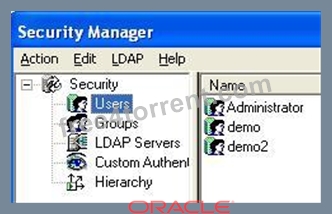
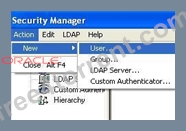
Note: When you open the administration tool, you can reach the security manager by the Menu :
Manage > Security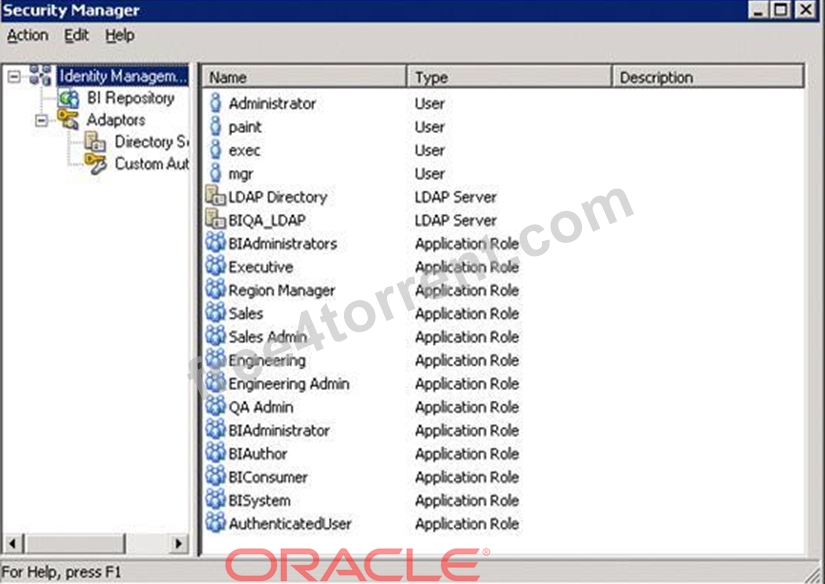
NEW QUESTION # 36
Which three components are part of a cluster server?
- A. Web Server
- B. Primary Cluster Controller
- C. Repository Publishing Directory
- D. Server request Controller
- E. Master Server
Answer: A,B,E
Explanation:
Explanation/Reference:
Oracle BI Cluster Server Components
* Oracle Business Intelligence Cluster Controller: The Cluster Controller determines which BI Server works in the cluster. It monitors the operation of servers in the cluster. The Cluster Controller is deployed in active-passive mode.
* Clustered BI Servers: The BI Cluster Server feature supports up to 16 BI Servers in a network domain to act as a single server. BI Servers in the cluster share requests from multiple Oracle BI clients.
* Master BI Server: A clustered Oracle Business Intelligence Server is designated as the Master BI Server.
The Oracle Business Intelligence Administration Tool connects to the master BI Server for online repository changes.
* Cluster Manager: The Cluster Manager is available in the Administration Tool when a repository is opened in online mode. The Cluster Manager enables Oracle BI Server clustered instances.
NEW QUESTION # 37
Pre Deployment sign-off is a milestone for a OBIEE implementation and is based on successful completion of certain tasks. Which option is not one of them?
- A. Performance Tuning
- B. Test Environment
- C. System Testing
- D. Projectinitiation and resourcing
- E. Data Validation / Verification
Answer: D
NEW QUESTION # 38
Content that is saved in personal and shared folders can be browsed by using which view?
- A. New -> Analysis
- B. Dashboard
- C. Favorites
- D. Home
- E. Catalog
Answer: E
Explanation:
Explanation/Reference:
The Catalog Manager workspace enables you to view and work with catalog objects. It displays the following folders for an open catalog:
The shared folder- Contains content that is shared among catalog users. This includes the preconfigured dashboards and analyses that are distributed with prebuilt applications, and other objects such as shared filters.
The system folder - Contains administrative elements of Presentation Services. Some of these elements are distributed with the product, and others are configured by you as the administrator, such as privileges. Avoid modifying any files in this folder. Presentation Services uses these files internally and modifying them might cause unexpected results.
The users folder - Contains content that catalog users with the appropriate permissions have saved to their personal folders, such as individual analyses.
Reference: Oracle Fusion Middleware System Administrator's Guide for Oracle Business Intelligence Enterprise Edition, What Does the Catalog Manager Workspace Look Like?
NEW QUESTION # 39
What must be done before you can run the Oracle Business Intelligence 11g Installer?
- A. Obtain BI installation media
- B. Create required Oracle Business Intelligence schemas in a database
- C. Ensure system meets installation requirements for Fusing Middleware, Oracle Business Intelligence, AND Repository Creation Utility
- D. Select installation components - OBIEE, BIP, RTD
- E. Install the WLS Admin Server
Answer: A,B,C
Explanation:
Before you can run Oracle Business Intelligence 11g Installer, you must first create required Oracle Business Intelligence schemas in an unhardened database. You use a tool called the Repository Creation Utility (RCU) to create these schemas with the appropriate permissions and data.
Reference: Installation Guide for Oracle Business Intelligence, Additional Oracle Business Intelligence 11g Installer Requirements
NEW QUESTION # 40
Oracle BI Server at a company is connected to Data Warehouse that is refreshed on a daily basis, the majority of users at the company log in to Oracle BI every Monday to generate the previous week's sales report. The BI Administrator schedules cache purge and cache seeding to improve
report response times. How is this accomplished?
- A. Every Monday late night
- B. Everyday before Data Warehouse refresh
- C. Every Monday early morning
- D. Every day after Data Warehouse refresh
Answer: A
Explanation:
Purge and reseed once a week after the reports have run to improve report response time.
NEW QUESTION # 41
Which option is not an example of a level-based measure?
- A. Sales
- B. Brand Cost
- C. Employee Salary
- D. Regional Revenue
Answer: A
Explanation:
All others are names for level-based measure but Sales is a base measure.
NEW QUESTION # 42
What must be purchased when integrating Oracle map with Oracle BI?
- A. Spatial Option with Database
- B. OLAP option
- C. Oracle Business Intelligence Enterprise Edition
- D. Oracle Mapviewer
Answer: D
Explanation:
Explanation
MapViewer is shipped as part of Oracle Fusion Middleware. Its main deliverable is a J2EE application that can be deployed to a J2EE container, such as that for Oracle Fusion Middleware. MapViewer includes the following main components:
* A core rendering engine (Java library) named SDOVIS that performs cartographic rendering. A servlet is provided to expose the rendering functions to Web applications.
* A suite of application programming interfaces (APIs) that allow programmable access to MapViewer features. These APIs include XML, Java, PL/SQL, and an AJAX-based JavaScript API.
* A graphical Map builder tool that enables you to create map symbols, define spatial data rendering rules, and create and edit MapViewer objects.
* Oracle Map, which includes map cache and FOI (feature of interest) servers that facilitate the development of interactive geospatial Web applications.
Oracle Maps can be configured now in the map viewer as a built in layer.
NEW QUESTION # 43
A customer has a requirement for rolling period calculations. What two additional steps will need to be done to enable this in the repository?
- A. Clicking the "Time" option in the Logical Table Source Dialog
- B. Clicking the "Time" option in the Logical Dimension Dialog
- C. Designating a chronological key for every level of every dimension hierarchy
- D. Specifying a sort order in the Logical Table dialog
- E. Designating a chronological key for every logical column in the Logical Table Source
Answer: B,C
Explanation:
Explanation
Creating Logical Time Dimensions
Compared to modeling an ordinary dimension, the time dimension requires just two additional steps: selecting the Time option in the Logical Dimension dialog, and designating a chronological key for every level of every dimension hierarchy.
Note: Time dimensions and chronological keys. You can identify a dimension as a time dimension. At least one level of a time dimension must have a chronological key. The following is a list of some guidelines you should use when setting up and using time dimensions:
* At least one level of a time dimension must have a chronological key.
* All time series measures using the AGO, TODATE, and PERIODROLLING functions must be on time levels. AGO, TODATE, and PERIODROLLING aggregates are created as derived logical columns.
NEW QUESTION # 44
A customer frequently queries multiple dimension tables without a measure. What needs to be defined in the presentation layer?
- A. Logical Key
- B. Custom Display Name
- C. Alias
- D. Implicit Fact Column
- E. Logical Column Name
Answer: D
Explanation:
Metadata Repository Builder's Guide http://download.oracle.com/docs/cd/E21764_01/bi.1111/e10540/toc.htm http://download.oracle.com/docs/cd/E21764_01/bi.1111/e10540.pdf
Setting an Implicit Fact Column in the Subject Area For each subject area in the Presentation layer, you can set an implicit fact column. The implicit fact column is added to a query when it contains columns from two or more dimension tables and no measures. The column is not visible in the results. It is used to specify a default join path between dimension tables when there are several possible alternatives or contexts.
NEW QUESTION # 45
Which two options are included in Oracle BI Server cache management techniques?
- A. Manage access to Subject Areas
- B. Scheduling Server password
- C. Maximum Number of Rows to Download to Excel
- D. Using NQSConfig.ini to manually edit the parameters
- E. Inspecting the cache reports
Answer: D,E
Explanation:
Explanation
A: Much of the configuration of OBI that used to be done in the NQSConfig.ini files can now be done using this front end console, which in turns updates the NQSConfig.ini file. Things in the NQSConfig.ini file that are set by EM are noted in the file with '# This Configuration setting is managed by Oracle Business Intelligence Enterprise Manager'. Some things that needs to be setup manually in the NQSConfig.ini file are:
1. Usage Tracking
2. Dynamic Libraries
3. Query Optimization Flags
4. MDX Member Name Cache Section (SAP BW)
5. More specific General Settings where EM doesn't contain the level of detail required D: Cache Management Techniques include
* Inspecting the cache reports
* Configuring the cache parameters
* Setting caching and cache persistence for tables
* Using the Cache Manager
* Inspecting SQL for cache entries
* Modifying the Cache Manager column display
* Purging the cache entries manually using the Cache Manager
* Purging the cache entries automatically
* Using event polling tables
* Seeding the cache
NEW QUESTION # 46
What are the two capabilities that users can apply to an Analysis when working within Plug-In for MS Office?
- A. Edit Prompts and Levels
- B. Refresh All
- C. Edit Analysis
- D. Publish
Answer: A,B
Explanation:
B: Click Refresh All from the Oracle BI menu in PowerPoint to refresh all the refreshable objects in the presentation.
C: Right-click Table and select Insert as List from the shortcut menu. The Edit Prompts and Levels dialog box appears. Accept the default options and click Insert.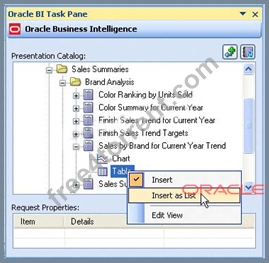
Reference: Using Oracle Business Intelligence Office Add-Ins with Oracle Business Intelligence Enterprise Edition (10.1.3.4) on Windows
NEW QUESTION # 47
How do you get the BI plug-in for MS Office?
- A. By downloading it from the Database Server
- B. By downloading it from Microsoft Server
- C. By contacting the administrator
- D. By downloading it from the BI Server
Answer: D
Explanation:
Download and installation of the client
The client install executable is available for download from the More Products menu in Oracle BI Interactive Dashboards and Oracle BI Answers.
See picture below.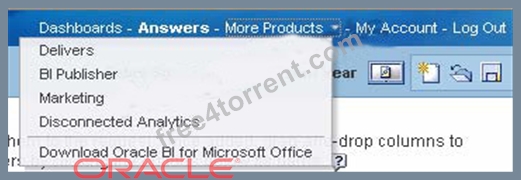
http://gerardnico.com/wiki/_media/dat/obiee/moreproducts.gif
NEW QUESTION # 48
How will you model a Type II Slowly-Changing Dimension?
- A. Add an additional column to the dimension table to capture a version of change
- B. Do Nothing
- C. Add a new row to the dimension table with a new key for the changed record
- D. Overwrite an existing dimension table record with the changed record
Answer: C
Explanation:
Dimensional Modeling - Slowly Changing Dimensions
* Type 1 - Overwrite Original Value
A change does not require tracking
* Type 2 - Add a new record
With Type II SCD, a new version of the dimension record (row) is created, and the existing version is marked as history.
Each row does not correspond to a different instance of an entity but a different "state", a "snapshot" of the instance at a point in time.
Note: Tracking changes in dimension is referred in datawarehousing as slowly changing dimensions.
In the source system a lot of changes are daily made :
new customers are added,
addresses are modified,
new regional hierarchies are implemented,
or simply the product descriptions and packaging change.
These sorts of changes need to be reflected in the dimension tables and in several cases, the history of the changes also needs to be tracked.
By remembering history, we are then able to look at historical data and compare it to their current situation.
NEW QUESTION # 49
You do not have a physical time table in your database but would like to use the time series functions that OBIEE offers. What two options do you have?
- A. Create a Logical Table that is sourced from a time field in one of your dimension tables.
- B. Create a Logical Table that is sourced from the time key in the fact table.
- C. Create a time table that is joined through a intervening Table so there is no foreign key relationship.
- D. Create an "Opaque View" in the physical layer that contains the time columns from the fact and map it into your physical model.
- E. Create a physical time table in your database.
Answer: A,E
Explanation:
Explanation
Modeling Time Series Function in OBIEE
Modeling Time Series Data
Time series functions provide the ability to compare business performance with previous time periods, allowing you to analyze data that spans multiple time periods. For example, time series functions enable comparisons between current sales and sales a year ago, a month ago, and so on.
Because SQL does not provide a direct way to make time comparisons, you must model time series data in the Oracle BI repository. First, set up time dimensions based on the period table in your data warehouse. Then, you can define measures that take advantage of this time dimension to use the AGO, TODATE, and PERIODROLLING functions.
NEW QUESTION # 50
A customer would like to create a change and a % Change for Revenue at the same time. How would they accomplish this?
- A. Using theExpression Builder
- B. Defining them in the physical data model
- C. Using the Calculation Wizard
- D. Defining themin the Presentation Layer
Answer: C
Explanation:
After creating your base metrics, try using the Calculation Wizard to automate the process of creating time-series metrics or comparison metrics such as: Change, Percent Change, Index, and Percent. The Wizard may save you many hours of time and frustration, especially if you have to create more than a handful of these metrics. In addition, the Wizard allows you to include customized logic to handle nulls in the base metrics. You may refer to the Oracle documentation for further detail.
NEW QUESTION # 51
What must be done before you can run the Oracle Business Intelligence 11g Installer?
- A. Obtain BI installation media
- B. Create required Oracle Business Intelligence schemas in a database
- C. Ensure system meets installation requirements for Fusing Middleware, Oracle Business Intelligence, AND Repository Creation Utility
- D. Select installation components - OBIEE, BIP, RTD
- E. Install the WLS Admin Server
Answer: A,B,C
Explanation:
Before you can run Oracle Business Intelligence 11g Installer, you must first create required Oracle Business Intelligence schemas in an unhardened database. You use a tool called the Repository Creation Utility (RCU) to create these schemas with the appropriate permissions and data.
NEW QUESTION # 52
The Time Dimension hierarchy is a good example of a__________.
- A. Ragged Hierarchy
- B. Skip Level Hierarchy
- C. Value-based Hierarchy
- D. Level-basedTime Dimension hierarchy
Answer: D
Explanation:
Level-based Hierarchy Level-based hierarchy is the first type of hierarchy in OBIEE. Consists of an ordered set of two or more levels. For example, a Time hierarchy might have three levels for Year, Quarter, and Month. Level-based hierarchies can also contain parent-child relationships.
Dimension hierarchy levels allow :
*to perform aggregate navigation,
*to configure level-based measure calculations,
*users from Dashboard and Answers to drill down from one parent to a child level.
Special type of level-based dimension are supported:
*Unbalanced (or ragged) and Skip-level hierarchy
*time dimension to provides special functionality for modeling time series data.
NEW QUESTION # 53
Query Limits are used to manage Query environment in the repository for users and roles and can_________.
- A. Control aggregation
- B. Control User Authentication
- C. Control runaway queries
- D. Limit Queries by maximum run time
- E. Control Write Back Capabilities
Answer: D
Explanation:
Query Limits. You can limit queries by the number of rows received, by maximum run time, and by restricting to particular time periods. You can also allow or disallow direct database requests or the Populate privilege.
See figure below.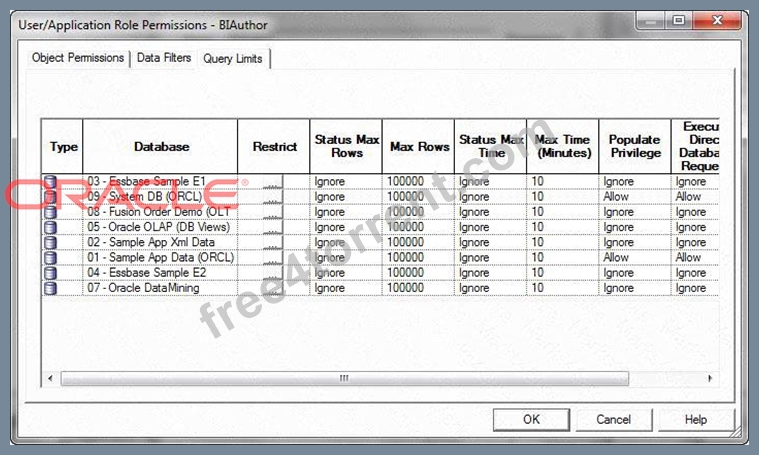
NEW QUESTION # 54
Object Security controls access to Subject Areas, Tables, and Columns in OBIEE and can be implemented by using which method?
- A. Single Sign-On (SSO)
- B. Business Logic Object Security
- C. Database Authentication
- D. External Table Authentication
- E. LDAP Authentication
Answer: B
Explanation:
Explanation
Object-level security controls the visibility to business logical objects based on a user's role. You can set up object-level security for metadata repository objects, such as subject areas and presentation folders, and for Web objects, such as dashboards and dashboard pages, which are defined in the Presentation Catalog.
1) Business logic object
This controls access to objects, such as:
* subject areas
* presentation tables
* presentation columns
For example, users in a particular department can view only the subject areas that belong to their department.
2) Web object security
This provides security for objects stored in the Web Catalog, such as dashboards, dashboard pages, folders, and reports. You can view only the objects for which you are authorized. For example, a mid-level manager may not be granted access to a dashboard containing summary information for an entire department.
NEW QUESTION # 55
......
Oracle 1z0-591 exam comprises of 70 multiple-choice questions, and candidates are given 2 hours to complete the exam. 1Z1-591 exam is available in several languages and can be taken at any authorized Oracle testing center. Candidates who pass the Oracle 1z0-591 exam will be awarded the Oracle Business Intelligence Foundation Suite 11g Essentials certification, which is recognized globally and can help individuals stand out in the job market. Oracle Business Intelligence Foundation Suite 11g Essentials certification also helps organizations identify individuals who possess the necessary skills to work with Oracle Business Intelligence Suite, making it a valuable asset for both individuals and organizations.
1Z1-591 Dumps PDF and Test Engine Exam Questions: https://validdumps.free4torrent.com/1z1-591-valid-dumps-torrent.html