

2026 Realistic 300-445 Dumps Exam Tips Test Pdf Exam Material
Powerful 300-445 PDF Dumps for 300-445 Questions
NEW QUESTION # 31
Which integration type facilitates the seamless exchange of data between Cisco technologies and third-party platforms?
- A. SNMP
- B. FTP
- C. CLI
- D. REST API
Answer: D
Explanation:
REST API integration facilitates the seamless exchange of data between Cisco technologies and third-party platforms, enabling interoperability and data-driven decision-making.
NEW QUESTION # 32
How does Meraki Insights help in identifying latency issues across network segments?
- A. By comparing historical data trends
- B. By isolating high latency connections
- C. By simulating network attacks
- D. By enforcing network access policies
Answer: B
NEW QUESTION # 33
What limitations should be considered when implementing synthetic web tests for network assurance?
- A. Vulnerability to DDoS attacks
- B. Limited scalability for large networks
- C. Inability to detect server-side issues
- D. Sensitivity to browser and device differences
- E. Dependency on network connectivity
- F. Lack of real user behavior replication
Answer: B,D,F
Explanation:
Limitations of synthetic web tests for network assurance include the lack of real user behavior replication, limited scalability for large networks, and sensitivity to browser and device differences, impacting the accuracy of test results.
NEW QUESTION # 34
Which authentication method is commonly used in synthetic web tests for secure access to web applications?
- A. Digest authentication
- B. Basic authentication
- C. OAuth
- D. LDAP
Answer: B
Explanation:
Basic authentication is commonly used in synthetic web tests for secure access to web applications, providing a simple yet effective authentication mechanism in network assurance.
NEW QUESTION # 35
Which agent type is best suited for simulating user interactions with web applications?
- A. Endpoint agent
- B. Local collection agent
- C. Scripting agent
- D. Synthetic user agent
Answer: D
Explanation:
A synthetic user agent is specifically designed to simulate user interactions with web applications, making it the most suitable option for this task.
NEW QUESTION # 36
How does the integration between Cisco technologies improve network visibility and management?
- A. Centralized control and monitoring
- B. Incompatible protocols
- C. Manual device configuration
- D. Limited data sharing
Answer: A
Explanation:
Integration between Cisco technologies enables centralized control and monitoring, improving network visibility and management efficiency.
NEW QUESTION # 37
SNMP data indicates that a wireless access point is experiencing high channel utilization and increased retransmissions. What optimization would you recommend to improve voice call quality for users on this access point?
- A. Change the access point to a different, less congested channel
- B. Increase the transmit power of the access point
- C. Disable all non-voice traffic on the wireless network
- D. Implement strict admission control for all wireless clients
Answer: A
Explanation:
In wireless network assurance, high channel utilization and increased retransmissions are clear indicators of RF interference or over-subscription. Retransmissions are particularly damaging to voice call quality because they introduce significant jitter and late-arrival packet loss that the jitter buffer cannot overcome.
The recommended optimization is tochange the access point to a different, less congested channel(Option B). This directly reduces the competition for airtime (Channel Utilization) and the likelihood of collisions from neighboring access points (Co-Channel Interference), which in turn lowers the retransmission rate.
Modern wireless controllers usingRadio Resource Management (RRM)often automate this, but a manual adjustment based on SNMP telemetry is a valid operational fix.
Other options are technically flawed:
* Option A:Increasing transmit power oftenincreasesinterference and channel utilization for surrounding cells, making the problem worse for everyone.
* Option C:Disabling all non-voice traffic is an extreme measure that is rarely feasible in a real business environment.
* Option D:Admission control limits thenumberof users but doesn't solve the underlying issue of poor channel health for those already connected.
NEW QUESTION # 38
Drag and drop the Cisco Network Assurance platforms from the left onto the corresponding business cases on the right.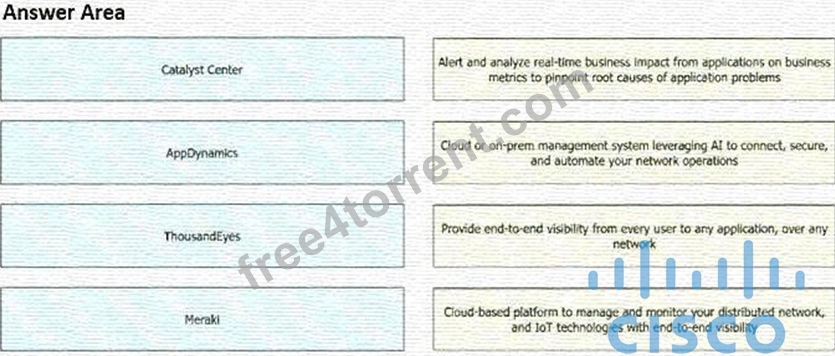
Answer:
Explanation: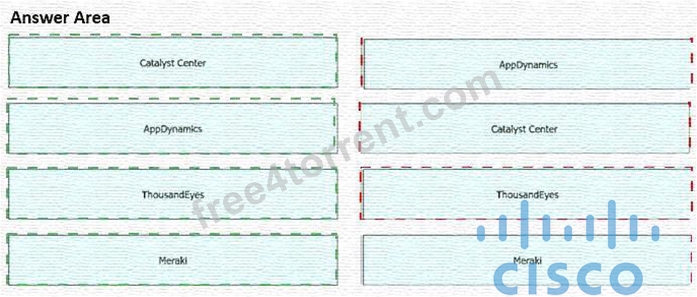
Explanation:
AppDynamics
Catalyst Center
ThousandEyes
Meraki
In theDesigning and Implementing Enterprise Network Assurance (300-445 ENNA)architecture, each platform is positioned to address a distinct domain of visibility and management within the modern IT visibility framework.
AppDynamics(matched to Case 1) is specifically engineered for Full-Stack Observability and Application Performance Monitoring (APM). Its unique focus is linking technical application performance-such as code- level execution and database queries-directly to business outcomes and real-time business metrics. By doing so, it allows organizations to pinpoint how application latency impacts revenue or user satisfaction, making it the primary choice for business impact analysis.
Catalyst Center, formerly DNA Center (matched to Case 2), serves as the foundational controller for campus and enterprise network infrastructure. It leverages AI-driven insights to automate network operations, enforce security policies, and provide at-a-glance health monitoring for local devices and clients. It is the definitive management system for connecting and securing "inside" the corporate network perimeter.
ThousandEyes(matched to Case 3) provides "Internet Intelligence" and is the key solution for monitoring the service delivery chain across environments the enterprise does not own. By utilizing a global network of Cloud, Enterprise, and Endpoint agents, it provides end-to-end visibility from any user location to any application (SaaS or Cloud) over any network (Internet, ISP, or WAN).
Meraki(matched to Case 4) is a cloud-first platform designed for managing highly distributed network environments and IoT deployments. It provides end-to-end visibility through a simplified dashboard that integrates wireless health, switching, and security across thousands of sites, making it ideal for lean IT teams managing distributed retail or branch locations.
Each platform utilizes different data collection methods-active synthetic testing for ThousandEyes and passive monitoring/AI telemetry for Catalyst Center-to ensure comprehensive network assurance across the entire enterprise ecosystem.
NEW QUESTION # 39
When selecting a Cisco network assurance platform, what factor should be prioritized for web-based applications?
- A. Network throughput
- B. Server hardware
- C. User experience
- D. Application scalability
Answer: C
Explanation:
For web-based applications, user experience should be prioritized when selecting a Cisco network assurance platform to ensure optimal performance and usability.
NEW QUESTION # 40
Refer to Exhibit: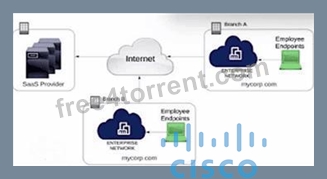
A network engineer is deploying a Cisco ThousandEyes agent to monitor the network for a SaaS application without affecting the performance of the employee endpoints. Which ThousandEyes agent must be deployed to obtain the network metrics from branch A?
- A. Cloud Agent
- B. Enterprise Agent
- C. Application Agent
- D. Endpoint Agent
Answer: B
Explanation:
In the framework ofDesigning and Implementing Enterprise Network Assurance (300-445 ENNA), selecting the appropriate ThousandEyes agent type is critical to balancing visibility requirements with infrastructure constraints. For Branch A, the primary objective is to gain network-layer metrics (such as latency, packet loss, and jitter) and path visualization for a SaaS application while strictly avoiding any performance impact on employee endpoints.
TheEnterprise Agent(Option C) is the correct choice because it is designed for "inside-out" monitoring from within the corporate network environment. These agents are lightweight software probes that can be deployed on existing network infrastructure, such asCisco Catalyst 9300/9400 switchesorCatalyst 8000 Edge Platforms, using Docker containers or virtual machines. By hosting the agent on the branch router or a dedicated local server, the engineer can execute synthetic tests to the SaaS provider's destination. This approach provides the necessary network vantage point from Branch A without requiring any software installation or resource consumption on the individual employee workstations (endpoints).
Other agent types do not satisfy the specific constraints of this scenario:
* Endpoint Agentsare installed directly on user devices (Windows/macOS) to provide "last-mile" visibility. However, they use the endpoint's CPU and memory, which contradicts the requirement to not affect endpoint performance.
* Cloud Agentsare maintained by Cisco in global ISP data centers. While they provide "outside-in" visibility, they cannot capture internal branch network characteristics or the specific path from Branch A's internal local area network.
* Application Agentis a non-standard term and does not exist as a standalone agent type within the ThousandEyes architecture.
Therefore, deploying anEnterprise Agentwithin the branch infrastructure ensures that the network engineer obtains high-fidelity network metrics while keeping employee devices entirely unburdened.
Introduction to ThousandEyes
This video provides an essential overview of how ThousandEyes agents function within a CCNP-level enterprise network assurance strategy.
NEW QUESTION # 41
What type of alert rule is configured based on the state of BGP routing table in network assurance?
- A. Performance alert
- B. Threshold alert
- C. Protocol alert
- D. Security alert
Answer: C
Explanation:
A protocol alert rule is configured based on the state of BGP routing table in network assurance to detect and mitigate potential routing issues.
NEW QUESTION # 42
Which of the following are examples of agent types in network assurance?
- A. Cloud integration agent
- B. Virtualization agent
- C. Remote management agent
- D. Scripting agent
- E. Local collection agent
- F. Synthetic user agent
Answer: D,E,F
Explanation:
Examples of agent types in network assurance include synthetic user agents, scripting agents, and local collection agents, each serving specific purposes in monitoring and data collection.
NEW QUESTION # 43
ThousandEyes offers several native integrations for receiving instant event notifications triggered by alerts.
Which of the following integrations are available directly within the ThousandEyes platform? Select all that apply.
- A. ServiceNow
- B. Splunk
- C. MS Teams
- D. AppDynamics
- E. AWS
- F. PagerDuty
- G. Webex
- H. Slack
Answer: A,B,C,D,F,G,H
Explanation:
According to theDesigning and Implementing Enterprise Network Assurance (300-445 ENNA) architecture, ThousandEyes provides a suite of native, "out-of-the-box" integrations specifically designed for alert notifications. These integrations are configured via theManage > IntegrationsorAlert Rules > Notificationstabs and allow the platform to push instant event data to a variety of collaboration, IT operations, and observability tools.
The verified list of native notification integrations includes:
* ServiceNow (A):Facilitates direct incident management and automated ticketing workflows.
* PagerDuty (B):Allows for automated incident escalation and on-call routing based on ThousandEyes alerts.
* MS Teams (C) & Slack (H):Enable real-time chatops by pushing alert details and permalinks directly into specified channels for team collaboration.
* Splunk (D):Utilizes theCisco ThousandEyes App for Splunkto ingest alert data for historical analysis and correlation within a SIEM or logging platform.
* AppDynamics (F):Sends alert notifications directly into an AppDynamics instance, allowing application owners to correlate network issues with APM metrics.12
* Webex (G):Integrates with theWebex Control Huband specific Webex spaces to provide unified visibility for collaboration performance.34 AWS (Option E)is not a nativealert notificationdestination5in this context; instead, ThousandEyes integrates with AWS for "Cloud Insights" (ingesting VPC Flow Logs) and "Test Recommendations" rather than acting as a receiver for event notifications like a chat or ITSM tool. By utilizing these native integrations, enterprise teams ensure that the right stakeholders are notified through their preferred communication channels the moment a performance threshold is breached, drastically improving response times across the organization.
NEW QUESTION # 44
What is a crucial consideration when determining the location of network agents for security purposes?
- A. Distance from employee workstations
- B. Availability of meeting rooms
- C. Access to natural light
- D. Proximity to critical infrastructure
Answer: D
Explanation:
Placing network agents near critical infrastructure enhances security monitoring and threat detection capabilities.
NEW QUESTION # 45
How do scripting agents contribute to network automation?
- A. Analyzing security logs
- B. Automating repetitive tasks
- C. Monitoring hardware health
- D. Optimizing server configurations
Answer: B
Explanation:
Scripting agents automate repetitive tasks to facilitate network automation and improve operational efficiency.
NEW QUESTION # 46
Which RFC defines the framework for passive performance monitoring in network assurance?
- A. RFC 791
- B. RFC 793
- C. RFC 7799
- D. RFC 7276
Answer: D
Explanation:
RFC 7276 defines the framework for passive performance monitoring, providing guidelines for collecting and analyzing network performance data in network assurance.
NEW QUESTION # 47
When deploying endpoint agents at scale across the enterprise, which operating systems are typically supported?
- A. Windows, Linux, and iOS
- B. Windows, Mac, and Linux
- C. Windows, Mac, and iOS
- D. Windows, Mac, and Android
Answer: B
Explanation:
When deploying endpoint agents at scale across the enterprise, endpoint agent support typically includes Windows, Mac, and Linux operating systems to ensure comprehensive coverage of end-user devices and network infrastructure for monitoring and troubleshooting purposes.
NEW QUESTION # 48
What is the primary benefit of integrating Cisco technologies in network management?
- A. Reduced software compatibility
- B. Limited scalability options
- C. Centralized management tasks
- D. Increased hardware complexity
Answer: C
Explanation:
Integration of Cisco technologies centralizes management tasks, streamlining network operations and improving efficiency.
NEW QUESTION # 49
What is the primary purpose of diagnosing end-device network issues using collected data?
- A. Optimizing server performance
- B. Ensuring device compliance
- C. Identifying network vulnerabilities
- D. Resolving connectivity issues
Answer: D
Explanation:
The primary purpose of diagnosing end-device network issues using collected data is to identify and resolve connectivity issues affecting device performance and user experience in network assurance.
NEW QUESTION # 50
What Meraki platform supports ThousandEyes?
- A. Meraki MS Series (Switches)
- B. Meraki MR Series (Wireless Access Points)
- C. Meraki MV (Smart Cameras)
- D. Meraki MX (Security Appliances)
- E. All of the above
- F. Meraki MG (Cellular Gateways)
Answer: D
Explanation:
According to theDesigning and Implementing Enterprise Network Assurance (300-445 ENNA) curriculum, the native integration of ThousandEyes within the Meraki portfolio is specifically focused on the Meraki MXsecurity and SD-WAN appliances. This integration allows users to install ThousandEyes Enterprise Agents directly on supported Meraki MX hardware, providing critical visibility into the performance of services that distributed users rely on.4 TheMeraki MX (Option A)supports the ThousandEyes Enterprise Agent as a containerized service that can be activated with a single click within the Meraki Dashboard.5This integration is designed to provide better monitoring and testing capabilities for customers interested in improving the quality of their experience and adding the appropriate SD-WAN policies to optimize network performance. By running the agent natively on the MX, administrators can monitor the performance of external applications and services directly from the SD-WAN sites, bridging the gap between local branch health and global internet performance.6 While Cisco continues to expand its assurance integrations across the portfolio, theMR (Wireless),MS (Switching),MV (Camera), andMG (Cellular)series do not currently support the native, "on-box" execution of the ThousandEyes Enterprise Agent. For these other platforms, visibility is typically achieved through passive monitoring viaMeraki Insight (MI)or by deploying ThousandEyes agents on connected client devices (Endpoint Agents) or nearby infrastructure. Therefore, theMeraki MXis the only verified platform supporting native ThousandEyes agent deployment in this context.
NEW QUESTION # 51
What is a key consideration when configuring network tests using Thousand Eyes and Meraki Insights?
- A. Ensuring hardware compatibility
- B. Analyzing server logs
- C. Maximizing server uptime
- D. Minimizing packet loss
Answer: D
Explanation:
A key consideration when configuring network tests is minimizing packet loss to ensure accurate performance measurement and analysis in network assurance.
NEW QUESTION # 52
Which alert rule configuration is commonly used to monitor VPN performance?
- A. CPU utilization
- B. Network latency
- C. Disk space usage
- D. Tunnel uptime
Answer: D
Explanation:
Tunnel uptime is commonly monitored using alert rules to assess VPN performance and detect potential VPN connection failures or disruptions.
NEW QUESTION # 53
A network engineer deploys a ThousandEyes Docker agent on a switch using app-hosting. The agent needs to communicate through a proxy server, but this configuration was missed during the initial deployment. The engineer adds the proxy settings to the app-hosting configuration. What is the next step to ensure the agent uses the proxy and appears online in the ThousandEyes portal?
- A. Restart the container using app-hosting stop appid agentname followed by app-hosting start appid agentname
- B. Execute the full agent lifecycle: app-hosting stop appid agentname, app-hosting deactivate appid agentname, app-hosting activate appid agentname, app-hosting start appid agentname
- C. No action required; the agent will pick up the configuration automatically
- D. Reinstall the agent using the app-hosting install command with the correct proxy settings
Answer: B
NEW QUESTION # 54
In network monitoring, what does RFC 7799 primarily focus on?
- A. Active monitoring
- B. Network performance
- C. Network security
- D. Passive monitoring
Answer: C
Explanation:
RFC 7799 primarily focuses on network security, providing guidelines and best practices for secure network monitoring implementations.
NEW QUESTION # 55
......
Guaranteed Accomplishment with Newest Jun-2026 FREE: https://validdumps.free4torrent.com/300-445-valid-dumps-torrent.html