

[Aug 27, 2025] Valid UiPath-ADPv1 Test Answers & UiPath UiPath-ADPv1 Exam PDF
Realistic UiPath-ADPv1 Exam Dumps with Accurate & Updated Questions
UiPath UiPath-ADPv1 Exam Syllabus Topics:
| Topic | Details |
|---|---|
| Topic 1 |
|
| Topic 2 |
|
| Topic 3 |
|
| Topic 4 |
|
NEW QUESTION # 60
What role do Triggers play in the UiPath Integration Service?
- A. Manage connections between UiPath Studio and third-party applications.
- B. Assist in the creation of automation projects by providing event-based activities.
- C. Provide a mechanism for starting processes on a scheduled basis from Orchestrator.
- D. Provide a mechanism for subscribing to specific events from third-party applications, automatically starting processes in Orchestrator.
Answer: D
NEW QUESTION # 61
Which of the following is an outcome of converting a personal workspace into a folder in UiPath Orchestrator?
- A. The admin user is added by default to the newly created folder with the User Administrator role.
- B. The owner of the initial workspace and the admin user are added by default to the newly created folder and assigned the Personal Workspace Administrator role.
- C. The owner of the initial workspace is added by default to the newly created folder and assigned the Folder Administrator role.
- D. The owner of the initial workspace loses access to the newly created folder and the existing admin users are added by default.
Answer: C
NEW QUESTION # 62
A developer is building an automation that must interact with a destination remote computer reached by jumping through multiple RDP connections, as described by the following scenario:
- The Robot is installed on Machine A, which connects through RDP to Machine B.
- From Machine B another RDP connection is opened to Machine C, where the automation must be performed.
Which of the following scenarios is appropriate for the developer who wants to use UI Automation activities?
- A. UI Automation can be used and the following are prerequisites:
Machine A - no requirement.
Machine B - no requirement.
Machine C - install RemoteRuntime.msi. - B. UI Automation can be used and the following are prerequisites:
Machine A - install RDP extension.
Machine B - no requirement.
Machine C - install RemoteRuntime.msi. - C. UI Automation can be used and the following are prerequisites:
Machine A - install RDP extension.
Machine B - install RemoteRuntime.msi.
Machine C - install RemoteRuntime.msi. - D. UI Automation can be used and the following are prerequisites:
Machine A - install RDP extension.
Machine B - install RDP extension and RemoteRuntime.msi.
Machine C - install RemoteRuntime.msi.
Answer: D
Explanation:
To use UI Automation activities in a scenario where the destination remote computer is reached by jumping through multiple RDP connections, the following prerequisites are required:
* Machine A - install the RDP extension. This extension enables the robot to generate native selectors over RDP connections and interact with the UI elements on the remote machines.
* Machine B - install the RDP extension and the RemoteRuntime.msi. The RDP extension allows the
* robot to connect to Machine C from Machine B, while the RemoteRuntime component enables the communication between the robot and the UI elements on Machine B.
* Machine C - install the RemoteRuntime.msi. This component enables the communication between the robot and the UI elements on Machine C, where the automation must be performed. References:
[Remote Runtime Architecture], [Multiple RDP Connections], [UiPath Extension for Microsoft Remote Desktop and Apps]
NEW QUESTION # 63
What is the correct execution order of the State activity sections?
instructions: Drag the Description found on the "Left" and drop on the correct Execution Order found on the
"Right"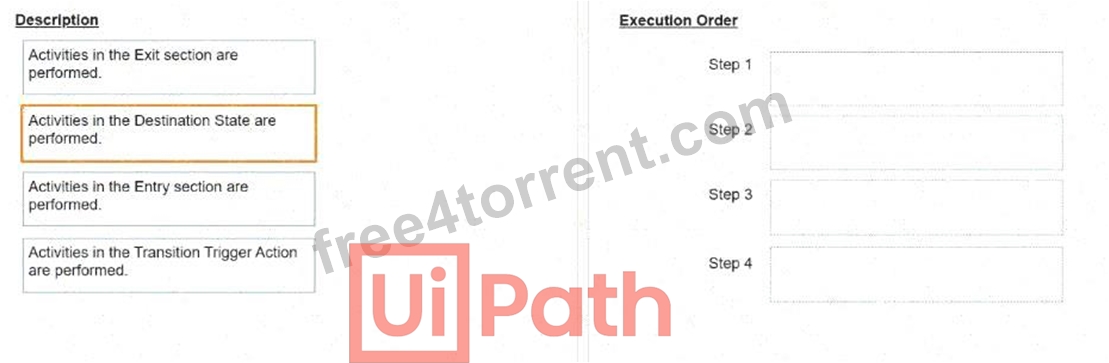
Answer:
Explanation: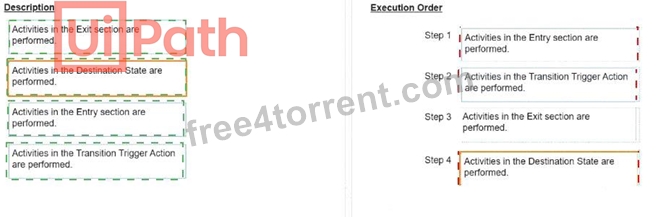
Explanation: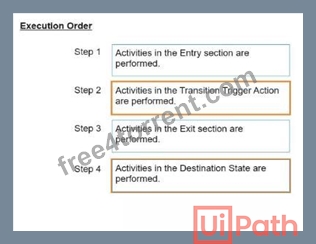
NEW QUESTION # 64
You have to create a testcase for an attended RPA process. At some point, the attended process asks the user to input a specific token for the execution to continue, as shown in the screenshot below.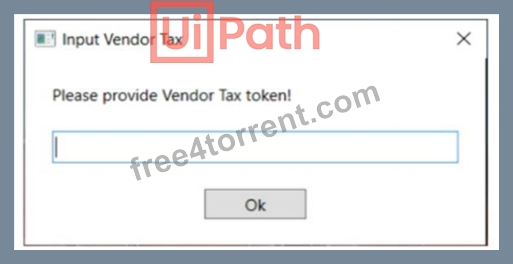
What testing concept (included in UiPath.Testing.Activities) can be used to isolate and replace the input part, without modifying the original workflow?
- A. Mock Testing
- B. Data-Driven Testing
- C. RPA Testing
- D. Application Testing
Answer: A
Explanation:
Mock Testing is a concept that allows you to isolate and replace the input part of an attended RPA process, without modifying the original workflow. Mock Testing enables you to create a mock file of your workflow by selecting Mock workflow under test in the Create Test Case window. This creates a copy of your workflow with the name workflowName_mock and stores it in Project > Mocks. This folder mirrors the source workflow file tree structure. In the mock file, you can use the Surround with mock option to insert a mock activity that replaces the original input activity. For example, instead of asking the user to input a specific token, you can use a mock activity that assigns a predefined token value to a variable. This way, you can test the specific function of the process without having to enter the token manually every time. Mock Testing is useful for tests that have permanent effects in production or require special resources1.
The other options are incorrect because:
* Option A is incorrect because Application Testing is not a concept that can be used to isolate and replace the input part of an attended RPA process, without modifying the original workflow. Application Testing is a type of testing that focuses on verifying the functionality, usability, performance, and security of an application2.
* Option B is incorrect because Data-Driven Testing is not a concept that can be used to isolate and replace the input part of an attended RPA process, without modifying the original workflow. Data- Driven Testing is a type of testing that uses external data sources, such as Excel files or databases, to provide input values and expected results for the test cases3.
* Option D is incorrect because RPA Testing is not a concept that can be used to isolate and replace the input part of an attended RPA process, without modifying the original workflow. RPA Testing is a type of testing that involves using robots to automate the testing of other robots or applications.
References:
* Studio - Mock Testing - UiPath Documentation Portal
* Application Testing - UiPath Documentation Portal
* Data-Driven Testing - UiPath Documentation Portal
* [RPA Testing - UiPath Documentation Portal]
NEW QUESTION # 65
What are the steps to publish a project from UiPath Studio?
Instructions: Drag the Description found on the "Left" and drop on the correct Step Sequence found on the "Right".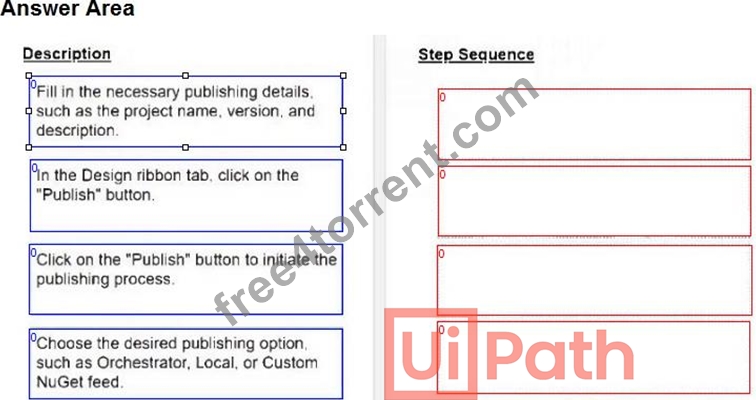
Answer:
Explanation: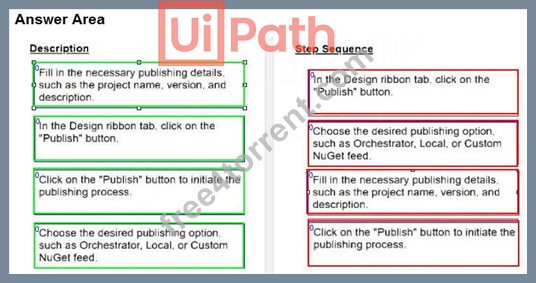
NEW QUESTION # 66
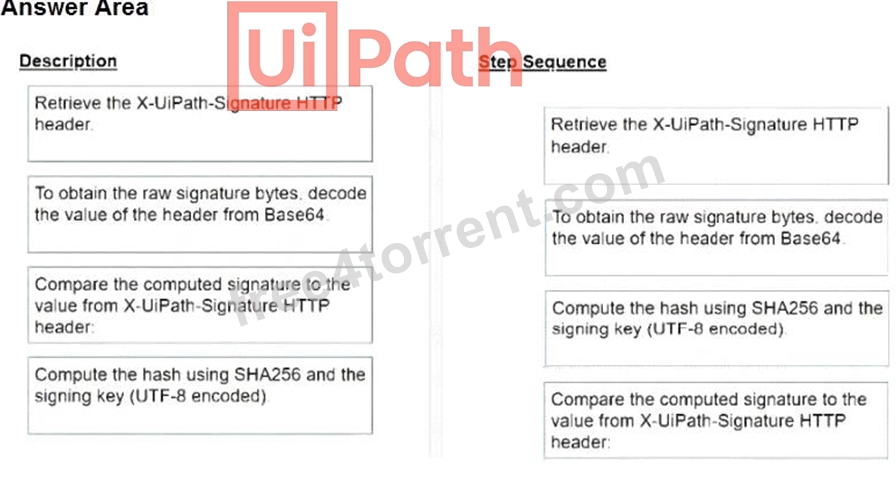
How should the computation of the signature be done for client apps that receive Orchestrator requests and need to check their authenticity?
Instructions: Drag the Description found on the left and drop on the correct Step Sequence found on the right.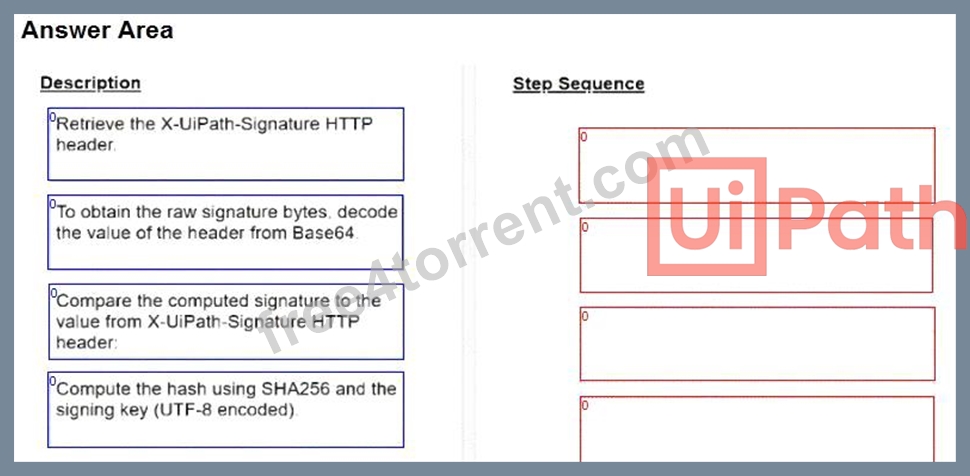
Answer:
Explanation: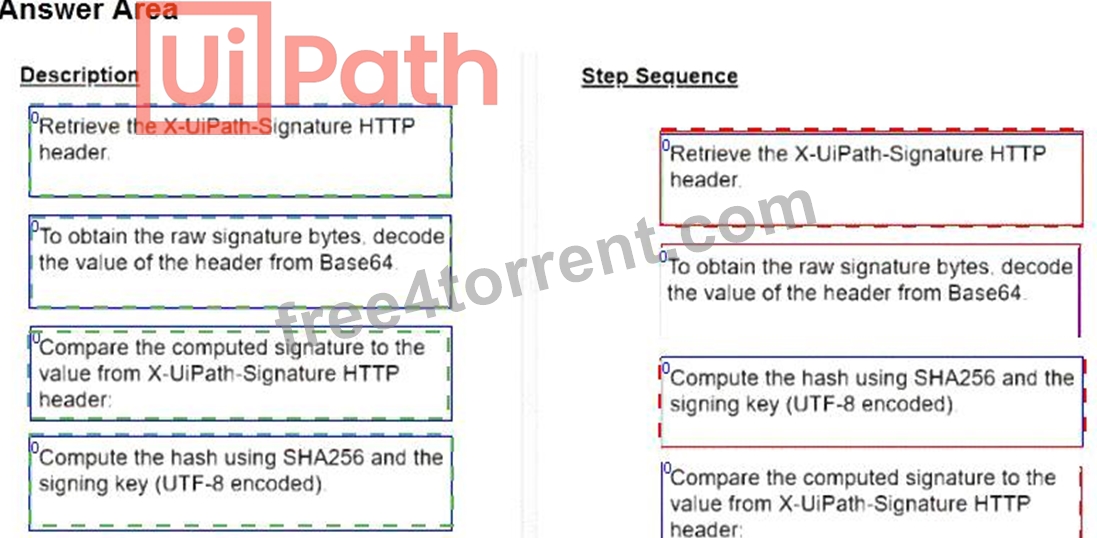
NEW QUESTION # 67
Which are the actions that can be done in Test Explorer?
- A. Export test data, perform debugging, analyze activity coverage.
- B. Export test data, group tests together, analyze activity coverage.
- C. Perform debugging, analyze activity coverage, group tests together.
- D. Export test results, group tests together, analyze activity coverage.
Answer: D
Explanation:
Test Explorer is a panel that shows information relevant to test automation in UiPath Studio. You can use Test Explorer and its sub-panels to perform various actions, such as1:
Export test results: You can export the test results shown in the Test Results panel to a JSON or HTML file, which can be used for further analysis or reporting.
Group tests together: You can group tests together based on different criteria, such as test type, test status, test suite, etc. This helps you organize and filter the tests in the Test Explorer panel.
Analyze activity coverage: You can analyze the activity coverage of your test cases by using the Activity Coverage panel, which shows the percentage of activities that have been executed during the test run. You can also filter the activities by covered or uncovered in the Designer panel.
The other options are not actions that can be done in Test Explorer, because they either involve features that are not part of Test Explorer, or they are not related to test automation. For example:
Option A is incorrect, because Test Explorer does not have a feature to export test data, but only test results. Test data can be generated or managed by using other activities, such as Generate Test Data or Test Data Queue.
Option B is incorrect, because Test Explorer does not have a feature to perform debugging, but only to run or retry tests. Debugging can be done by using the Debug tab in Studio, which allows you to set breakpoints, inspect variables, and step through the workflow.
Option D is incorrect, because Test Explorer does not have a feature to export test data, but only test results. Test data can be generated or managed by using other activities, such as Generate Test Data or Test Data Queue.
References:
1: Studio - Test Explorer - UiPath Documentation Portal
NEW QUESTION # 68
Which command in the UiPath installation folder configures the UIPath.RemoteDebugging.Agent utility on a Windows robot to accept remote debugging requests from Studio?
- A. dotnet ./UiPath.RemoteDebuqqinq.Aqent.dll enable -port -password -verbose
- B. UiPath.RemoteDebuqqinq.Aqent.exe enable -port -username -password -verbose
- C. UiPath-RemoteDebuqqinq.Aqent.exe enable -port -password -verbose
- D. UiPath.RemoteDebuqqinq.Aqent.exe start -port -password -verbose
Answer: C
NEW QUESTION # 69
What is a pre-requisite for running InitAllApplications TestCase?
- A. Invoke KillAllProcesses XAML file in Given.
- B. Invoke SetTransactionStatus XAML file in Given.
- C. Invoke InitAllSettings XAML file in Given.
- D. Invoke CloseAllApplications XAML file in Given.
Answer: C
Explanation:
A test case is a set of steps and expected results that verify a certain functionality or behavior of an automation. A test case can be created in UiPath Studio or UiPath Test Manager, and it can contain both manual and automated steps. A test case can be executed manually or automatically, depending on the type of steps it contains.
A test case follows the Given-When-Then structure, which is a common format for writing test scenarios. The Given section describes the preconditions or initial state of the system before the test is executed. The When section describes the actions or events that trigger the test. The Then section describes the expected outcomes or postconditions of the test.
The InitAllApplications TestCase is a test case that verifies the initialization of all the applications that are used in the automation project. It is usually created in UiPath Studio, using the Test Cases feature. The InitAllApplications TestCase can be linked to the InitAllApplications.xaml workflow, which is a component of the REFramework template that opens and logs in to all the applications that are required for the automation.
The pre-requisite for running the InitAllApplications TestCase is to invoke the InitAllSettings.xaml file in the Given section of the test case. The InitAllSettings.xaml workflow is another component of the REFramework template that reads the configuration data from the Config.xlsx file and initializes the settings and assets for the automation project. By invoking the InitAllSettings.xaml file in the Given section, the test case ensures that the settings and assets are available and ready before opening and logging in to the applications.
The other options are not pre-requisites for running the InitAllApplications TestCase. Option B is incorrect, because the SetTransactionStatus.xaml file is not related to the initialization of applications, but to the setting of the status of a queue item after processing it. Option C is incorrect, because the CloseAllApplications.xaml file is not related to the initialization of applications, but to the closing of all the applications that were opened by the automation. Option D is incorrect, because the KillAllProcesses.xaml file is not related to the initialization of applications, but to the killing of all the processes that are associated with the automation.
References: Studio - Test Cases - UiPath Documentation Portal, REFramework documentation - UiPath Documentation Portal, How to use test cases in the REFramework? - Test Suite - UiPath Community Forum, Linking Test Cases in Studio to Test Manager - UiPath Documentation Portal
NEW QUESTION # 70
While troubleshooting a process developed using the Robotic Enterprise (RE) Framework, you have placed a breakpoint at the "Invoke InitAllSettings" workflow activity.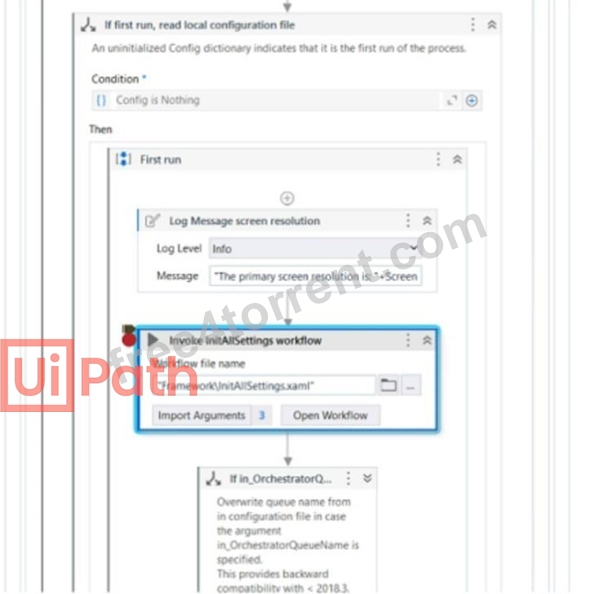
Given the current state of the Executor, what will occur when you click on the Step Over button?
- A. Executor directs to the first InitAllSettings workflow activity
- B. Executor directs to the "First Run" sequence
- C. Executor directs to the first activity outside "If first run, read local configuration"
- D. Executor directs to the "If in_OrchestratorQ ... " activity
Answer: D
Explanation:
When a breakpoint is placed at a particular activity within the workflow and the Step Over function is used, the Executor will move to the next activity in the sequence. Given the context of the REFramework, after stepping over the "Invoke InitAllSettings" workflow, the next activity that would execute is the "If in_OrchestratorQueueName ..." activity, assuming there are no activities in between within the
"InitAllSettings" workflow itself. Step Over will not go into the invoked workflow but will move to the next activity at the same level of the workflow where the breakpoint was placed.
References:
* UiPath Studio Guide: Debugging
NEW QUESTION # 71
A developer wants to add items to a list of strings using the Invoke Method activity. The list is declared as follows: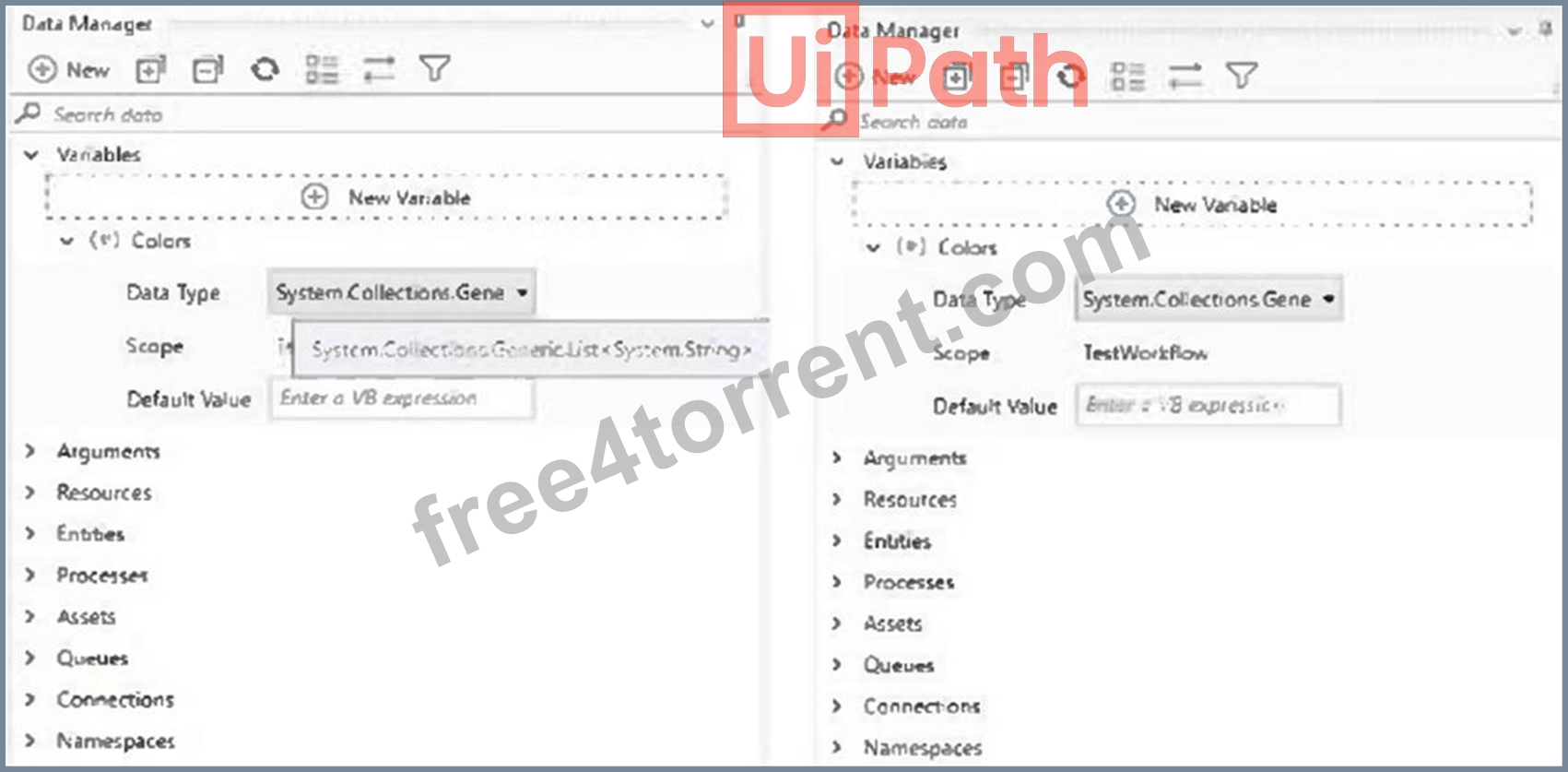
The Invoke Method activity has the following properties: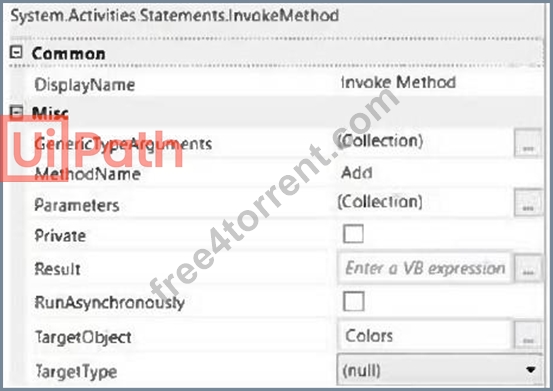
The Parameters property is as follows: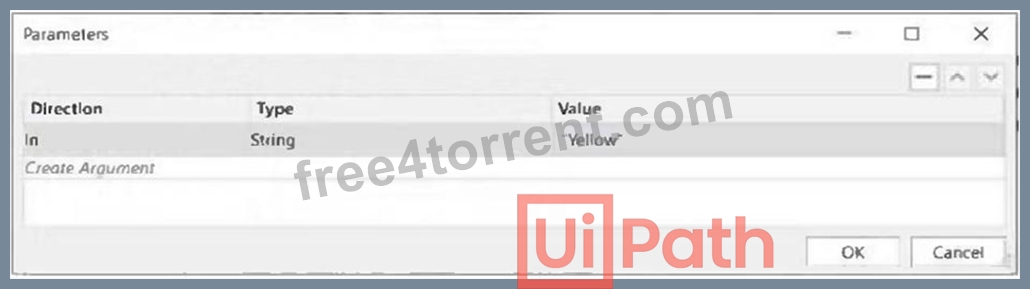
Based on the information shown in the exhibits what is the outcome of the Invoke Method activity?
- A. Colors will contain an item with the value "Colors: Yellow".
- B. Colors will contain an item with an empty value.
- C. Colors will contain an item with the value "Yellow".
- D. An exception will be thrown.
Answer: C
Explanation:
The Invoke Method activity is used to invoke a method of a class or an object. In this case, the developer wants to add items to a list of strings using the Invoke Method activity. The list is declared as follows:
Dim Colors As New List(Of String)
This means that the list is named Colors and it can store strings. The Invoke Method activity has the following properties:
* TargetType: System.Collections.Generic.List`1[System.String]. This means that the target type is a generic list of strings.
* TargetObject: Colors. This means that the target object is the list named Colors.
* MethodName: Add. This means that the method name is Add, which is a method of the list class that adds an item to the end of the list.
* Parameters: In, String, Yellow. This means that the parameter direction is In, which means that the value is passed to the method. The parameter type is String, which means that the value is a string. The parameter value is Yellow, which means that the value is the string "Yellow".
Based on the information shown in the exhibits, the outcome of the Invoke Method activity is that Colors will contain an item with the value "Yellow". This is because the Invoke Method activity will add "Yellow" to the list of strings declared as Colors.
NEW QUESTION # 72
Considering that the attached table is stored in a variable called "dt":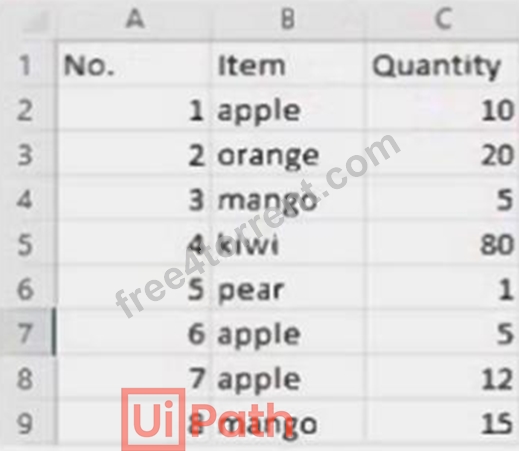
Which LINQ query can be used to return the maximum total Quantity?
- A. dt.AsEnumerable. GroupBy(Function(x) x("Item").ToString). Max(Function(x) x.Sum(Function(y) Convert.ToInt32(y("Quantity").ToString)))
- B. dt.AsEnumerable. Max(Function(x) Convert.ToInt32(x("Quantity").ToString))
- C. dt.AsEnumerable. OrderByDescending(Function(x) Convert.ToInt32(x("Quantity").ToString)). First.Item("Quantity")
- D. dt.AsEnumerable. Max(Function(x) Convert.ToInt32(x("Quantity").ToString))("Item")
Answer: A
Explanation:
The LINQ query that can be used to return the maximum total Quantity from the attached table is dt.
AsEnumerable. GroupBy(Function(x) x("Item").ToString). Max(Function(x) x.Sum(Function(y) Convert.
ToInt32(y("Quantity").ToString))). This query uses the LINQ methods AsEnumerable, GroupBy, Max, and Sum to manipulate the data in the dt variable. The dt variable is a DataTable that contains the following data:
No.
Item
Quantity
1
apple
10
2
orange
20
3
mango
50
4
kiwi
80
5
pear
1
6
apple
5
7
mango
15
The AsEnumerable method converts the DataTable into an Enumerable collection of DataRow objects. The GroupBy method groups the elements of the collection by the value of the Item column, creating a collection of groups. Each group has a key, which is the Item name, and a list of elements, which are the DataRows that have the same Item value. The Max method returns the maximum value of the collection, based on a selector function. The selector function is a lambda expression that calculates the sum of the Quantity column for each group. The Sum method returns the sum of the elements in a collection, based on a selector function. The selector function is a lambda expression that converts the value of the Quantity column into an integer.
Therefore, the query will group the DataRows by the Item name, calculate the total Quantity for each group, and return the maximum total Quantity among the groups. The maximum total Quantity is 80, which corresponds to the group with the key "kiwi". References: [DataTable.AsEnumerable Method], [Enumerable.
GroupBy Method], [Enumerable.Max Method], [Enumerable.Sum Method]
NEW QUESTION # 73
Which Scraping method should be used for the Get Text activity to capture hidden text from an application?
- A. Text attribute
- B. Full text
- C. Native
- D. Default
Answer: B
Explanation:
The Get Text activity in UiPath Studio is used to extract and copy the text from a UI element. It has a property called Scraping method, which allows you to choose the method of scraping text from the target element. The available methods are Default, Text attribute, Full text, and Native.
The Default method tries all the other methods and chooses the best one automatically. The Text attribute method uses the text value of the target element as the output. The Native method uses the native method of the application to scrape the text, and allows formatting and screen coordinates to be retrieved. The Full text method uses an OCR engine to scrape the text, and offers the option to Ignore hidden text, which can be activated by selecting its respective check box.
To capture hidden text from an application, the Full text method with the Ignore hidden text option enabled should be used. This way, the Get Text activity can retrieve the text that is not visible on the screen, but is present in the UI element. For example, this method can be used to get the text from a combo box that has more items than the ones displayed, or from a terminal window that has more editable text than the ones shown.
References: Activities - Get Text - UiPath Documentation Portal, Get Text or Get Full Text for Hidden Text - Studio - UiPath Community Forum, How to: Scrape the Whole Text, Including Hidden Elements from ... - UiPath
NEW QUESTION # 74
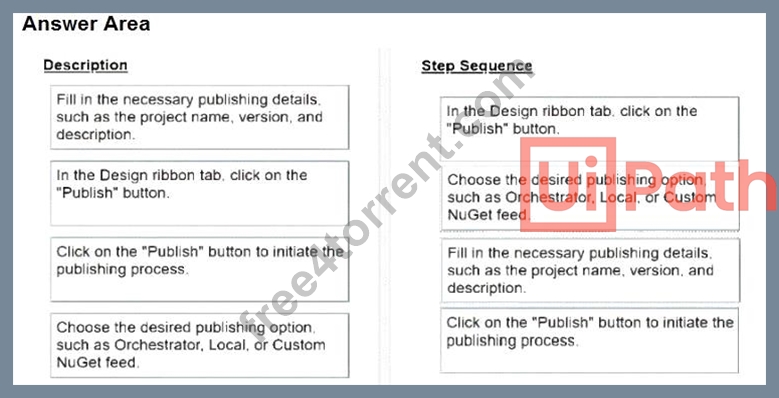
What are the steps to publish a project from UiPath Studio?
Instructions: Drag the Description found on the "Left" and drop on the correct Step Sequence found on the
"Right".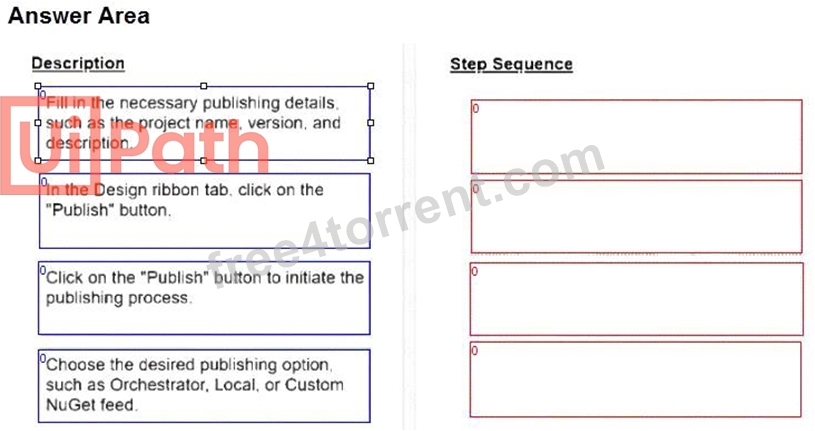
Answer:
Explanation: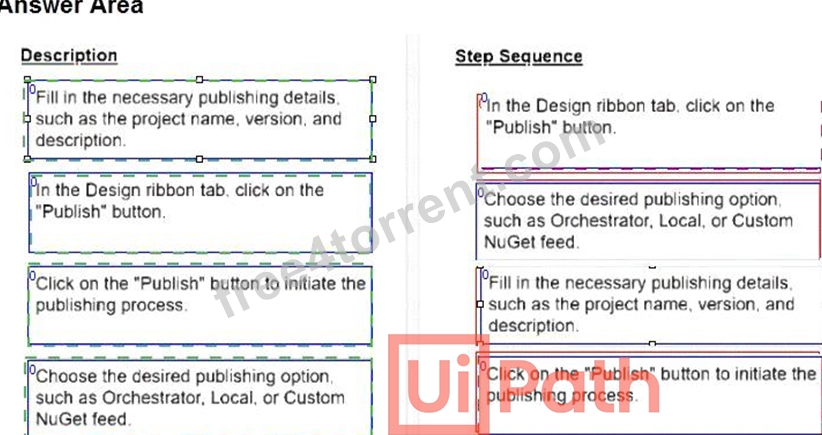
NEW QUESTION # 75
......
UiPath-ADPv1 Exam Dumps - PDF Questions and Testing Engine: https://validdumps.free4torrent.com/UiPath-ADPv1-valid-dumps-torrent.html