

Download Analytics-DA-201 Dumps (2025) - Free PDF Exam Demo
Enhance your career with Analytics-DA-201 PDF Dumps - True Salesforce Exam Questions
Salesforce Analytics-DA-201 Exam Syllabus Topics:
| Topic | Details |
|---|---|
| Topic 1 |
|
| Topic 2 |
|
| Topic 3 |
|
NEW QUESTION # 68
You have the following worksheet.
Answer:
Explanation:
NEW QUESTION # 69
in which three formats can you export a worksheet from the Worksheet menu? Choose three
- A. .pptx
- B. .xlsx
- C. .txt
- D. .html
- E. .png
- F. .csv
Answer: A,B,E
Explanation:
Tableau provides various options to export data from a worksheet. The formats available are typically those that are best suited for visualization or further data analysis. The options include:
* .png for exporting images of the visualizations
* .xlsx for exporting data in a format that can be opened with Microsoft Excel
* .pptx for creating PowerPoint presentations with the visualization embedded These formats are designed to facilitate sharing and presenting the insights derived from Tableau visualizations, or for conducting further analysis in tools like Excel.
NEW QUESTION # 70
You have a dashboard that is configured for desktop browsers.
You want to customize a layout for mobile users.
Which option should you select first? (Click the appropriate Option in the Answer Area.)
Answer:
Explanation: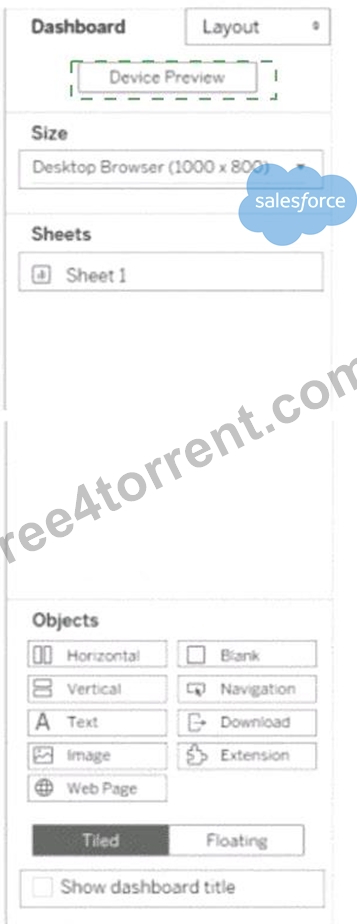
Explanation: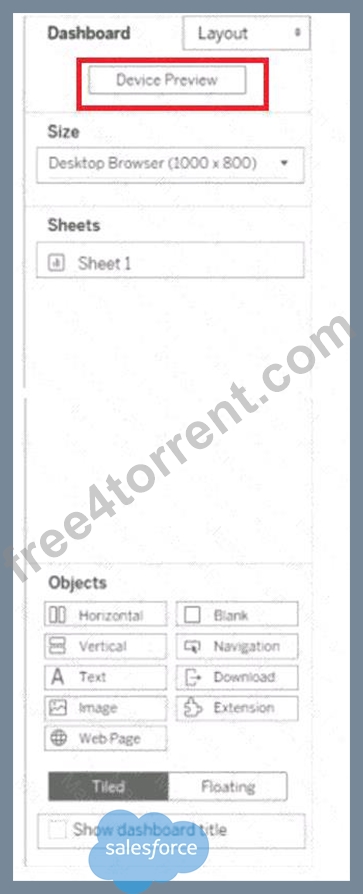
To customize a layout for mobile users, you should select the Device Preview option first. This option will allow you to see how your dashboard will look on different types of devices, such as phones, tablets, or desktops. You can also choose different models and orientations to preview different screen sizes and resolutions. From the Device Preview mode, you can add, edit, or delete device layouts for each device type.
You can also adjust the size, position, and formatting of the dashboard elements for each device layout. References:
* Create Dashboard Layouts for Different Device Types - Tableau
* Tableau Certified Data Analyst Study Guide
NEW QUESTION # 71
A Data Analyst is creating a new dashboard.
The analyst needs to add a button to the dashboard that allows users to export the dashboard as an image.
Which type of object should the analyst use?
- A. Extension
- B. Image
- C. Navigation
- D. Download
Answer: D
NEW QUESTION # 72
You have a blank dashboard.
You want to add two sheets to the dashboard. The sheets must support the Show/Hide button.
To which two objects can you add the sheets? (Click the two appropriate Options in the Answer Area.)
Answer:
Explanation:
To add two sheets to the dashboard that support the Show/Hide button, you can add them to either a horizontal or a vertical container. A container is an object that can hold one or more sheets or other objects and allow you to arrange them in a layout. A Show/Hide button is a feature that lets you hide or show a container and its contents on the dashboard. You can add a Show/Hide button to any container, whether it is tiled or floating, by using the drop-down menu of the container and selecting "Add Show/Hide Button." You can also customize the appearance and behavior of the button.
To add a horizontal or a vertical container to the dashboard, you can drag them from the Objects pane to the dashboard. A horizontal container will arrange the sheets or objects horizontally, while a vertical container will arrange them vertically. You can then drag the sheets you want to add from the Sheets pane to the container. You can resize and reorder the sheets or objects within the container by using the handles and arrows.
The other objects in the Answer Area, such as text, image, web page, blank, navigation, download, and extension, do not support the Show/Hide button. They are either static elements that cannot hold other objects, or dynamic elements that require user interaction or external sources. You can add them to the dashboard as well, but they will not have the same functionality as a container with a Show/Hide button.
References:
Add Show/Hide Buttons - Tableau
Layout Containers - Tableau
NEW QUESTION # 73
You have the following dashboard.
Currently the map is used as a filter that affects the data on the otter sheets of the dashboard You need to configure the dashboard to ensure that selecting a data point on the map only tillers the Detail table What should you do?
- A. From the context menu of Sales over lime select Remove Dashboard Item
- B. From the context menu of Sales over time select Deselect
- C. From the context menu of Profits by Stale deselect Use as Filter
- D. From the context menu of Sales over time select Ignore Actions
Answer: D
Explanation:
To configure the dashboard to ensure that selecting a data point on the map only filters the Detail table, you should select Ignore Actions from the context menu of Sales over time. Ignore Actions is a feature that allows you to exclude a sheet from being affected by any actions on the dashboard, such as filters or highlights. You can select Ignore Actions by right-clicking on a sheet on the dashboard and selecting Ignore Actions from the menu.
In this case, you want to exclude Sales over time from being filtered by the map, so you should select Ignore Actions from its context menu. This will make Sales over time ignore any selections on the map and show all values. The Detail table will still be filtered by the map as usual.
The other options are not correct for this scenario. Removing Dashboard Item will delete Sales over time from the dashboard, which is not what you want. Deselecting Use as Filter will disable the map as a filter for any sheet on the dashboard, which is not what you want. Selecting Deselect will clear any selections on the map, but it will not prevent Sales over time from being filtered by future selections. References: https://help.tableau.
com/current/pro/desktop/en-us/actions.htm https://help.tableau.com/current/pro/desktop/en-us/actions_ignore.
htm
On a Tableau dashboard, when a map is used as a filter, it affects all other sheets in the dashboard by default.
To restrict the filter action to only affect the Detail table and not the 'Sales over time' chart, you would modify the action settings. By selecting "Ignore Actions" from the context menu of the 'Sales over time' chart, it will no longer respond to the filtering action initiated by selecting data points on the map.
NEW QUESTION # 74
A Data Analyst has a data source that contains data for every city in the United States. The following is a sample of the data.
The analyst needs to use the City dimension to create a dynamic filter that shows the cities that have a population greater than 1 million.
Which type of filter should the analyst use?
- A. Top
- B. Special
- C. Range
- D. Condition
Answer: D
NEW QUESTION # 75
You have the following data source in tableau Server.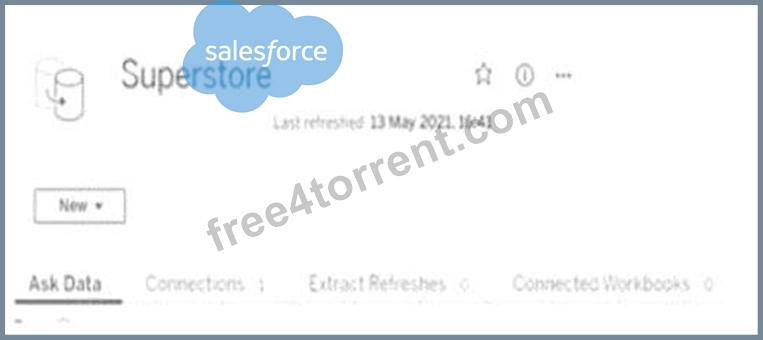
You need to ensure that the data is updated every hour.
What should you select?
- A. Connected Workbooks
- B. New
- C. Extract Refreshes
- D. Connections
Answer: C
Explanation:
To ensure that the data is updated every hour, you need to select Extract Refreshes from the data source menu on Tableau Server. This will allow you to add a new extract refresh schedule or edit an existing one. You can specify the frequency and time of the refresh, as well as any custom options or credentials. New will create a new data source, Connected Workbooks will show you which workbooks use this data source, and Connections will show you which tables or files are connected to this data source. References: https://help.
tableau.com/current/server/en-us/refresh_extracts.htm https://help.tableau.com/current/server/en-us
/refresh_extracts_add.htm
To ensure that the data is updated every hour on Tableau Server, you would need to go to the "Extract Refreshes" option. Here, you can schedule the data extracts to refresh at the desired frequency, which in this case would be every hour.
NEW QUESTION # 76
You have the following data source in tableau Server.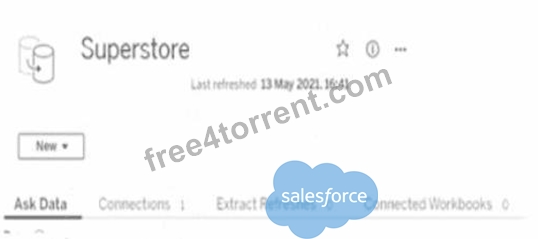
You need to ensure that the data is updated every hour.
What should you select?
- A. Connected Workbooks
- B. New
- C. Extract Refreshes
- D. Connections
Answer: C
Explanation:
To ensure that the data is updated every hour, you need to select Extract Refreshes from the data source menu on Tableau Server. This will allow you to add a new extract refresh schedule or edit an existing one. You can specify the frequency and time of the refresh, as well as any custom options or credentials. New will create a new data source, Connected Workbooks will show you which workbooks use this data source, and Connections will show you which tables or files are connected to this data source. References: https://help.
tableau.com/current/server/en-us/refresh_extracts.htm https://help.tableau.com/current/server/en-us
/refresh_extracts_add.htm
To ensure that the data is updated every hour on Tableau Server, you would need to go to the "Extract Refreshes" option. Here, you can schedule the data extracts to refresh at the desired frequency, which in this case would be every hour.
NEW QUESTION # 77
You have the following tiled dashboard that has one sheet.
You want to replace the sheet with Sheet2.
What should you do?
- A. From the context menu of Sheet3, select Deselect.
- B. From the context menu of Sheet3, select Remove Dashboard Item.
- C. Right-click Sheet2 and select Add to Dashboard.
- D. Select Sheet3 and click the Swap Sheet button next to Sheet2.
- E. Drag Sheet2 to the dashboard.
Answer: E
Explanation:
In Tableau, to replace a sheet on a dashboard, you can simply drag the desired sheet (Sheet2 in this case) from the sheets list onto the dashboard where the current sheet (Sheet3) is. This will replace the existing visualization with the new one.
NEW QUESTION # 78
You have the following chart that shows profits and discounts over time.
You need to combine the lines to appear as shown in the following chart.
What should you do?
- A. Drag Discount to the Columns shelf
- B. Convert Discount to Discrete
- C. Set Discount to Dual Axis
- D. Drag Discount to Color on the Marks card
Answer: C
Explanation:
To combine the lines to appear as shown in the second chart, you should set Discount to Dual Axis. Dual Axis is a feature that allows you to show two measures on two separate axes on one chart. You can create a dual axis by right-clicking on a measure on any shelf and selecting Dual Axis from the menu. This will create two axes on one chart and synchronize their scales.
In this case, you want to show Profit and Discount on two separate axes on one chart. You can right-click on Discount on any shelf and select Dual Axis from the menu. This will create a dual axis chart that shows Profit and Discount as two lines with different colors.
The other options are not correct for this scenario. Dragging Discount to Color on the Marks card will change the color of Profit based on Discount, but it will not show two lines. Converting Discount to Discrete will change Discount from a green pill to a blue pill, but it will not affect how it appears on the chart. Dragging Discount to Columns shelf will create two separate charts for Profit and Discount, but it will not combine them. References: https://help.tableau.com/current/pro/desktop/en-us/multiplemeasures.htm https://help.
tableau.com/current/pro/desktop/en-us/multiplemeasures_dualaxes.htm
NEW QUESTION # 79
A Data Analyst is using containers on a dashboard.
How should the analyst make sure multiple objects within a container are always taking up the same width or height, even if the container is resized?
- A. Adjust the size of each object individually
- B. Use the Layout tab to set the size of each object
- C. Use the distribute evenly option
- D. Float the objects and manually adjust the size
Answer: C
NEW QUESTION # 80
You subscribe to a view that delivers a daily email to your inbox.
You want to make the subscription available to other stakeholders.
What should you do?
- A. From the dashboard overview page, modify the subscription.
- B. From the worksheet, modify the subscription.
- C. From the My Content overview page, modify the alert.
- D. From the My Content overview page, modify the subscription.
Answer: D
NEW QUESTION # 81
A Data Analyst has created a Tableau Prep flow that is ready to be used. The output will be used by a colleague to build a dashboard on Tableau Cloud or Tableau Server.
Where should the analyst output the data to?
- A. CRM Analytics
- B. A Tableau data extract file
- C. Salesforce Data Cloud
- D. A published data source
Answer: D
NEW QUESTION # 82 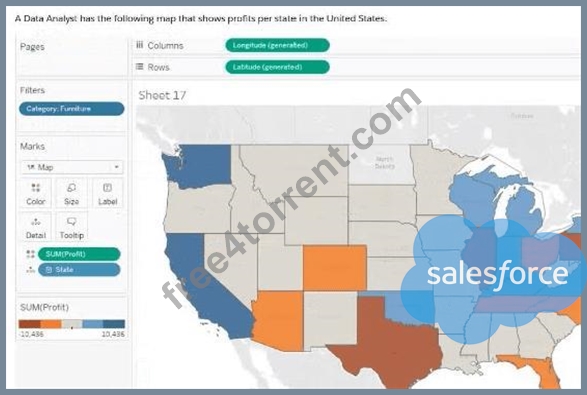
How are the colors configured for the map?
- A. A single color gradient
- B. A sequential color gradient
- C. A diverging color palette that has five stepped colors
- D. A diverging color palette that has six stepped colors
Answer: C
NEW QUESTION # 83
You have the following dataset.
You want to create a new calculated dimension field named Category that meets the following conditions:
. When Subject is Computer Science or Science, Category must be Sciences.
. When Subject is English or Social Studies, Category must be Humanities.
Which two logical functions achieve the goal? Choose two.
- A. CASE [Subject]
WHEN 'Computer Science' THEN 'Sciences'
WHEN 'Science' THEN 'Sciences'
WHEN 'English' THEN 'Humanities'
WHEN 'Social Studies' THEN 'Humanities'
End - B. IF ENDSWITH ( [Subject], 'Computer Science') THEN 'Sciences' ELSE 'Humanities' END
- C. IIF(( CONTAINS ([Subject], 'Science') = TRUE) , 'Humanities', 'Sciences')
- D. IF [Subject]- 'Science' THEN 'Sciences'
ELSEIF [Subject]='English' THEN 'Humanities'
ELSEIF [Subject]-'Social Studies' THEN 'Humanities'
ELSEIF [Subject]= 'Computer Science' THEN 'Sciences'
END
Answer: A,D
Explanation:
To create a new calculated dimension field named Category that meets the given conditions, you can use either the IF or the CASE logical function. Both functions allow you to evaluate an expression and return a value based on different scenarios. Option A uses the IF function with multiple ELSEIF clauses to check the value of the Subject field and assign it to either 'Sciences' or 'Humanities'. Option D uses the CASE function with multiple WHEN clauses to do the same thing. Both options will produce the same result, but the CASE function is more concise and easier to read. Option B is incorrect because it will assign 'Humanities' to any subject that contains 'Science' in its name, which is not the desired outcome. Option C is incorrect because it will only check if the subject ends with 'Computer Science' and ignore the other subjects. References:
* Logical Functions - Tableau
* Tableau Certified Data Analyst Study Guide
NEW QUESTION # 84
You want to ensure that when you click a bar on a dashboard, a tooltip appears that contains a link named
"Click here to know more!" as shown in the following exhibit.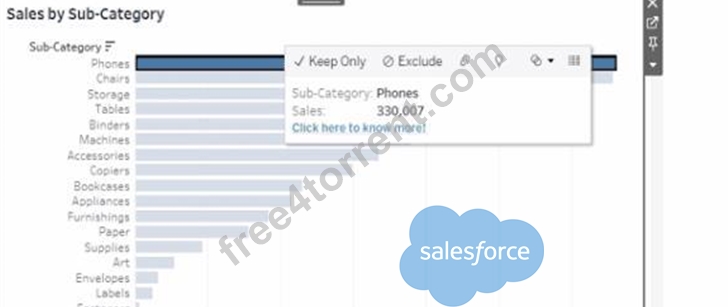

Answer:
Explanation:
Explanation:
NEW QUESTION # 85
You want to show the cumulative total of each year for every state.
Which quick table calculation should you use?
- A. Year Over Year Growth
- B. Running Total
- C. VTD Growth
- D. YTD Total
Answer: B
NEW QUESTION # 86
Open the link to Book1 found on the desktop. Open Disciplines worksheet.
Filter the table to show the Top 10 NOC based on the number of medals won.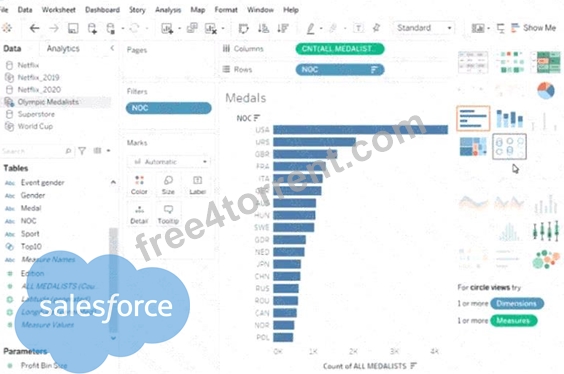
Answer:
Explanation:
check the steps below in explanation.
Explanation:
To filter the table to show the Top 10 NOC based on the number of medals won, you need to do the following steps:
* Open the link to Book1 found on the desktop. This will open the Tableau workbook that contains the Disciplines worksheet.
* Click on the Disciplines tab at the bottom of the workbook to open the worksheet. You will see a table that shows the NOC, discipline, and medals for each country.
* Drag Medals from the Measures pane to the Filters shelf. This will open a dialog box that allows you to filter by different criteria.
* Select Top from the dialog box. This will show you options to filter by the top or bottom values of a field.
* Enter 10 in the text box next to By field. This will filter by the top 10 values of Medals.
* Select NOC from the drop-down list next to By field. This will filter by the top 10 values of NOC based on Medals.
* Click OK to apply the filter. You will see that the table now shows only 10 rows, one for each NOC with the highest number of medals.
References: https://help.tableau.com/current/pro/desktop/en-us/filtering.htm https://help.tableau.com/current/pro/desktop/en-us/filtering_topn.htm
NEW QUESTION # 87
You have the following visualization.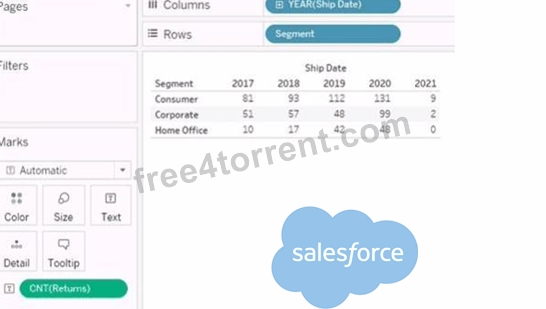
You want the count of Returns displayed only for the first year in the table.
How should you complete the formula in the calculated field? (Use the dropdowns in the Answer Area to select the correct options to complete the formula.)
Answer:
Explanation:
Explanation:
we need to create a calculated field that displays the count of returns only for the first year in the table. To do this, we can use the following formula:
IF FIRST () = 0 THEN COUNT (Returns) END
This formula uses the FIRST () function, which returns the number of rows from the current row to the first row in the partition. If the current row is the first row, then FIRST () returns 0. The IF statement checks if this condition is true, and if so, it returns the count of returns for that row. Otherwise, it returns NULL.
To complete the formula in the calculated field, you should select the following options from the drop-down menus:
* FIRST ()
* 0
* COUNT (Returns)
https://help.tableau.com/current/pro/desktop/en-us/functions_functions_date.htm
NEW QUESTION # 88
You have the following dataset.
Which formula calculates the percent difference in sales relative to the same quarter the previous year as shown in the Calculation field?
- A. (SUM ([Sales]) - LOOKUP (SUM ( [Sales]), -4))
- B. (ZN (SUM ([Sales]) ) - LOOKUP (ZN (SUM ([Sales]) ), -4) )
- C. (SUM ([Sales]) - LOOKUP (SUM ([Sales]), -4) ) / (LOOKUP (SUM ([Sales]), -4) )
- D. (SUM([Sales]) / (LOOKUP (SUM ([Sales]), -4))
Answer: C
Explanation:
The formula in option B calculates the percent difference in sales relative to the same quarter the previous year. It subtracts the sales of the same quarter from the previous year from the current year's sales, and then divides this by the previous year's sales. This gives a percentage change, which aligns with what is shown in the Calculation field of your dataset. The LOOKUP function returns the value of a specified offset from the current row in the partition. In this case, the offset is -4, which means the value of the same measure four rows above the current row. This corresponds to the same quarter of the previous year, assuming the data is sorted by quarter. References:
* LOOKUP Function - Tableau
* Table Calculations - Tableau
* Tableau Certified Data Analyst Study Guide
NEW QUESTION # 89
You have the following chart that sorts states by the number of products each state has purchased.
Which formula should you use to include a number with the position of each state within each region?
- A. WINDOW_SUM(SUM ([Quantity]))
- B. FIRST ()
- C. INDEX ()
- D. LOOKUP (SUM ([Quantity]))
Answer: C
Explanation:
The LOOKUP function is used to return the value of a specified field in a different row, which can be defined relative to the current row. In this context, it can be used to include a number with the position of each state within each region by looking up the SUM([Quantity]) in each respective position. References: The information is inferred from general Tableau knowledge as well as the following sources:
* Tableau Functions (Alphabetical)
* LOOKUP
* Tableau Certified Data Analyst Exam Guide
NEW QUESTION # 90
From Tableau Desktop you sign in lo a Tableau Server site.
What appears in the list of available data sources when you search for a published data source?
- A. All the data sources published to the site
- B. All the data sources published to the site within the folders to which you have access
- C. All the data sources published to the Tableau Server within the folders to which you have access
- D. All the data sources published to the Tableau Server
Answer: B
Explanation:
When you sign in to a Tableau Server site from Tableau Desktop and search for a published data source, you will see all the data sources published to the site within the folders to which you have access. You will not see data sources published to other sites or folders that you do not have permission to view. You can also filter your search by project, owner, or tag. References: https://help.tableau.com/current/pro/desktop/en-us
/connect_basic.htm https://help.tableau.com/current/pro/desktop/en-us/connect_tableauserver.htm When signed in to Tableau Server from Tableau Desktop, you'll only be able to see the data sources that have been published to the site and are within the folders that you have been granted access to. Tableau's permission and project structure mean that you won't see all data sources from the entire server unless you have permissions to do so.
NEW QUESTION # 91
You have a dashboard than contains two sheets named Sheet 1 and Sheet 2.
You want to add an object to the dashboard that users can click to switch to a different dashboard in the workbook.
Which object should you add to the dashboard?
Answer:
Explanation:
The object that you should add to the dashboard to allow users to switch to a different dashboard in the workbook is Navigation.
Navigation objects are used to create links between dashboards or sheets in a workbook. You can add a navigation object to a dashboard by dragging it from the list of objects and dropping it on the dashboard. You can then configure the navigation object to specify the destination dashboard or sheet that you want users to navigate to when they click on it.
You can learn more about navigation objects and how to use them in this article: https://help.tableau.com
/current/pro/desktop/en-us/dashboards_navigation.htm
NEW QUESTION # 92
......
100% Free Analytics-DA-201 Files For passing the exam Quickly: https://validdumps.free4torrent.com/Analytics-DA-201-valid-dumps-torrent.html