

[Jun-2026] Palo Alto Networks NetSec-Analyst Dumps - Secret To Pass in First Attempt
Palo Alto Networks NetSec-Analyst Exam Dumps [2026] Practice Valid Exam Dumps Question
Palo Alto Networks NetSec-Analyst Exam Syllabus Topics:
| Topic | Details |
|---|---|
| Topic 1 |
|
| Topic 2 |
|
| Topic 3 |
|
| Topic 4 |
|
NEW QUESTION # 21
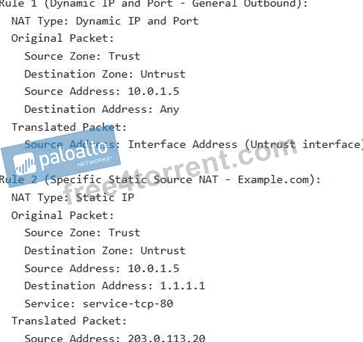
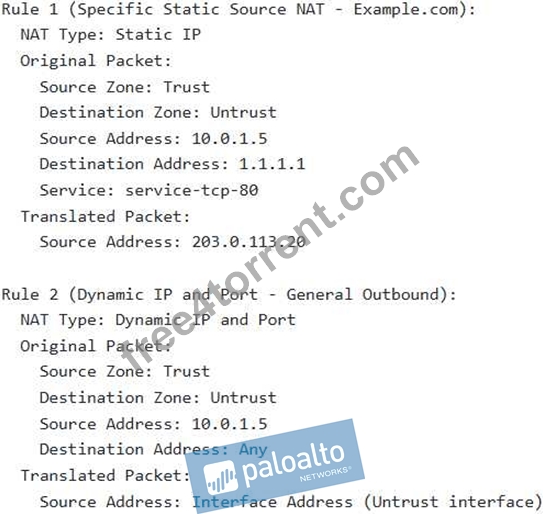
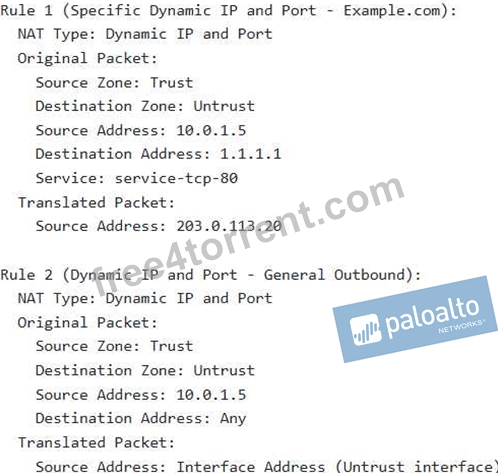
An internal server (10.0.1.5) on the 'Trust' zone needs to access a specific public service (example.com, 1.1.1.1) on TCP port 80. Due to a complex network design and a requirement for strict outbound traffic control, all traffic from this server to 1.1.1.1:80 must be translated to a specific public IP 203.0.113.20. All other traffic from 10.0.1.5 to the Internet should use the firewall's egress interface IP (203.0.113.1 Additionally, any return traffic from 1.1.1.1 to 203.0.113.20 should be automatically translated back to 10.0.1.5. Which of the following NAT configurations achieves this with the highest specificity and ensures bi-directional communication for the dedicated service?
- A.
- B.
- C.
- D. A single NAT rule with a U-Turn NAT for the specific service.
- E. This requires two separate security policies, one for 1.1.1.1 and another for general internet access, with no specific NAT configuration.
Answer: B
Explanation:
This scenario requires conditional Source NAT based on the destination. The key is that the rule for the specific destination (1.1.1.1:80) must be evaluated before the more general outbound NAT rule. A Static IP Source NAT is generally preferred for dedicated public IPs, as it implicitly creates a corresponding return Destination NAT, ensuring bi-directional communication for that specific service without needing a separate DNAT rule. Dynamic IP and Port, while working, would also translate the source port, which isn't strictly necessary if a dedicated IP is used and can sometimes complicate troubleshooting compared to Static IP.
Let's analyze the options:
- Option A: Correctly places the more specific 'Static IP' Source NAT rule (matching 10.0.1.5 to 1.1.1.1:80) above the general 'Dynamic IP and Port' rule. When 10.0.1.5 connects to 1.1.1.1:80, Rule 1 will match, translating the source to 203.0.113.20. All other traffic from 10.0.1.5 will fall through to Rule 2 and use the interface IP (203.0.113.1). Static IP Source NAT automatically handles the return traffic.
- Option B: Incorrect order. The general rule (Rule 1) would match all traffic from 10.0.1.5 first, so traffic to 1.1.1.1:80 would also be translated to 203.0.113.1 , failing the requirement.
- Option C: While the order is correct, using 'Dynamic IP and Port' for the specific 203.0.113.20 isn't ideal if a dedicated IP is the goal. 'Static IP' provides a cleaner 1:1 mapping and automatic reverse NAT, which is generally better for this type of dedicated service translation.
- Option D: Incorrect. NAT is required to achieve the IP translation
- Option E: U-Turn NAT is for internal clients accessing a server via its public IP, not for outbound dedicated service access.
NEW QUESTION # 22
Which type of DNS signatures are used by the firewall to identify malicious and command-and-control domains?
- A. DNS Security signatures
- B. DNS Malicious signatures
- C. DNS Malware signatures
- D. DNS Block signatures
Answer: A
Explanation:
https://docs.paloaltonetworks.com/dns-security/administration/configure-dns-security/enable-dns-security#tabs-id066476b2-c4dd-4fc0-b7e4-f4ba32e19f60
NEW QUESTION # 23
Refer to the exhibit.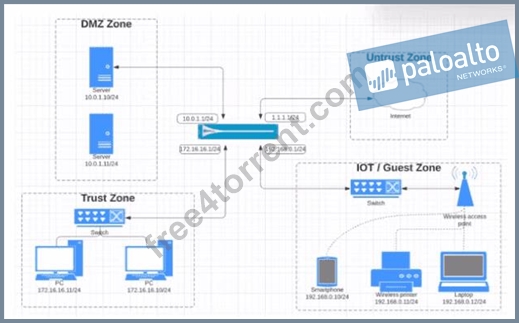
View the diagram. What is the most restrictive, yet fully functional rule, to allow general Internet and SSH traffic into both the DMZ and Untrust/lnternet zones from each of the lOT/Guest and Trust Zones?
- A.

- B.

- C.

- D.

Answer: B
NEW QUESTION # 24
An organization relies heavily on Microsoft Remote Desktop Protocol (RDP) for administrative access, but they've implemented a custom RDP gateway on a non-standard port TCP/3390. While App-ID correctly identifies 'ms-rdp' on standard port 3389, it identifies TCP/3390 traffic as 'unknown-tcp'. The security team wants to ensure:
1 . All TCP/3390 traffic to the RDP gateway is explicitly identified as 'ms-rdp'.
2. Specific threat prevention profiles and a custom QOS profile are applied to this 'ms-rdp' traffic.
3. No other application override rule or App-ID signature should inadvertently reclassify this critical traffic.
Which of the following CLI command sequences for an Application Override policy would best meet these requirements?
- A.

- B.

- C.

- D.

- E.

Answer: D
Explanation:
The crucial part of the requirement is to ensure 'no other application override rule or App-ID signature should inadvertently reclassify this critical traffic'. Application Override rules are processed in order. By using 'position-before 'any", you ensure this specific override rule is placed at the very top of the override policy list, meaning it's evaluated before any other override or App-ID. This guarantees its precedence. 'position-top' (Option C) achieves a similar effect but might be less explicit in its positioning relative to other rules, depending on the specific CLI version and context. 'position-after' (Option A) would mean other rules might match first. 'match-criteria 'all" (Option D) is not a valid or relevant option for positioning. Option E 'order 'first" is not a standard CLI command for positioning. The specific source and destination zones also ensure the override is precise and doesn't broadly impact other traffic on TCP/3390 if it were to exist.
NEW QUESTION # 25
A multinational corporation uses Panorama for centralized management. A recent compliance audit highlighted that several regional firewalls have overly permissive 'any-any' rules that are rarely, if ever, used, creating unnecessary attack surface. The security team wants to systematically address these. Which sequence of operations, leveraging Policy Optimizer, would be most efficient and ensure minimal disruption?
- A. 1. In Policy Optimizer, identify all 'any-any' rules across relevant Device Groups using the 'Rule Browser'. 2. For each identified rule, change its action to 'Alert' and observe traffic patterns for a week. 3. If no legitimate traffic is logged, change action to 'Deny' and commit.
- B. 1. In Policy Optimizer, run a 'Rule Usage' report across all Device Groups. 2. For rules with zero or very low hit count, change action to 'Deny' and commit. 3. Monitor logs for complaints.
- C. 1. In Policy Optimizer, utilize the 'Security Policy Rule Optimization' dashboard. 2. Filter for 'Any-Any' rules with low hit counts. 3. For each candidate rule, use the 'Convert to specific' feature (if applicable) or change its action to 'Deny' after a validation period. 4. Push updates to respective firewalls.
- D. 1. Use Activity Insights to find the least used applications. 2. Create new policies to block these applications. 3. Push to firewalls.
- E. 1. Manually review each firewall's security policy for 'any-any' rules. 2. Delete the rules if they appear unused. 3. Push commits.
Answer: C
Explanation:
Policy Optimizer's 'Security Policy Rule Optimization' dashboard specifically targets identifying and refining overly broad or unused rules. Filtering for 'Any-Any' with low hit counts directly addresses the auditor's concern. The 'Convert to specific' feature within Policy Optimizer is key for refining these rules rather than just deleting them, and if conversion isn't suitable, changing to 'Deny' after a validation period (which Policy Optimizer helps facilitate by showing usage over time) ensures minimal disruption while improving posture. The Panorama push ensures centralized enforcement.
NEW QUESTION # 26
An administrator is implementing an exception to an external dynamic list by adding an entry to the list manually. The administrator wants to save the changes, but the OK button is grayed out.
What are two possible reasons the OK button is grayed out? (Choose two.)
- A. The entry contains wildcards.
- B. The entry is duplicated.
- C. The entry doesn't match a list entry.
- D. The entry matches a list entry.
Answer: B,D
NEW QUESTION # 27
Where does a user assign a tag group to a policy rule in the policy creation window?
- A. Application tab
- B. Usage tab
- C. Actions tab
- D. General tab
Answer: D
Explanation:
A user can assign a tag group to a policy rule in the policy creation window by selecting the General tab. A tag group is a collection of tags that can be used to identify and filter policy rules based on different criteria, such as function, location, or priority. A user can create a tag group on Panorama and assign it to a policy rule to apply the same set of tags to multiple firewalls or device groups1. To assign a tag group to a policy rule, the user needs to:
Select the General tab in the policy creation window.
Click the Tag Group drop-down menu and select the tag group that the user wants to assign to the policy rule.
Click OK to save the changes. The policy rule will inherit the tags from the tag group and display them in the Tag column.
NEW QUESTION # 28
The Palo Alto Networks NGFW was configured with a single virtual router named VR-1 What changes are required on VR-1 to route traffic between two interfaces on the NGFW?
- A. Enable the redistribution profile to redistribute connected routes
- B. Add zones attached to interfaces to the virtual router
- C. Add interfaces to the virtual router
- D. Add a static routes to route between the two interfaces
Answer: D
NEW QUESTION # 29
For the firewall to use Active Directory to authenticate users, which Server Profile is required in the Authentication Profile?
- A. LDAP
- B. TACACS+
- C. RADIUS
- D. SAML
Answer: A
Explanation:
Explanation/Reference:
Reference:
https://docs.paloaltonetworks.com/pan-os/8-1/pan-os-admin/authentication/configure-an- authenticationprofile-and-sequence
NEW QUESTION # 30
In which two Security Profiles can an action equal to the block IP feature be configured? (Choose two.)
- A. Antivirus b
- B. Vulnerability Protection
- C. URL Filtering
- D. Anti-spyware
Answer: B,D
Explanation:
The block IP feature can be configured in two Security Profiles: Vulnerability Protection and Anti-spyware. The block IP feature allows the firewall to block traffic from a source IP address for a specified period of time after detecting a threat. This feature can help prevent further attacks from the same source and reduce the load on the firewall1. The block IP feature can be enabled in the following Security Profiles:
Vulnerability Protection: A Vulnerability Protection profile defines the actions that the firewall takes to protect against exploits and vulnerabilities in applications and protocols. You can configure a rule in the Vulnerability Protection profile to block IP connections for a specific threat or a group of threats2.
Anti-spyware: An Anti-spyware profile defines the actions that the firewall takes to protect against spyware and command-and-control (C2) traffic. You can configure a rule in the Anti-spyware profile to block IP addresses for a specific spyware or C2 signature.
NEW QUESTION # 31
A network administrator created an intrazone Security policy rule on the firewall. The source zones were set to IT. Finance, and HR.
Which two types of traffic will the rule apply to? (Choose two)
- A. traffic between zone IT and zone Finance
- B. traffic within zone HR
- C. traffic between zone Finance and zone HR
- D. traffic within zone IT
Answer: B,D
NEW QUESTION # 32
A company requires all traffic to their critical SaaS provider (secure-saas.com, public IP 203.0.113.1) from all internal user subnets (10.0.0.0/8) to traverse a specific dedicated IPSec VPN tunnel (tunnel. 1) to their cloud security gateway. However, if this tunnel goes down, the traffic must NOT fail over to the internet; it must be blocked. All other internet traffic from 10.0.0.0/8 should use the primary internet uplink. Additionally, the PBF solution must be scalable and robust, handling potential changes in the SaaS provider's IP addresses. Which combined configuration achieves this?
- A. 1. Create an Address Group for 'secure-saas.com' containing 203.0.113.1.2. Define a PBF rule: Source Address: 10.0.0.0/8, Destination Address: (Address Group for secure-saas.com), Application: any, Egress Interface: tunnel.1, Next Hop: (cloud gateway IP), Action: Forward, Fall back to: Discard. 3. Configure a security policy rule allowing this traffic.
- B. 1. Define a PBF rule: Source Address: 10.0.0.0/8, Destination FQDN: secure-saas.com, Application: web-browsing, ssl, Egress Interface: tunnel. 1, Next Hop: (cloud gateway IP), Action: Forward, Fall back to: Discard. 2. Configure a security policy rule allowing this traffic.
- C. 1. Create an External Dynamic List (EDL) for 'secure-saas.com' with 'Type: IP List' and 'Source: URL for secure-saas.com's IPs'. 2. Define a PBF rule: Source Address: 10.0.0.0/8, Destination Address: (EDL for secure-saas.com), Application: any, Egress Interface: tunnel. 1, Next Hop: (cloud gateway IP), Action: Forward, Fall back to: Discard. 3. Configure a security policy rule allowing this traffic.
- D. 1. Create a Custom URL Category for 'secure-saas.com'. 2. Define a PBF rule: Source Address: 10.0.0.0/8, URL Category: (Custom URL Category for secure- saas.com), Application: web-browsing, ssl, Egress Interface: tunnel.1 , Next Hop: (cloud gateway IP), Action: Forward, Fall back to: Discard. 3. Configure a security policy rule allowing this traffic.
- E. 1. Define a PBF rule: Source Address: 10.0.0.0/8, Destination Address: 203.0.113.1, Application: any, Egress Interface: tunnel. 1, Next Hop: (cloud gateway IP), Action: Forward, Fall back to: Discard. 2. Configure a security policy rule allowing this traffic from internal zones to 'Untrust' via tunnel. 1.
Answer: B
Explanation:
This question combines PBF for specific path, fallback to discard, and scalability for changing IPs. Scalability for IP Changes: The most robust and scalable way to handle changing IP addresses for a SaaS provider in PBF is to use 'Destination FQDN'. This allows the firewall to dynamically resolve the FQDN to its current IPs, eliminating the need for manual updates to address objects or EDLs when IPs change. Fallback to Discard: The 'Fall back to: Discard' action in the PBF rule is precisely what's needed to ensure traffic is blocked if the tunnel goes down, preventing it from using the default internet route. Application Specificity: Specifying 'Application: web-browsing, SSI' (or specific applications used by secure-saas.com) is good practice to ensure only relevant traffic is steered by this PBF rule, although 'any' would also work if all traffic to the FQDN needs steering. Let's analyze other options: Option A and B: Rely on static IP addresses or address groups, which are not scalable for changing SaaS IPs and require manual updates. Option C: While EDLs can update dynamically, they are primarily for blacklisting/whitelisting and involve a fetching mechanism. Using FQDN directly in PBF is more native and direct for routing decisions for known destinations. Option D: Using a Custom URL Category in PBF is for URL-based filtering, not IP-based routing decisions for the entire FQDN traffic flow. While the PBF rule can match URL categories for HTTP/HTTPS traffic, the primary routing decision for the entire connection is based on IP and FQDN. FQDN matching in PBF directly resolves IPs for routing.
NEW QUESTION # 33
Which CLI command will help confirm if FQDN objects are resolved in the event there is a shadow rule?
- A. >show system fqdn
- B. >request fqdn show system
- C. >request system fqdn show
- D. >request show system fqdn
Answer: A
Explanation:
The show system fqdn command displays the FQDN objects configured on the firewall and their resolved IP addresses. This can help confirm if the FQDN objects are resolved correctly and if they match the expected traffic. A shadow rule is a rule that is never matched because a preceding rule covers the same traffic. If a shadow rule uses FQDN objects, it is possible that the FQDN objects are not resolved or have different IP addresses than the traffic, causing the rule to be ineffective.
NEW QUESTION # 34
The CFO found a malware infected USB drive in the parking lot, which when inserted infected their corporate laptop the malware contacted a known command-and-control server which exfiltrating corporate data.
Which Security profile feature could have been used to prevent the communications with the command-and-control server?
- A. Create an Antivirus Profile and enable its DNS sinkhole feature.
- B. Create a Data Filtering Profile and enable its DNS sinkhole feature.
- C. Create an Anti-Spyware Profile and enable its DNS sinkhole feature.
- D. Create a URL Filtering Profile and block the DNS sinkhole URL category.
Answer: C
NEW QUESTION # 35
Based on the image provided, which two statements apply to the Security policy rules? (Choose two.)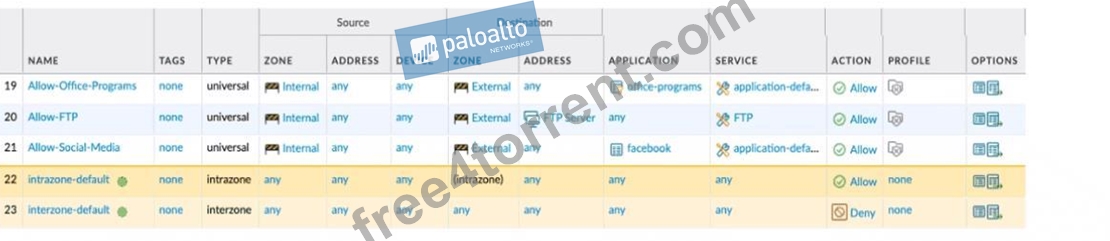
- A. The Allow-Social-Media rule allows all Facebook functions.
- B. The Allow-Office-Programs rule is using an application group.
- C. In the Allow-FTP policy, FTP is allowed using App-ID.
- D. The Allow-Office-Programs rule is using an application filter.
Answer: A,D
NEW QUESTION # 36
Which URL profiling action does not generate a log entry when a user attempts to access that URL?
- A. Override
- B. Block
- C. Allow
- D. Continue
Answer: C
Explanation:
References:
NEW QUESTION # 37
A large enterprise uses Palo Alto Networks firewalls and has a stringent security requirement to prevent intellectual property (IP) leakage. They want to block any outbound traffic containing source code patterns specific to their proprietary software, which uses a unique internal commenting style (e.g., W Companylnternal: [text]'). This pattern needs to be detected within any file type transferred via HTTP/S, FTP, or SMB, but only if the user belongs to the 'Developers' or 'Contractors' user groups. Furthermore, detection of a single instance of this pattern should trigger a block. Which combination of Data Patterns, Data Filtering Profiles, and Security Policy rules is most effective and efficient to implement this, leveraging user-ID and ensuring comprehensive coverage?
- A.

- B.

- C.

- D.

- E.

Answer: D
Explanation:
This is a complex scenario requiring proper understanding of Data Filtering, User-ID, and SSL Decryption. Let's break down the requirements and why option D is correct. Requirements Analysis: Pattern: 7/ Companylnternal: [text]' -Y Requires a Regex Data Pattern. Coverage: Any file type via HTTP/S, FTP, or SMB -> This implies inspecting file transfers and potentially encrypted traffic (HTTP/S). User Scope: ONLY 'Developers' or 'Contractors' user groups Requires User-ID in the security policy. Action: Block on single instance -> Data Filtering Profile with 'Block' action and Threshold of 1 . Evaluation of Options: A: Data Pattern: Correct regex, 'Data Type: Any, 'Context: Any' is good for broad file content scanning. Data Filtering Profile: Correct (Block action, Threshold 1). Security Policy Rule: Source User and Application are correct. Crucially, the 'Action: Allow' is a problem. Data Filtering profiles are applied to 'allow' rules. If the rule's action is 'Allow', the profile then determines what happens if a pattern is matched (e.g., block, alert). This structure is correct for applying Data Filtering. However, it's missing the critical aspect of SSL Decryption if the traffic is HTTPS, which is implicitly included in 'HTTP/S'. B: Data Pattern: 'Data Type: ASCII' might be too restrictive if the code is in other encodings. 'Context: File' is good. Security Policy Rule: 'Action: Denys means traffic is blocked before Data Filtering can even inspect it. Data Filtering profiles only apply to 'Allow' security policies. So, this option is fundamentally flawed for data filtering. C: Data Pattern: Correct. Data Filtering Profile: 'Object Type: File' is redundant with 'Context: Any' and the application types. 'Threshold: is correct. Security Policy Rule: 'Action: Block' has the same flaw as Option B: Data Filtering profiles do not apply to 'Block' rules. D (Correct): 1. Data Pattern: ProprietaryCode_Pattern' (Regex: W Companylnternal: . ' , Data Type: Any, Context: Any). This is the I correct, flexible definition for the pattern. 2. Data Filtering Profile: (add 'ProprietaryCode_Pattern' with 'Block' action, Threshold: 1). This ensures that a single match triggers a block. 3. Security Policy Rule: Source User: 'Developers', 'Contractors' - Correctly leverages User-ID Application: 'web-browsing', 'ftp', 'smb' - Covers the required protocols. Action: 'Allow' - This is essential because Data Filtering profiles are applied to 'Allow' rules. When a match occurs, the profile's 'Block' action overrides the 'Allow' for that specific session. Profiles: (as part of a Profile Group) with SSL Decryption enabled for this traffic. This is the critical missing piece from option A. Since the requirement includes HTTP/S, SSL decryption must be enabled on the firewall for it to be able to inspect the encrypted payload and apply the data patterm Applying the Data Filtering profile within a Profile Group is the standard way to attach multiple security profiles. This option correctly specifies all components needed for a robust solution. E: Using custom URL categories or vulnerability signatures for data leakage is incorrect. Custom URL categories are for blocking/allowing URLs, not content inspection. Vulnerability signatures are for detecting exploits, not sensitive data patterns. Data Filtering is the dedicated feature for this purpose.
NEW QUESTION # 38
A firewall administrator is creating an application override rule to bypass Layer 7 inspection for a pre-defined application. What is the expected behavior for Content-ID checks for this application?
- A. Threat inspection will occur if the pre-defined application supports threat inspection.
- B. No additional security checks will occur due to there being only Layer 4 handling.
- C. DNS Security will have degraded performance for advanced features.
- D. WildFire will only use inline-ML checks instead of sending items to WildFire Cloud.
Answer: B
Explanation:
Comprehensive and Detailed 150 to 250 words of Explanation From Palo Alto Networks Network Security Analyst Knowledge:
In the Palo Alto Networks environment, an Application Override rule is a specialized policy used to change how the firewall identifies and processes traffic. When an Application Override rule is triggered, the firewall skips the standard App-ID identification process (the Layer 7 signature matching) and forces the traffic to be identified as a specific, manually assigned application based on the Layer 4 criteria (Source/Destination IP and Port/Protocol).
The critical consequence of using an Application Override is its impact on the Content-ID engine. Because the firewall is forced to treat the traffic as a simple Layer 4 stream without full Layer 7 context, the Content- ID engine-which is responsible for Antivirus, Anti-Spyware, Vulnerability Protection, and WildFire inspection-cannot be applied to the session. Effectively, once an application is overridden, the traffic is handled purely at the network and transport layers.
As a result, no additional security checks will occur (D) for that traffic. This is why Application Overrides are typically reserved for trusted internal traffic, high-throughput applications that do not require inspection, or custom applications that might be misidentified by standard App-ID signatures. A Network Security Analyst must use this tool with caution, as it creates a "blind spot" in the security posture where threats, malware, and data exfiltration patterns will not be detected by the firewall's security profiles.
NEW QUESTION # 39
Which profile should be used to obtain a verdict regarding analyzed files?
- A. Content-ID
- B. Advanced threat prevention
- C. Vulnerability profile
- D. WildFire analysis
Answer: D
Explanation:
A profile is a set of rules or settings that defines how the firewall performs a specific function, such as detecting and preventing threats, filtering URLs, or decrypting traffic1.
There are different types of profiles that can be applied to different types of traffic or scenarios, such as Antivirus, Anti-Spyware, Vulnerability Protection, URL Filtering, File Blocking, Data Filtering, Decryption, or WildFire Analysis1.
The WildFire Analysis profile is a profile that enables the firewall to submit unknown files or email links to the cloud-based WildFire service for analysis and verdict determination2. WildFire is the industry's most advanced analysis and prevention engine for highly evasive zero-day exploits and malware3. WildFire uses a variety of malware detection techniques, such as static analysis, dynamic analysis, machine learning, and intelligent run-time memory analysis, to identify and protect against unknown threats34.
The Vulnerability Protection profile is a profile that protects the network from exploits that target known software vulnerabilities. It allows the administrator to configure the actions and log settings for each vulnerability severity level, such as critical, high, medium, low, or informational5.
Content-ID is not a profile, but a feature of the firewall that performs multiple functions to identify and control applications, users, content, and threats on the network. Content-ID consists of four components: App-ID, User-ID, Content Inspection, and Threat Prevention.
Advanced Threat Prevention is not a profile, but a term that refers to the comprehensive approach of Palo Alto Networks to prevent sophisticated and unknown threats. Advanced Threat Prevention includes WildFire, but also other products and services, such as DNS Security, Cortex XDR, Cortex XSOAR, and AutoFocus.
Therefore, the profile that should be used to obtain a verdict regarding analyzed files is the WildFire Analysis profile.
Reference:
1: Security Profiles - Palo Alto Networks 2: WildFire Analysis Profile - Palo Alto Networks 3: WildFire - Palo Alto Networks 4: Advanced Wildfire as an ICAP Alternative | Palo Alto Networks 5: Vulnerability Protection Profile - Palo Alto Networks : [Content-ID - Palo Alto Networks] : [Advanced Threat Prevention - Palo Alto Networks]
NEW QUESTION # 40
In which two Security Profiles can an action equal to the block IP feature be configured? (Choose two.)
- A. Antivirus b
- B. Vulnerability Protection
- C. URL Filtering
- D. Anti-spyware
Answer: B,D
Explanation:
The block IP feature can be configured in two Security Profiles: Vulnerability Protection and Anti-spyware.
The block IP feature allows the firewall to block traffic from a source IP address for a specified period of time after detecting a threat. This feature can help prevent further attacks from the same source and reduce the load on the firewall1. The block IP feature can be enabled in the following Security Profiles:
Vulnerability Protection: A Vulnerability Protection profile defines the actions that the firewall takes to protect against exploits and vulnerabilities in applications and protocols. You can configure a rule in the Vulnerability Protection profile to block IP connections for a specific threat or a group of threats2.
Anti-spyware: An Anti-spyware profile defines the actions that the firewall takes to protect against spyware and command-and-control (C2) traffic. You can configure a rule in the Anti-spyware profile to block IP addresses for a specific spyware or C2 signature.
References: Monitor Blocked IP Addresses, Block IP Addresses, Vulnerability Protection Profile, [Anti- Spyware Profile], Certifications - Palo Alto Networks, [Palo Alto Networks Certified Network Security Administrator (PAN-OS 10.0)] or [Palo Alto Networks Certified Network Security Administrator (PAN-OS
10.0)].
NEW QUESTION # 41
Four configuration choices are listed, and each could be used to block access to a specific URL. If you configured each choices to block the sameURL then which choice would be the last to block access to the URL?
- A. EDL in URL Filtering Profile.
- B. Custom URL category in Security Policy rule.
- C. PAN-DB URL category in URL Filtering Profile.
- D. Custom URL category in URL Filtering Profile.
Answer: C
Explanation:
The precedence is from the top down; First Match Wins: 1) Block list: Manually entered blocked URLs Objects - 2) Allow list: Manually entered allowed URLs Objects - 3) Custom URL Categories - 4) Cached Cached: URLs learned from External Dynamic Lists (EDLs) - 5) Pre-Defined Categories: PAN-DB or Brightcloud categories.
NEW QUESTION # 42
Consider a scenario where an organization wants to dynamically block access to newly registered domains (NRDs) identified as potential phishing sites. They subscribe to a reputable threat intelligence service that provides a daily updated list of NRDs. Which of the following configurations would be essential for successfully implementing this security measure using External Dynamic Lists on a Palo Alto Networks firewall?
- A. Creating an EDL of type 'URL' and configuring a URL Filtering profile to block access to this EDL.
- B. Creating an EDL of type 'IP Address (IPv4/lPv6)' and attaching it to a DoS Protection Policy.
- C. Creating an EDL of type 'Domain' and referencing it in a Security Policy rule with a 'deny' action for web browsing.
- D. Configuring a WildFire analysis profile to submit all NRD traffic for inspection.
- E. Implementing a DNS Sinkhole to redirect NRD queries to a blackhole server.
Answer: C
Explanation:
To block newly registered domains, an EDL of type 'Domain' is required. This EDL can then be referenced in a Security Policy rule. When a user attempts to access a domain listed in the EDL, the security policy will enforce the 'deny' action, blocking the connection. 'URL' EDLs are for specific URLs, not just domain names. 'IP Address' EDLs are for IP addresses. WildFire and DNS Sinkhole are different security mechanisms, not directly related to applying a dynamic domain list in a security policy for blocking access.
NEW QUESTION # 43
......
NetSec-Analyst Exam Dumps PDF Guaranteed Success with Accurate & Updated Questions: https://validdumps.free4torrent.com/NetSec-Analyst-valid-dumps-torrent.html