

Latest [Oct 16, 2025] Real OutSystems Architecture-Specialist-11 Exam Dumps Questions
Architecture-Specialist-11 Dumps To Pass Architecture Specialization Exam in One Day (Updated 85 Questions)
NEW QUESTION # 35
Which of the below matches the most to Core Module Pattern - ECS Lazy Load variation
- A. ... a wrapper used to contain the logic, actions and data that will expose code that is inside of i external library or to inspect external database and import the data structures so they can be used as entities inside of OS
- B. ... Entity is not in Outsystems but in an external ERP system. IS just makes remote call to external system/database. No data is being kept inside OS. Data retrieval may not be optimized as it needs to traverse two different systems to get the information back. Con: Integration API must support all use cases
- C. ... tries to fetch data from local cache entity, if not there, get single entry from the external system. Cache only that record (read-through caching) Use when whole database too big or costly to synchronize. Integration only touches a small portion of the database. Avoid if access to lists of data is needed up front
- D. Same as Base ECS pattern, but have a local replica. Store data to serve as a local cache. Pro: Leverage Entity Use, Simpler Integration API. Con: Less impact on source system
- E. Same as ECS with local replica but synchronization logic is separated. Pro: Code independence. Consumers of CS is not affected by Sync. Sync can orchestrate several CS
- F. ... is needed if data is coming from MULTIPLE external systems. IS will decide which driver to use depending on the data.
- G. Same as ECS with local replica but API module is provided. So any changes to the external system can notify OS, which OS then gets update from the ERP system (subscription system)
- H. ... caches only summary data that is frequently lister, joined or searched. Full detail for a single entry is fetched directly from external system. Use when whole database too big or costly to synchronize. Details are only required for single entities (not lists)
- I. ... Entity is exposed as read-only and API is available to centralize business logic for entity creation/update
- J. ... is a pattern with two modules, a connector module that can be used to encapsulate an external API with the input/output structures and a wrapper module to expose the normalized API to the consumers.
Answer: C
NEW QUESTION # 36
What does NOT happen due to a lack of architecture concerns?
- A. Poor service abstraction : Business concepts not correctly isolated, business rules tend to be spread over different systems and little to no code reuse
- B. Tech Debt : AI Mentor will raise architectural tech debt such as cyclic dependency and side to side dependency
- C. Unmanageable dependencies : System not isolated from each other. Updating or replacing a system has a cascade/snowball effect on other systems
- D. Inflexible and slow-moving legacy systems : adapting legacy systems to business changes may be difficult. Changes in complex and inflexible systems can take a long time
Answer: B
NEW QUESTION # 37
_Sync module is for
- A. Reusable Core Services with public entities, actions, and blocks.
- B. Isolated Business Logic (Actions) or Core Widgets (blocks), to manage complexity, composition or to have its own lifecycle.
- C. Logic to Synchronize data in CS's with an external system. Isolating this logic makes the CS completely system agnostic and it's easier to decouple or replace the external system.
- D. Technical wrapper to expose an API to External consumers, keeping core services system agnostic and supporting multiple versions of the API.
- E. A BL becomes a Calculation Engine if it performs complex calculations, (e.g. an invoice calculation engine or an insurance simulator). Engines are usually subject to versions.
Answer: C
NEW QUESTION # 38
Which of the below matches the most to Library Module Pattern - Extension Pattern...
- A. Entity is exposed as read-only and API is available to centralize business logic for entity creation/update
- B. ... caches only summary data that is frequently lister, joined or searched. Full detail for a ) single entry is fetched directly from external system. Use when whole database too big or costly to synchronize. Details are only required for single entities (not lists)
- C. ... a wrapper used to contain the logic, actions and data that will expose code that is inside of ) external library or to inspect external database and import the data structures so they can be used as entities inside of OS
- D. Same as Base ECS pattern, but have a local replica. Store data to serve as a local cache. Pro: Leverage Entity Use, Simpler Integration API. Con: Less impact on source system
- E. ... tries to fetch data from local cache entity, if not there, get single entry from the external system. Cache only that record (read-through caching) Use when whole database too big or costly to synchronize. Integration only touches a small portion of the database. Avoid if access to lists of data is needed up front
- F. Same as ECS with local replica but synchronization logic is separated. Pro: Code independence. Consumers of CS is not affected by Sync. Sync can orchestrate several CS
- G. ... is needed if data is coming from MULTIPLE external systems. IS will decide which driver to use depending on the data.
- H. Same as ECS with local replica but API module is provided. So any changes to the external system can notify OS, which OS then gets update from the ERP system (subscription system)
- I. Entity is not in Outsystems but in an external ERP system. IS just makes remote call to v external system/database. No data is being kept inside OS. Data retrieval may not be optimized as it needs to traverse two different systems to get the information back. Con: Integration API must support all use cases
- J. ... is a pattern with two modules, a connector module that can be used to encapsulate an external API with the input/output structures and a wrapper module to expose the normalized API to the consumers.
Answer: C
NEW QUESTION # 39
_IS module is for
- A. Theme, look & feel elements, menu, etc.
- B. technical wrapper to consume and normalize an external service.
- C. Reusable UI Patterns for layout and display only - no Business logic.
- D. several integration services with different systems, performing the same type of operation (e.g. printers) you can create several drivers exposing the same API, with specialized implementations (like the transparency services pattern).
- E. Generic Library module.
Answer: B
NEW QUESTION # 40
Which of the below is not part of the Architecture Validation Rules?
- A. Layer Applications Correctly
- B. Don't Mix Sponsers : Split the Apps based on the Lines of Business
- C. Don't Mix Owners
- D. Layer Entities Correctly
- E. Layer Modules Correctly
Answer: D
NEW QUESTION # 41
What is the new name for Architecture Dashboard?
- A. Architecture Canvas
- B. AI Mentor
- C. Architecture Validation
- D. Architecture Framework
Answer: B
NEW QUESTION # 42
Regarding Validation Rules for application composition, which of the following sentences is correct?
- A. Owners of the Application should not be mixed, but mixing Sponsors has no direct impact on the release.
- B. Applications in the Foundation layer can reference Applications in the End-user layer.
- C. If you follow all the rules for validating modules, your application composition will be sound, and easy to maintain and deploy.
- D. Common modules and services should be isolated in a separate app that can be referenced by other apps.
Answer: D
NEW QUESTION # 43
The Architecture Canvas is a multi-layer framework. Which of the following is NOT a benefit of this framework?
- A. It promotes a correct abstraction of reusable services.
- B. It identifies possible performance bottlenecks.
- C. It minimizes the impact of changes.
- D. It optimizes lifecycle independence.
Answer: B
NEW QUESTION # 44
What is the Architecture Blueprint?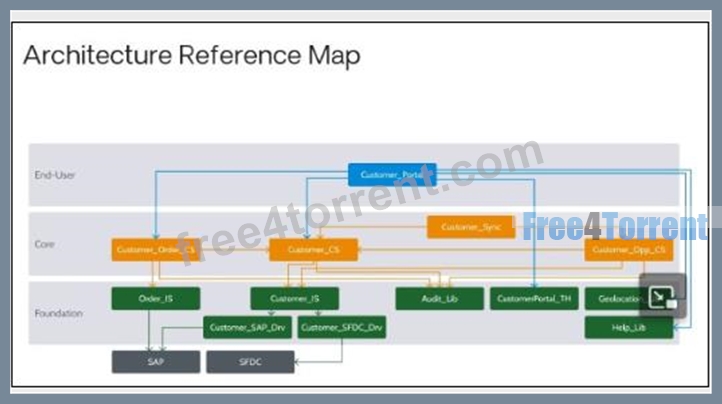
- A. Above is the answer
- B. Is the end result of Architecture Design Process. At this point you should add dependencies between the Modules.
Answer: B
NEW QUESTION # 45
Elements such as the menu and login can be shared across different apps. In the menu and login are defined inside the theme. Which use case is this?
- A. Intranet
- B. Portal
- C. Independent Apps
Answer: B
NEW QUESTION # 46
CS modules is for
- A. Logic to Synchronize data in CS's with an external system. Isolating this logic makes the CS completely system agnostic and it's easier to decouple or replace the external system.
- B. Isolated Business Logic (Actions) or Core Widgets (blocks), to manage complexity, composition or to have its own lifecycle.
- C. Reusable Core Services with public entities, actions, and blocks.
- D. Technical wrapper to expose an API to External consumers, keeping core services system agnostic and supporting multiple versions of the API.
- E. A BL becomes a Calculation Engine if it performs complex calculations, (e.g. an invoice calculation engine or an insurance simulator). Engines are usually subject to versions.
Answer: C
NEW QUESTION # 47
What is a best practice for Mobile Application Architecture: Local Storage?
- A. Use a centralized local storage for all mobile applications to ensure maintainability
- B. Map server side static entities into local entities
- C. Have a local storage inside the CS Module instead of M_CS Module
- D. Do not use local storage(mobile device), instead try to use central storage(server side)
Answer: B
NEW QUESTION # 48
Which of the below is not a best practice for mobile security:authentication?
- A. Authentication : Use google or facebook for online authentication or fingerprint or pin for offline authentication
- B. Store password in local storage
- C. Encrypt (only) sensitive data
Answer: B
NEW QUESTION # 49
In which Architecture Canvas layer do you expect to have a higher reusability rate?
- A. End-User layer
- B. Core layer
- C. Foundation layer
Answer: C
NEW QUESTION # 50
ISO/IEC 25010:2011 adds two more aspect to ISO/IEC 9126:1991. Which of the below is not part of it?
- A. Integration : Integration to allow data exchange with other software
- B. Compatibility : Compatibility was also added as a way to ensure that a piece of software can work together with other systems
- C. Security : Security ensure software solutions can protect information and data
Answer: A
NEW QUESTION # 51
There are generally 4 common style guide scenario. Which of the below is NOT a common style guide scenario?
- A. Clone a Built-in: Use when introducing extensive changes to existing theme. First, CLONE a custom theme from a Base Theme. Second, clone a Custom Template from the Base Template but this custom theme will reference the custom theme created previously. Third, create new applications based on the Custom Theme and Custom Template.Base Theme can be Outsystems UI or your own custom theme.
- B. Since the theme is very basic, front-end developer will have to expand and design the theme from there.
Modify Built-in Style Guide: Use when only small changes are required for single application. First, create a custom theme that REFERENCE the Base Theme. Second, clone a Custom Template from the Base Template but this custom theme will reference the custom theme created previously. Third, reference that application to the custom Theme and Template. - C. Specialize a Built-in: Use when introducing changes to an existing theme for multiple apps. First, create a custom theme that REFERENCE the Base Theme. Second, clone a Custom Template from the Base Template but this custom theme will reference the custom theme created previously. Third, create new applications based on the Custom Theme and Custom Template
- D. Built-in Style Guide: Uses Built-in style guide from Outsystems UI. Minor customizations to the Base Theme should be done inside the App Theme.
C, Build Your Own: Use when custom style guide cannot benefit from any existing theme. Just like Clone a Built In scenario, clone both Custom Theme and Custom Template from the Base Theme and Base Template, however clone the Base Theme from Outsystems UI.
Answer: B
NEW QUESTION # 52
What is NOT a best practice for Mobile Application Architecture: Limit server side calls?
- A. Direct calls is bad from Security, Performance and Maintainability standpoint. Direct calls will require javascript Code and javascript Code is harder to maintain.
- B. Synchronize on every screen or online event for better granularity
No direct calls to backend systems. Do call to Outsystems Core Services and Outsystems will handle the interaction with external backend systems. - C. Limit Server side calls to online transactions or Synchronization. Do the bulk of the operations on the Client Side before passing information to the Server Side.
Answer: B
NEW QUESTION # 53
Which of the below is NOT a disadvantage of having a fragmented system or microservices?
- A. All of the above
- B. Limited data mashup in memory and limited to APIs
- C. Inter-process communication : network latency and hiccups
- D. Security : need to manage credentials and access management
- E. Multiple transactions committed independently
- F. Monitoring & Logging : for effective monitoring & logging, requires centralized service
- G. Complicated Debugging and troubleshooting : root cause may be deep inside the chain of services
- H. Fault tolerance : communication errors, service consistency
Answer: A
NEW QUESTION # 54
Which of the following is NOT a benefit of having well-defined application architecture?
- A. Supports planning
- B. Reduces costs
- C. Reduces risk
- D. Poor service abstraction
Answer: D
NEW QUESTION # 55
_CW module is for
- A. Core Widgets (blocks), to manage complexity, composition or to have its own lifecycle.
- B. Reusable Core Services with public entities, actions, and blocks.
- C. Logic to Synchronize data in CS's with an external system. Isolating this logic makes the CS completely system agnostic and it's easier to decouple or replace the external system.
- D. Technical wrapper to expose an API to External consumers, keeping core services system agnostic and supporting multiple versions of the API.
- E. A BL becomes a Calculation Engine if it performs complex calculations, (e.g. an invoice calculation engine or an insurance simulator). Engines are usually subject to versions.
Answer: A
NEW QUESTION # 56
......
Architecture-Specialist-11 Exam Brain Dumps - Study Notes and Theory: https://validdumps.free4torrent.com/Architecture-Specialist-11-valid-dumps-torrent.html