

Dec-2025 Realistic HPE7-A07 Accurate & Verified Answers As Experienced in the Actual Test!
Latest HP HPE7-A07 Practice Test Questions, Aruba Certified Campus Access Mobility Expert Written Exam Exam Dumps
HP HPE7-A07 Exam Syllabus Topics:
| Topic | Details |
|---|---|
| Topic 1 |
|
| Topic 2 |
|
| Topic 3 |
|
| Topic 4 |
|
| Topic 5 |
|
| Topic 6 |
|
NEW QUESTION # 14
You configured a tunneled SSID with captive portal and a ClearPass Guest Self Registration workflow when testing and launching the self-registration workflow, after successful registration, the login action shows the following error: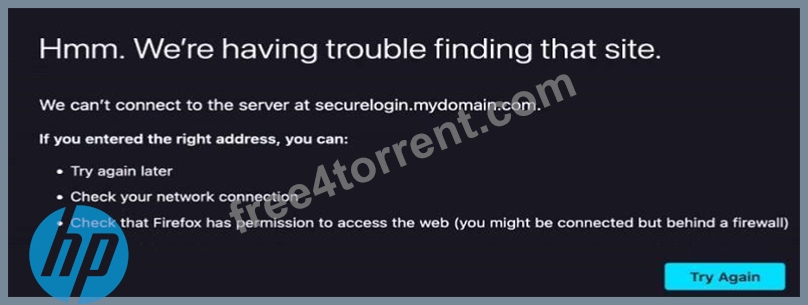
What is the best solution to resolve this error?
- A. You need to include the root and intermediate certificates in the captive portal certificate for your access points
- B. You need to De connected to the guest SSiD while testing.
- C. You need to include the root and intermediate certificates in the captive portal certificate for your gateway
- D. You need to change the Login Address in ClearPass to securelogin arubanetworKs.com
Answer: C
Explanation:
Including the root and intermediate certificates in the captive portal certificate for the gateway will resolve the error seen during the login action after successful registration. This is necessary to ensure the SSL/TLS handshake can be completed successfully, as the client browser needs to validate the entire certificate chain.
NEW QUESTION # 15
An ACME company employee complained about a recent poor-quality VoIP call while moving aroundtheir office environment HPE Aruba Networking Central reported a fair UCC score for this callwhile your VoIP engineer reported that their systems reported a MOS of 2,3. The VoIP devices are operatingover the 5GHz frequency band.
What are the possible contributing factors? (Select two.)
- A. The client roamed into an area that continuously operates Zigbee.
- B. 802.tr is enabled in the WLAN Security settings.
- C. Coverage AP deployment plans generally don't support enough cell overlap for VoIP.
- D. There was localized interference at the caller's location
- E. 802.1K is disabled in the WLAN Security settings
Answer: A,C
Explanation:
VoIP quality can be negatively impacted by insufficient cell overlap in AP deployment plans, which can cause poor handoffs between APs as a user moves around. This results in a degraded VoIP experience. Additionally, roaming into an area with continuous Zigbee operation can cause interference with the 5GHz frequency band, further contributing to poor VoIP call quality. The Zigbee communication protocol operates on the same frequency band as Wi-Fi and can introduce noise and interference, which leads to a reduced MOS score, as reported by the VoIP engineer.
NEW QUESTION # 16
What directly affects the MCS used by wireless stations? (Select two.)
- A. SNR
- B. frequency band
- C. number of connected clients
- D. channel utilization
- E. retry rate
Answer: A,B
Explanation:
The Modulation and Coding Scheme (MCS) used by wireless stations is directly affected by the signal-to-noise ratio (SNR) and the frequency band. Higher SNR can lead to higher MCS values, which means better data rates. The frequency band can affect MCS due to different channel characteristics, such as the presence of interference and propagation properties, which are factors in determining data rates.
NEW QUESTION # 17
What is me recommended configuration to ensure link aggregation is consistent in a campus topology using VSX with two aggregation switches and downlinks to access switches?
- A. Use the command "vsx-sync mclag-interfaces" under the VSX context.
- B. Use a custom LACP hash algorithm for improved load Balancing.
- C. Use the command "vsx-sync active-gateways" under the VSX context.
- D. Keep the MTU values at the default setting for GRE and VXLAN communications
Answer: A
Explanation:
When configuring Virtual Switching Extension (VSX) in a campus topology for link aggregation across two aggregation switches, it is important to synchronize Multi-Chassis Link Aggregation Group (MC-LAG) interfaces. The command "vsx-sync mclag-interfaces" ensures that the state and configuration of MC-LAG interfaces are synchronized between the two VSX-linked switches,providing consistent link aggregation and preventing any loops or mismatched configurations that might occur if the interfaces were not in sync.
NEW QUESTION # 18
A customer is planning to add loT devices that connect wirelessly to the existing 802.1X SSlD. The customer will use ClearPass to authenticate the IoT devices by MAC address but other devices will still need to authenticate by only 802 1X Exhibit.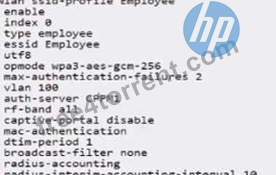
The customer provided the current configuration and reported their non-loT 802. IX devices are no longer able to connect. Which configuration change can be made to fix the issue?
- A. Remove mac-authentication from the WLAN configuration
- B. Modify opmode wpa3-aes-gcm-256 to opmode wpa2-aes
- C. Add i2-autn-fairtnrougn to the WLAN configuration
- D. Modify max-authentication failures to 0.
Answer: A
Explanation:
The existing configuration for the WLAN ssid-profile has enabled MAC authentication which, while suitable for IoT devices that may not support 802.1X, can interfere with the normal 802.1X authentication process for other devices. By removing themac-authenticationdirective from the WLAN configuration, the non-IoT
802.1X devices should be able to connect without issues as the authentication process will not be disrupted by MAC authentication checks. This adjustment ensures that the WLAN ssid-profile is correctly aligned with the authentication requirements for both IoT and non-IoT devices within the network environment, conforming to the best practices for mixed-device WLAN configurations.
NEW QUESTION # 19
You are testing the use of the automated port-access role configuration process using RadSec authentication over VXLAN. During your testing you observed that the RadSec connection will fan during the digital certificate exchange What would be the cause of this Issue?
- A. Tracking mode was set to "dead-only", and the RadSec server was marked as unreachable.
- B. The RADIUS TCP packets are Being dropped and the TLS tunnel is not established.
- C. The RadSec server was defined on the switch using an IPv6 address that was unreachable
- D. The switch is configured to establish a TLS connection with a proxy server, not the radius server.
Answer: B
Explanation:
During the testing of RadSec authentication over VXLAN, if the RadSec connection fails during the digital certificate exchange, it typically indicates an issue with the establishment of the TLS tunnel, which is required for RadSec's secure communication. The failure of TLS tunnel establishment can occur due to RADIUS TCP packets being dropped, preventing the secure exchange of digital certificates necessary for RadSec authentication. The other options, such as IPv6 address reachability, tracking mode settings, and proxy server misconfiguration, are not directly related to the failure of the TLS tunnel establishment during the certificate exchange process
NEW QUESTION # 20
The wireless administrator for a college campus is gelling reports of connectivity issues when students are working outdoors.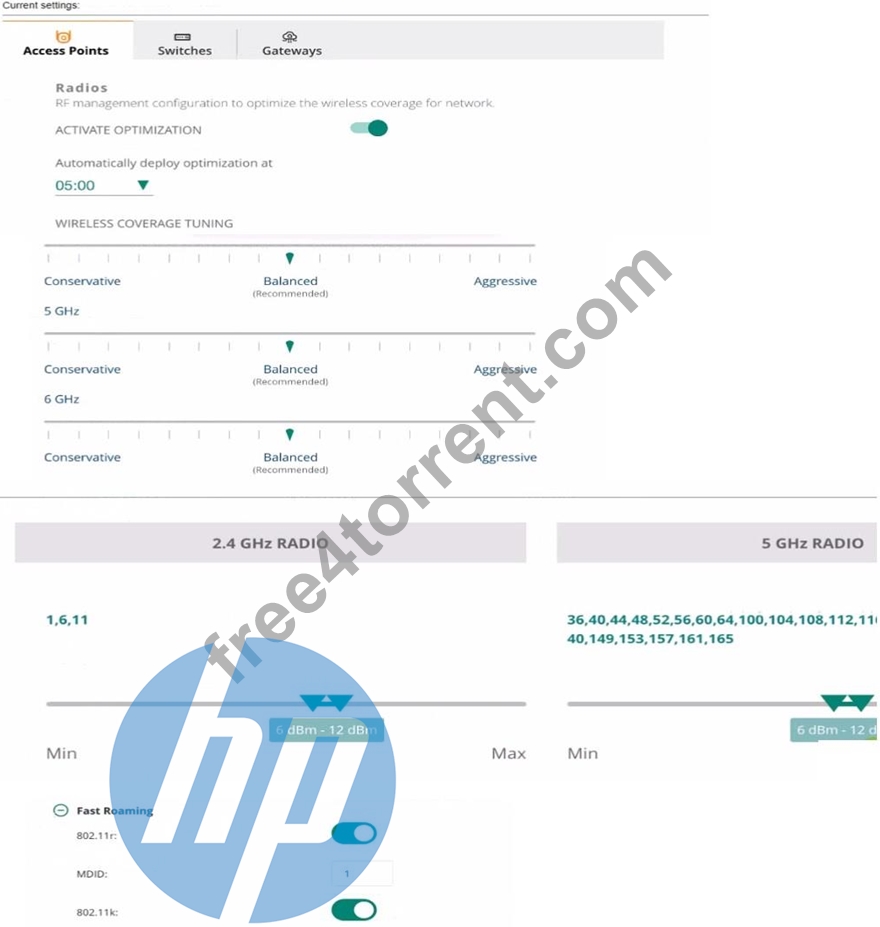
Reviewing the settings above, watch change is needed to align with best practices?
- A. Disable 802 11k.
- B. increase 5Gnz TX power range Min/Max.
- C. increase 5 GHz wireless coverage tuning to Aggressive.
- D. Disable 802 11r.
Answer: B
Explanation:
To address connectivity issues when students are working outdoors, increasing the transmission (TX) power range for the 5GHz radios can help improve signal strength and coverage. The setting shown indicates a conservative approach to power settings, which might not provide sufficient coverage for outdoor areas. By increasing the power range, you can extend the wireless signal reach, which aligns with best practices for outdoor wireless coverage.
NEW QUESTION # 21
A customer is deploying a new warehouse with AP-634 APs inthe unitedStates with mobile devices that can operate in the 6GHz spectrum All testing and RF analyses were performed during the POC using AP-635 APs In a different location During the deployment, they noticed fewer 6GHz channels were broadcasting in the air.
Why would the AP-634 deployment have a lesser amount of broadcasting channels?
- A. The AP-634 AP's persona was configured in the Central group as Standard Power.
- B. The AP-634 APs do not have an advanced subscription.
- C. The AP-634 APs cannot broadcast an 6Gnz channels due to regulatory restrictions.
- D. The AP-635 APs received different allowable 6GHz channels from the AFC service versus the AP-634 APs due to the POC running in a different location.
Answer: D
Explanation:
In the United States, the operation in the 6GHz band for Wi-Fi devices such as the AP-634 and AP-635 is regulated by the Automated Frequency Coordination (AFC) system, which determines the channels that can be used based on the location. Since the Proof of Concept (POC) was conducted in a different location using AP-635 APs, the allowable channels identified by the AFC service for that location would be different than the channels allowed for the actual deployment location of the AP-634 APs. This would result in a different set of broadcasting channels being available for use in the new warehouse deployment.
NEW QUESTION # 22
A customer's infrastructure is set up to use both primary and secondary gateway clusters on the SSID profile cased on best practices. Why do they have an equal split of their 120 APs across the primary and secondary gateway clusters?
- A. The secondary gateway cluster is a homogeneous cluster with six nodes.
- B. The primary gateway cluster is a heterogeneous cluster with six nodes.
- C. The primary and secondary gateway clusters are up. but the cluster preemption Is not enabled
- D. The primary and secondary gateway clusters are up. and the cluster preemption is enabled
Answer: C
Explanation:
When cluster preemption is not enabled, access points (APs) will not automatically fail back to the primary gateway cluster once it is up again after having failed over to the secondary. This would result in an equal split of APs across primary and secondary clusters if both clusters are operational. Without preemption, there's no automatic rebalancing of APs back to the primary cluster, leading to the current distribution.
NEW QUESTION # 23
Exhibit.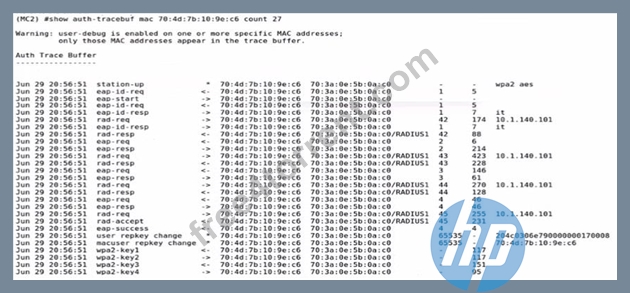
Which wireless connection phase has Just been completed?
- A. L2 authentication and encryption
- B. 802.11 enhanced open association
- C. L3 authentication and encryption
- D. MAC Authentication and 4-way handshake
Answer: A
Explanation:
The wireless connection phase that has just been completed is L2 authentication and encryption. This phase includes processes such as the Extensible Authentication Protocol (EAP) exchange, RADIUS requests and responses, and the 4-way handshake which is characteristic of WPA2-AES encryption.
NEW QUESTION # 24
A BGP routing tablecontains multiple routes to the same destination prefix.
Referring to the table below whichroutewould be marked with a ">" symbol?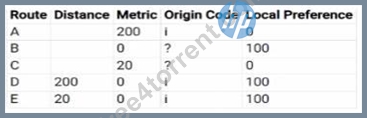
- A. Option D
- B. Option C
- C. Option B
- D. Option A
- E. Option E
Answer: E
Explanation:
In BGP, the route marked with a ">" symbol is the best route that is chosen based on BGP attributes in the following order: highest weight (Cisco-specific), highest local preference, originated by BGP running on the local router, shortest AS path, lowest origin type, lowest MED, eBGP over iBGP, closest IGP neighbor, and lowest BGP router ID. Based on the table provided, Option E would be marked with a ">" symbol as it has the highest local preference of 100 which is a decisive factor in the BGP best path selection process.
NEW QUESTION # 25
A customer is running out of IP addresses in a network segment. What will happen If they add an additional IPsubnet to the same VLAN?
- A. This would result in a single SVI using two subinterfaces.
- B. IGMP will not work in both of the subnets in the same VLAN
- C. Broadcasts for me two subnets win arrive on all ports in the same VLAN
- D. Users can reach each other and establish PTP traffic without passing an L3 point in the same VLAN
Answer: D
Explanation:
Adding an additional IP subnet to the same VLAN means that devices configured with either subnet can communicate at Layer 2 without the need for routing. This is because they are on the same VLAN and thus in the same broadcast domain. However, to communicate between subnets, an L3 device or inter-VLAN routing would be required.
NEW QUESTION # 26
Exhibit.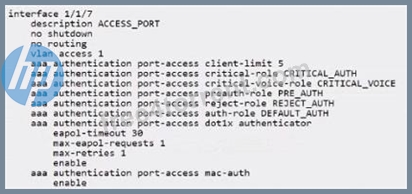
Which user role will be assigned when a voice client tries to connect for the first time, but the RADIUS server is unavailable?
- A. CRITICAl_AUTH
- B. DEFAULT_AUTH
- C. PRE_AUTH
- D. CRIT1CAL_V0ICE
Answer: D
Explanation:
In the provided configuration for interface 1/1/7, there are roles specified for different scenarios concerning authentication. When a voice client attempts to connect and the RADIUS server is unreachable, the role that is assigned is the one specified as the "critical-voice-role". In this case, the "CRITICAL_VOICE" role is configured to be assigned under such circumstances, ensuring that voice clients receive appropriate network access permissions even when the RADIUS server is not available to authenticate them.
NEW QUESTION # 27
Exhibit.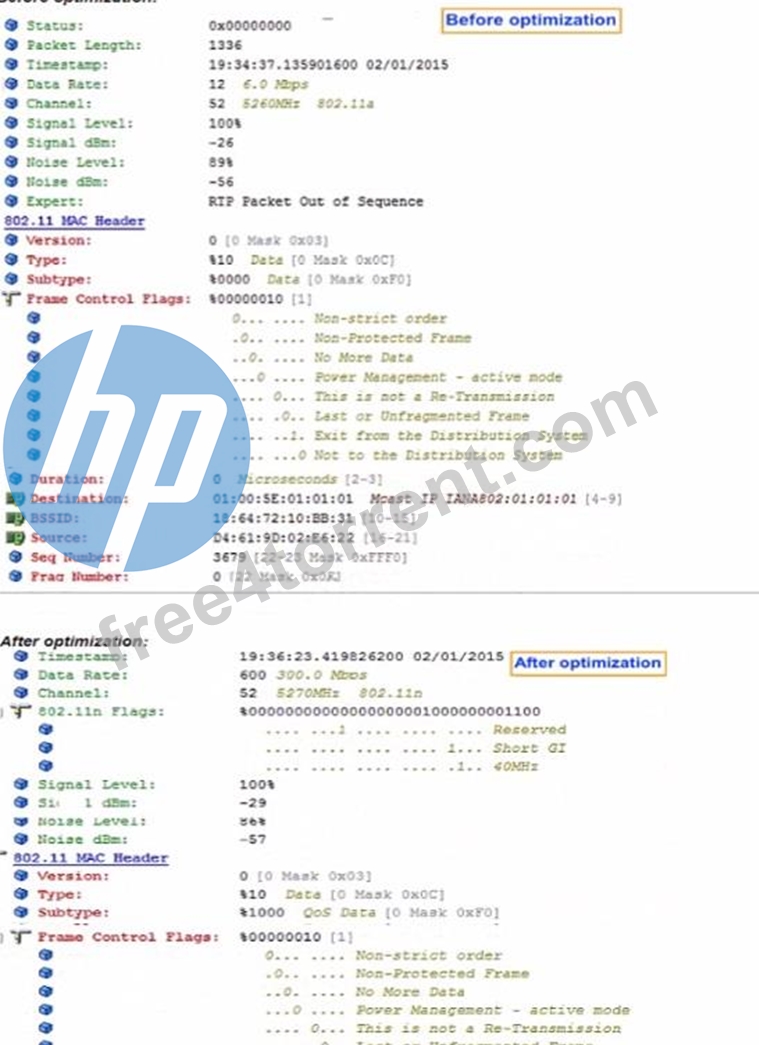
A network administrator attempts to improve multicast traffic flow and performs some packet captures for validation What can the network administrator conclude from the results?
- A. The type flew remains consistent because Dynamic Multicast Optimization (DMO) was configured.
- B. The data rate increased from 6 Mbps to 300 Mops because Dynamic Multicast Optimization (DMO) was configured.
- C. The capture taken after optimization does not show a packet length because Multicast Transmission Optimization was configured.
- D. The data rate increased from 6 Mops to 300 Mops because Broadcast Multicast optimization (BCMCO) was configured.
Answer: B
Explanation:
Dynamic Multicast Optimization (DMO) is a feature that enhances the delivery of multicast traffic by optimizing the data rate. The before and after optimization images show a significant increase in the data rate, which is a typical result of DMO being configured, as it allows multicast traffic to be transmitted at higher data rates by converting multicast streams into unicast streams for the clients that need them.
NEW QUESTION # 28
Based on best practices if an SSID is configured Tor a primary and secondary gateway cluster with cluster preemption enabled, which will decide if the APs move to the secondary gateway cluster if all of the nodes in the primary gateway cluster are down?
- A. tunnel orchestrator for LAN tunnel service in HPE Aruba Networking Central
- B. cluster leader in the primary gateway cluster
- C. every AP individually
- D. cluster leader in the secondary gateway cluster
Answer: C
Explanation:
In an Aruba network, if an SSID is configured for a primary and secondary gateway cluster with cluster preemption enabled, each AP individually will decide to move to the secondary gateway cluster if all of the nodes in the primary gateway cluster are down. This decentralized decision-making process enhances network resilience and ensures uninterrupted service for clients connected to the APs.
NEW QUESTION # 29
Your customer's employees connected to a wired network are complaining about a poor user experience. The customer has UXI sensors deployed on their premises. These sensors nave been running for multiple months.
They are testing both the wired network (using the wired Interface of each sensor) and the wireless networks.
Your customer used the UXI dashboard to find the reason for the poor userexperience to find more details, the customer asked you to check the packet captures that have been downloaded from the sensors using the UXI dashboard.
From the zip file downloaded from the UXI sensors, you checked the "datagrams" .pcap file, but you were not able to find any issues How can you explain this?
- A. The datagrams captured on the physical Ethernet interface are in a different .pcap file.
- B. The UXI sensor could not upload the latest test results to the cloud, so the packet capture is outdated
- C. The default filers of the packet captures do not allow tailed tests to be captured by the sensor
- D. The "datagrams- pcap file only contains me successful tests Failed tests are contained in the
"datagrams-failed" .pcap file
Answer: D
Explanation:
It is a common practice to separate successful and failed test results into different files for ease of troubleshooting. If the "datagrams.pcap" file shows no issues, it's likely because it only contains successful test data, and the failed tests that could explain the poor user experience would be in a different file, such as
"datagrams-failed.pcap."
NEW QUESTION # 30
Your customer added third-party USB dongles to the USB ports of their AOS 10 access points. The customer uses AP-615 and AP-635 Each AP is connected with a Cat 6A cable to a CX 6300F Class 4 PoE switch All APs are in the same group in HPE Aruba Networking Central and share the same configuration However, many of the dongles do not come up.
Which option will solve this issue?
- A. Perform a "poe disable" followed by a "poe enable" for the switch ports which connect to the APs so that the APs reboot.
- B. Move the AP-635 access points to a different group in Central to configure the dongles separately from the AP-615.
- C. Create two separate service profiles in the loT tab of the Central configuration settings.
- D. Replace the Class a PoE switches with Class 6 PoE switches.
Answer: D
Explanation:
USB dongles often require additional power, which may exceed the power delivery capabilities of Class 4 PoE switches. Aruba AP-615 and AP-635 are designed to work with USB dongles that require additional power for proper operation. Since the Cat 6A cable can support higher power levels, replacing the Class 4 PoE switches with Class 6 PoE switches, which can deliver higher power, should resolve the issue with the dongles not powering up.
NEW QUESTION # 31
An administrator is creating a fabric withNetConductor in HPE Aruba Networking Central Considering an EVPN VXLAN fabric, click on the most appropriate layer to be configured as a Rome-Reflector Persona.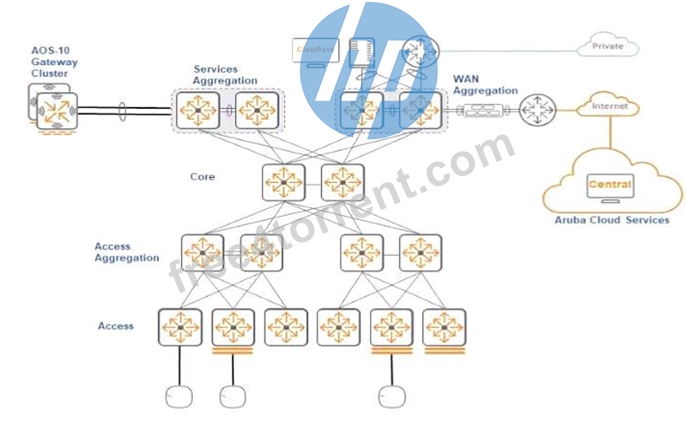
Answer:
Explanation: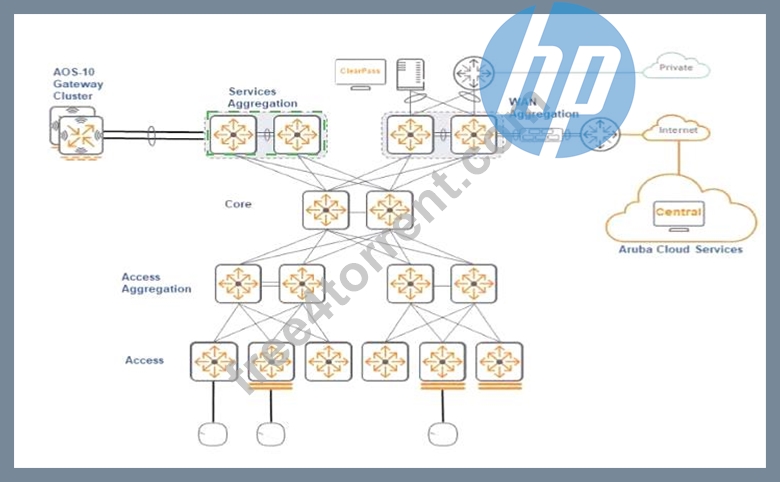
Explanation:
In the context of an EVPN VXLAN fabric, the Route-Reflector Persona is most appropriately configured at theServices Aggregationlayer. This layer is responsible for interconnecting different network services and typically includes more robust, higher-capacity devices capable of handling the route-reflection functions for EVPN VXLAN.
In an Aruba Networks fabric, route reflectors are used to optimize the distribution of BGP routes. The Services Aggregation layer, which is centrally located in the network topology, is best suited for this role due to its high availability and ability to efficiently manage routes between the core and access layers.
Therefore, if you were to click on the image provided, you would select the Services Aggregation layer to configure the Route-Reflector Persona.
NEW QUESTION # 32
A Windows device attempts to connect to an 802.1X network but it is not receiving the correct role. TEAP has been configured asthe only authentication method in ClearPass.The wireless configuration is correct.
Exhibit.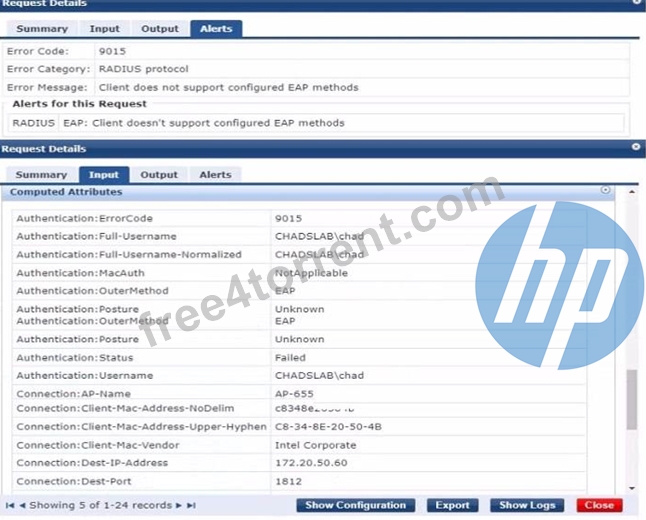
What is me mostlikelycause?
- A. Only machine authentication should be configured on the Windows device
- B. 802.1X is not compatible with TEAP in windows device
- C. ClearPass requires a second authentication method.
- D. The Windows device needs 10 De configured tor TEAP.
Answer: D
Explanation:
The issue likely stems from the Windows device not being configured to use TEAP (Tunneled Extensible Authentication Protocol) as specified in the ClearPass configuration. TEAP is an EAP method that encapsulates an inner EAP method for secure authentication. The Windows device must have TEAP enabled and correctly configured in its network settings to authenticate successfully on the network using ClearPass.
NEW QUESTION # 33
A customer would like to allow their IT Helpdesk to configure loT devices to connect lo a single SSID using a unique PSK that other devices cannot use. Which solution would you recommend?
- A. MPSK AES with ClearPass
- B. MPSK AES with Cloud Auth
- C. MPSK Local
- D. MPSK AES with MAC Auth
Answer: A
Explanation:
Multi-Pre-Shared Key (MPSK) with ClearPass is the recommended solution for a scenario where the IT Helpdesk needs to configure IoT devices to connect to a single SSID using unique PSKs. MPSK allows for the use of different PSKs on the same SSID, and ClearPass enables the management of these unique keys efficiently.
NEW QUESTION # 34
The ACME company has an AOS-CX 6200 VSF switch slack with an uplink over subscription ratio of 9.6:1.
They have indicated that their low-priority TCP traffic has been flagged with a DSCP marking coloring them yellow.
Refer to the exhibit.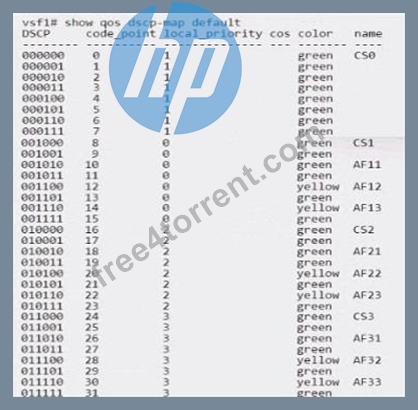
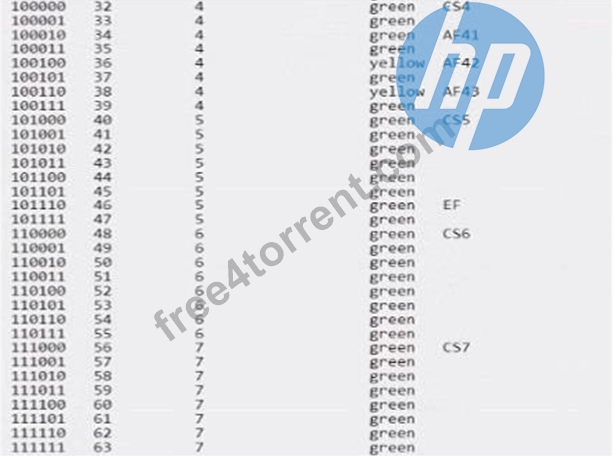
They are considering adding two more nodes to thestack without adding any additional uplinks due to existing wiring constraints.One of their architects has suggested adding the following configuration:
What would be the impact of applying the acmethreshold profile as shown? (Select two.)
- A. Yellow-flagged TCP traffic egressing LAG1 will be subject to drop probability
- B. All TCP traffic egressing LAG1 wail be subject to drop probability
- C. All upper-layer protocol traffic egressing LAG1 will be subject to drop probability.
- D. Only VoIP packets egressing queue 5 on LAG1 will likely be protected from uplink over-utilization.
- E. VoIP packets egressing any queue on LAG1 will more likely be protected from uplink over-utilization
Answer: A,C
Explanation:
Applying the 'acmethreshold' profile as shown in the exhibit would set a minimum and maximum threshold for queue 0, which affects the drop probability for traffic that exceeds these thresholds. The yellow marking indicates a medium drop precedence, so yellow-flagged traffic would be more likely to be dropped when congestion occurs, and the uplink is over-utilized. This action is intended to protect higher-priority traffic, such as VoIP, by giving it a lower probability of being dropped.
NEW QUESTION # 35
A university owns a campus with several buildings segmented into east and west wings, which are L3 separated. The east wing has 1600 APs. and the west wing has 1200 Aps. Each wing has a single gateway cluster managed by HPE Aruba Networking Central. Each cluster contains one 7210 mobility gateway The gateways are configured with DHCP relay and route all client VLANs. A new business-critical facultyreal-time application requires users to roam within wings but not across wings without disconnections or delay increments.
Which changes must the network administrator make lo successfully meet the requirement without performance degradation matching best practices? (Select two.)
- A. Replace me 7210 mobility gateway in the east wing with a pair or 9012 mobility gateways
- B. Replace the 7210 mobility gateway in the west wing with a pair of 7030 mobility gateways.
- C. Run L2 for all SSIDs and permit the users' VLANs in the gateway's uplinks.
- D. Remove the DHCP relay from the gateways and enable the DHCP server instead
- E. Add a single 7210 mobility gateway to each cluster.
Answer: C,E
Explanation:
To support a business-critical faculty real-time application that requires seamless roaming within wings without cross-wing roaming, it's essential to ensure high availability and sufficient capacity. Adding an additional 7210 mobility gateway to each cluster would provide the required redundancy and capacity.
Running L2 for all SSIDs and permitting user VLANs on gateway uplinks would facilitate the necessary traffic flow without L3 segmentation issues, thus supporting seamless roaming within each wing.
NEW QUESTION # 36
in a WLAN network with a tunneled SSID. you see the following events in HPE Aruba Networking Central: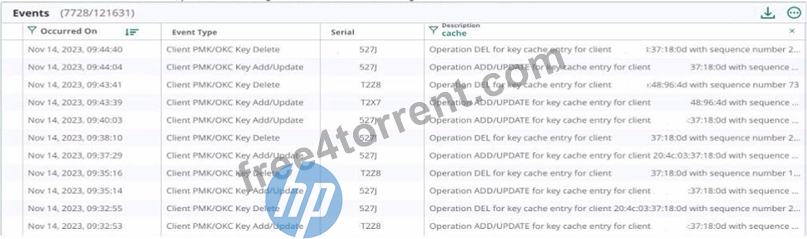
The customer asks you to investigate log messages What should you tell them?
- A. This indicates a security issue. The client with a MAC address ending with 37 18;0d Is performing a Denial-of-Service attack on your network. You should track down the client and remove it from the network.
- B. There is a roaming issue Enable Fast Roaming 802.11r and OKC to resolve the issue.
- C. This is normal, expected behavior. No further actions are needed.
- D. This indicates a client WLAN driver issue for the client with a MAC address ending with 37:18
:Od. You should upgrade the client WLAN driver.
Answer: C
Explanation:
The event log showing PMK (Pairwise Master Key) and OKC (Opportunistic Key Caching) key add/update and delete operations is indicative of normal client behavior in a WLAN environment. These events are part of the standard process for maintaining client session security and do not necessarily indicate any issue.
NEW QUESTION # 37
A network technician racked up two 9240 mobility gateways in a single cluster that will be terminating 1700 APs in a medium-sized branch office Next, the technician cabled the gateways with two SFP28 Direct Attach Copper (DAC) cables, distributed between a two-member core switching stack and powered them up.
What must the network administrator do next regarding the gateway configuration to ensure maximum wired bandwidth utilization?
- A. Map two physical ports to a port channel on each gateway.
- B. Manually set 25Gbps speeds on all ports.
- C. Make an ports trunk interfaces and permit data VLANs
- D. Disable the spanning tree and allocate unique VLANs to each port.
Answer: A
Explanation:
To maximize wired bandwidth utilization, especially when multiple APs are terminating on mobility gateways, it's best practice to aggregate physical ports into a port channel. This provides redundancy and increased bandwidth by combining the throughput of multiple ports.
NEW QUESTION # 38
You are deploying a new AOS 10 mobility gateway cluster. Due to customer requirements, the gateways must be configured with static IP addresses and are restricted from communicating using port 443 to any URLs except tor "central arubanetworks.com How would you onboard these gateways successfully into HPE Aruba Networking Central?
- A.
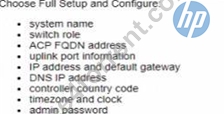
- B.
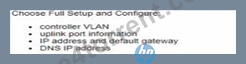
- C.
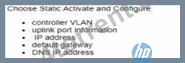
- D.
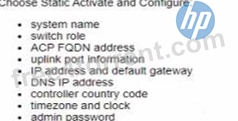
Answer: A
Explanation:
Option A includes all necessary steps for a full setup of an AOS 10 mobility gateway cluster, including setting the system name, switch role, ACP FQDN address, uplink port information, IP address and default gateway, DNS IP address, controller country code, timezone and clock, andadmin password. Since the gateways must have static IP addresses and can only communicate on port 443 for a specific URL, this configuration would need to allow for static IP configuration and restrict communication to the required URL.
NEW QUESTION # 39
......
Free HPE7-A07 Exam Files Downloaded Instantly 100% Dumps & Practice Exam: https://validdumps.free4torrent.com/HPE7-A07-valid-dumps-torrent.html