

[Mar 14, 2022] New Updated CKA Exam Questions 2022
Updated Free Linux Foundation CKA Test Engine Questions with 63 Q&As
CNCF CKA Certification Exam Experience
The one thing I have been constantly aware of after getting my certification is how much I have been able to help out with the company. Prior to getting the certification, all I used to do was oversee projects and do work in a design capacity, but now that I have this certification, people constantly come to me for help with problems they are having. The interactive exam is available online. Delivery will be done within six weeks of the exam. Absolutely no writing is done during the CNCF CKA Certification Exam.
After going through what you have to go through in order to get your certification, it is no wonder why there are so many people out there that are willing to pay for your services. Studied from a reliable source will help you get the CNCF CKA Certification Exam. Suggested by your colleagues will help you get the CNCF CKA Certification Exam. CNCF CKA exam dumps will help you get the CNCF CKA Certification Exam. Many IT professionals will opt for this certification. This certification is recognized worldwide. A lot of companies offer this certification. The cost of getting this certification is affordable compared to the benefits of having it. Core skills such as Chef and Kubernetes will help you get the CNCF CKA Certification Exam. Persistent will help you get the CNCF CKA Certification Exam. The CNCF Certified Kubernetes Administrator exam is only available in English. Tools such as Docker and OpenShift will help you get the CNCF CKA Certification Exam. Consistent knowledge of Kubernetes, chef, and docker will help you get the CNCF CKA Certification Exam. Nodes will help you get the CNCF CKA Certification Exam. Users should pay attention to the fact that they should choose a platform that can be accessed from various devices. Infrastructure experts will help you get the CNCF CKA Certification Exam.
How to Register the CNCF CKA Certification Exam
Registration:
- You will need your examination confirmation within 48 hours of the exam date and time.
- After registration, you will receive a confirmation email with instructions on how to complete your exam registration.
- Please click “Register” and follow the instructions on-screen to sign up for your preferred exam date and time. To register for the CKA exam, go to CNCF Website.
- CNCF Certification Exams is an online exam. You must take an official CNCF Certification exam to receive a certificate after the examination.
The Need for CNCF CKA Certification Exam
The CNCF Certified Kubernetes Administrator exam is designed to test the knowledge of candidates on deploying, managing, and troubleshooting applications on Kubernetes clusters. Answers to the CNCF Certified Kubernetes Administrator exam questions can be found in the official study guide. Real world experience and hands-on configuration and troubleshooting is critical to passing any certification exam. Real world experience will put candidates in good stead for the CNCF Certified Kubernetes Administrator exam. Download the study guide and start studying for the exam. CNCF CKA exam dumps can be accessed from certain test providers. The CNCF CKA exam dumps will provide the candidate with the knowledge to pass the exam. Application of knowledge from the study guide to real life configuration will help candidates pass the CNCF Certified Kubernetes Administrator exam. Updates on the official definition of each question will be available on the Brightwork website. Understanding questions on Kubernetes in the CNCF Certified Kubernetes Administrator exam is subject to change. Understanding real-world configuration and troubleshooting is central to passing the CNCF Certified Kubernetes Administrator exam.
NEW QUESTION 36
Add a taint to node "worker-2" with effect as "NoSchedule" and
list the node with taint effect as "NoSchedule"
- A. // Add taint to node "worker-2"
kubectl taint nodes worker-2 key=value:NoSchedule
.items[*]}{.metadata.name} {.spec.taints[?(
@.effect=='NoSchedule' )].effect}{\"\n\"}{end}" | awk 'NF==2
{print $0}' - B. // Add taint to node "worker-2"
kubectl taint nodes worker-2 key=value:NoSchedule
// Verify
// Using "custom-coloumns" , you can customize which coloumn to
be printed
kubectl get nodes -o customcolumns=NAME:.metadata.name,TAINTS:.spec.taints --no-headers
// Using jsonpath
kubectl get nodes -o jsonpath="{range
.items[*]}{.metadata.name} {.spec.taints[?(
@.effect=='NoSchedule' )].effect}{\"\n\"}{end}" | awk 'NF==2
{print $0}'
Answer: B
NEW QUESTION 37
Get list of all the pods showing name and namespace with a jsonpath expression.
Answer:
Explanation:
kubectl get pods -o=jsonpath="{.items[*]['metadata.name' , 'metadata.namespace']}"
NEW QUESTION 38
Create a nginx pod with label env=test in engineering namespace
See the solution below.
- A. kubectl run nginx --image=nginx --restart=Never --labels=env=test --namespace=engineering --dry-run -o yaml > nginx-pod.yaml kubectl run nginx --image=nginx --restart=Never --labels=env=test --namespace=engineering --dry-run -o yaml | kubectl create -n engineering -f - YAML File:
apiVersion: v1
kind: Pod
metadata:
name: nginx
namespace: engineering
labels:
env: test
spec:
containers:
- name: nginx
image: nginx
imagePullPolicy: IfNotPresent
restartPolicy: Never
kubectl create -f nginx-pod.yaml - B. kubectl run nginx --image=nginx --restart=Never --labels=env=test --namespace=engineering --dry-run -o yaml > nginx-pod.yaml kubectl run nginx --image=nginx --restart=Never --labels=env=test --namespace=engineering --dry-run -o yaml | kubectl create -n engineering -f - YAML File:
apiVersion: v1
kind: Pod
metadata:
name: nginx
namespace: engineering
labels:
env: test
spec:
containers:
- name: nginx
image: nginx
imagePullPolicy: IfNotPresent
restartPolicy: Never
kubectl create -f nginx-pod.yaml
Answer: B
NEW QUESTION 39
Score: 5%
Task
Monitor the logs of pod bar and:
* Extract log lines corresponding to error
* Write them to /opt/KUTR00101/bar
Answer:
Explanation:
See the solution below.
Explanation
Solution:
kubectl logs bar | grep 'unable-to-access-website' > /opt/KUTR00101/bar cat /opt/KUTR00101/bar
NEW QUESTION 40
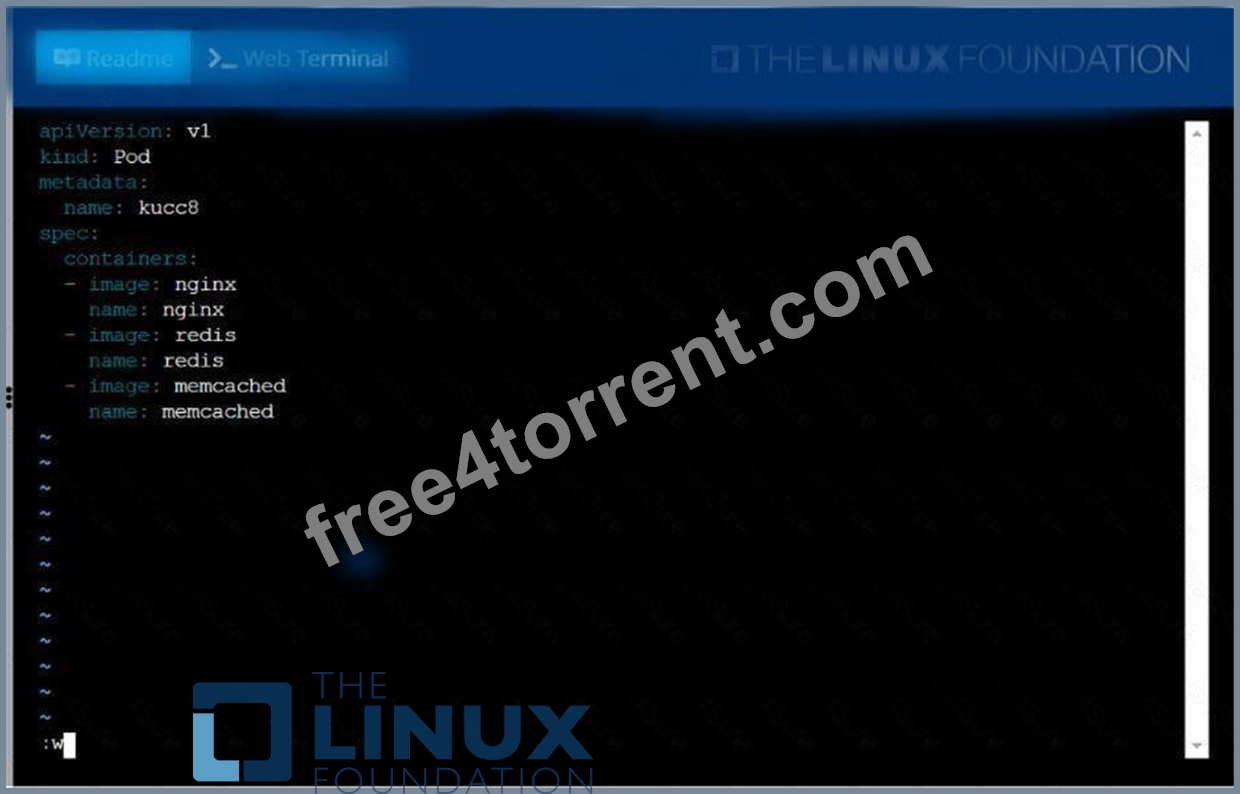
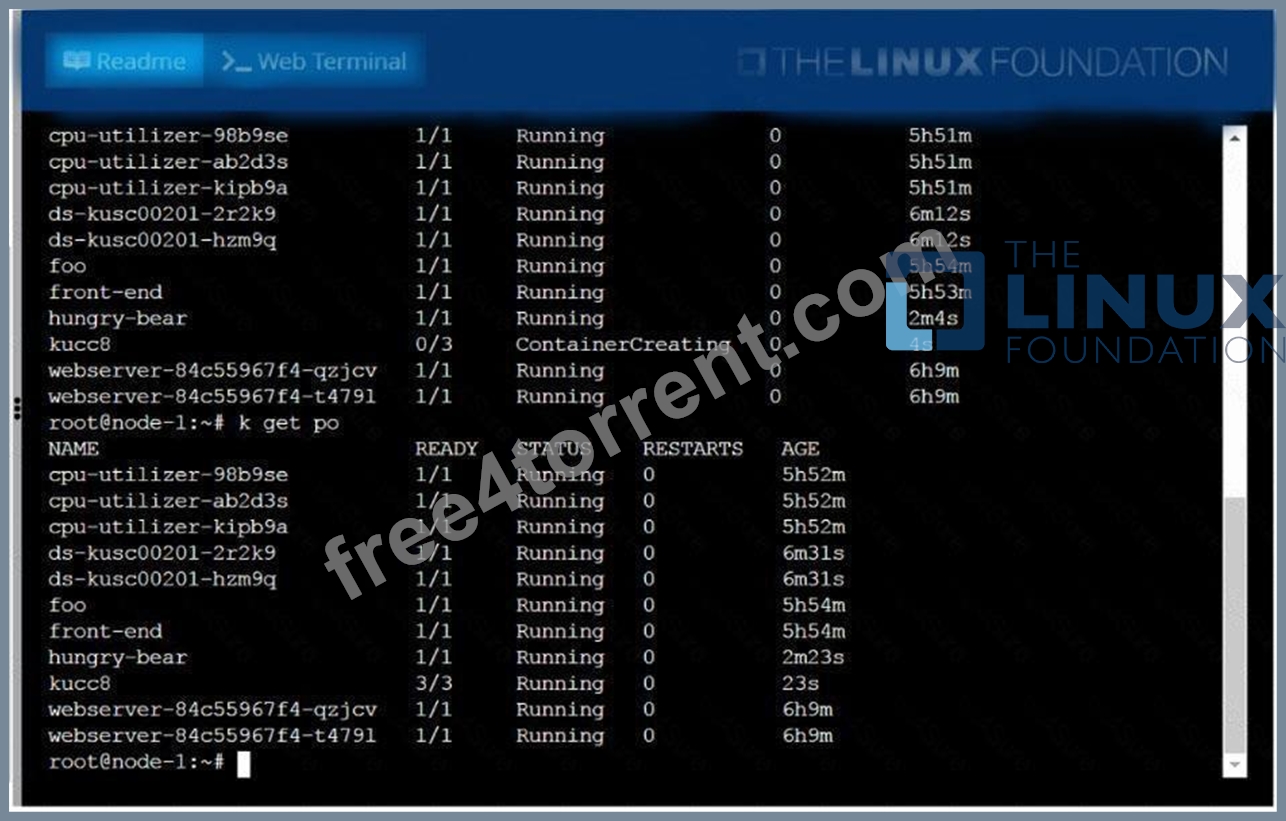
Create a pod namedkucc8with asingle app container for each of the
following images running inside(there may be between 1 and 4images specified):
nginx + redis + memcached.
Answer:
Explanation:
See the solution below.
Explanation
solution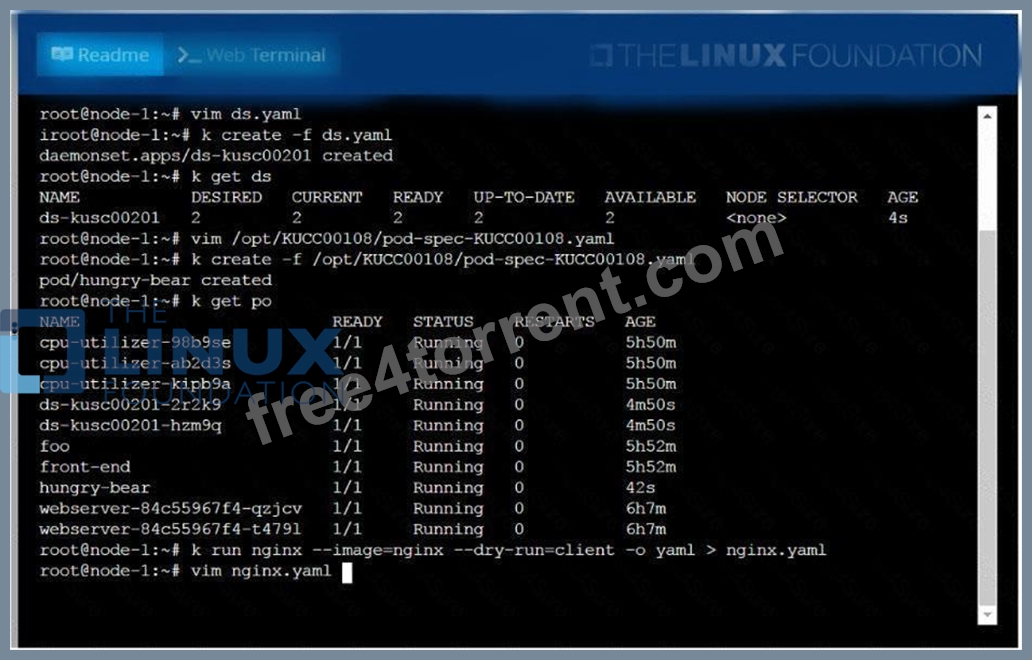
NEW QUESTION 41
Score: 7%
Task
First, create a snapshot of the existing etcd instance running at https://127.0.0.1:2379, saving the snapshot to
/srv/data/etcd-snapshot.db.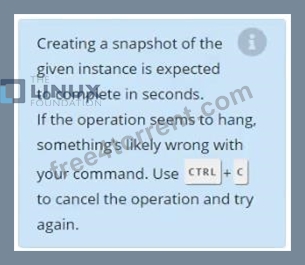
Next, restore an existing, previous snapshot located at /var/lib/backup/etcd-snapshot-previo us.db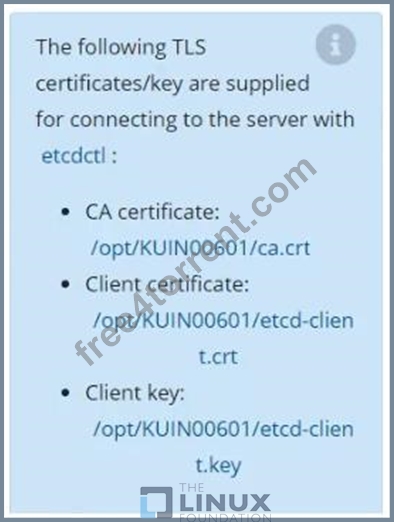
Answer:
Explanation:
See the solution below.
Explanation
Solution:
#backup
ETCDCTL_API=3 etcdctl --endpoints="https://127.0.0.1:2379" --cacert=/opt/KUIN000601/ca.crt
--cert=/opt/KUIN000601/etcd-client.crt --key=/opt/KUIN000601/etcd-client.key snapshot save
/etc/data/etcd-snapshot.db
#restore
ETCDCTL_API=3 etcdctl --endpoints="https://127.0.0.1:2379" --cacert=/opt/KUIN000601/ca.crt
--cert=/opt/KUIN000601/etcd-client.crt --key=/opt/KUIN000601/etcd-client.key snapshot restore
/var/lib/backup/etcd-snapshot-previoys.db
NEW QUESTION 42
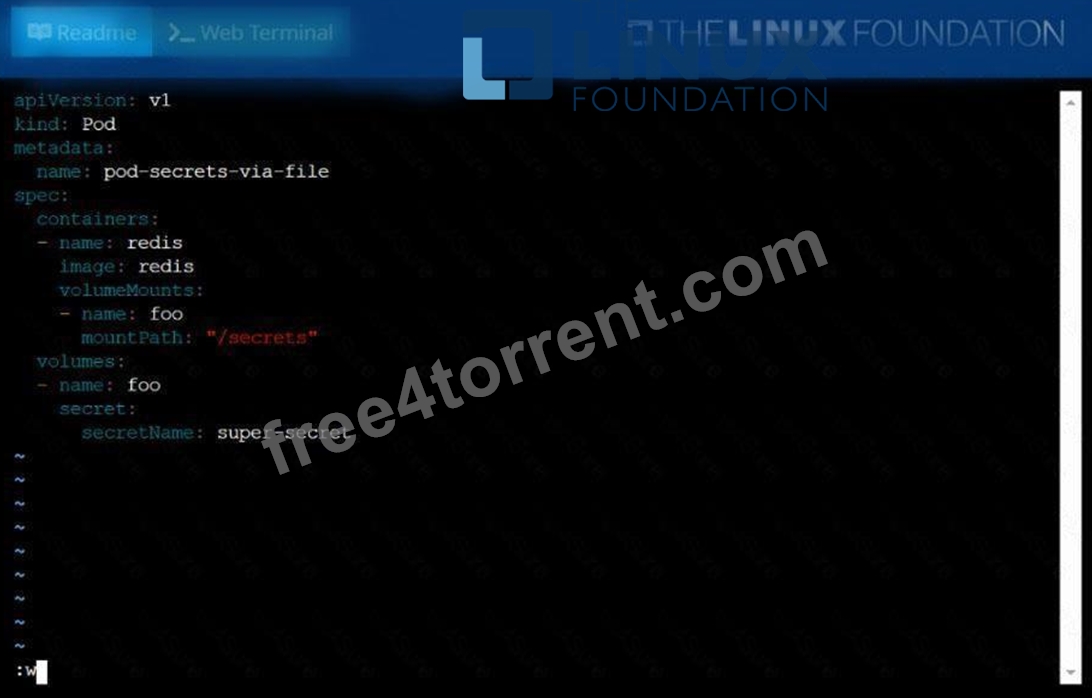
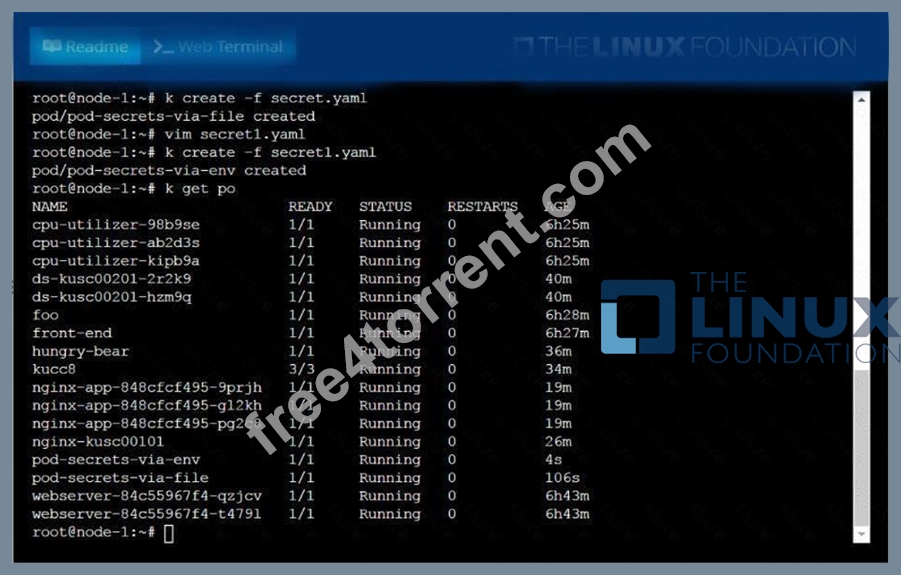
Create a Kubernetes secret asfollows:
* Name: super-secret
* password: bob
Create a pod namedpod-secrets-via-file Image, which mounts a secret namedsuper-secretat
/secrets.
Create a second pod namedpod-secrets-via-env Image, which exportspasswordas CONFIDENTIAL
Answer:
Explanation:
See the solution below.
Explanation
solution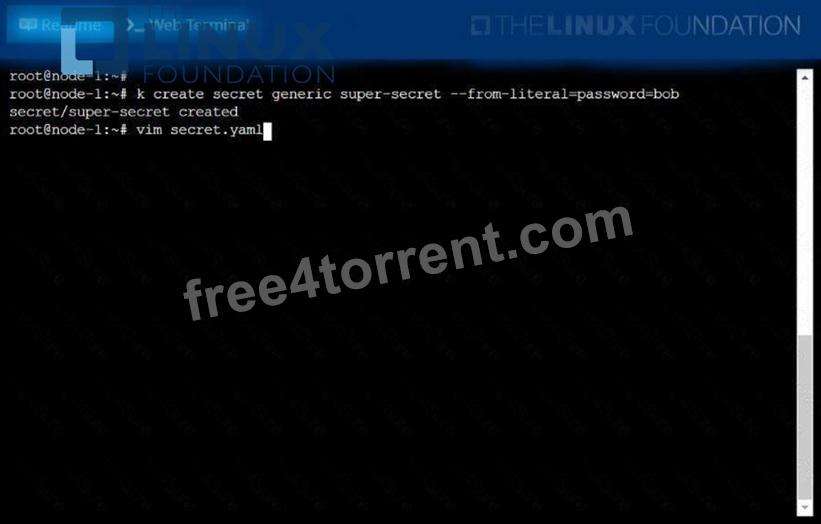
NEW QUESTION 43
Score: 4%
Task
Create a pod named kucc8 with a single app container for each of the following images running inside (there may be between 1 and 4 images specified): nginx + redis + memcached .
Answer:
Explanation:
See the solution below.
Explanation
Solution:
kubectl run kucc8 --image=nginx --dry-run -o yaml > kucc8.yaml
# vi kucc8.yaml
apiVersion: v1
kind: Pod
metadata:
creationTimestamp: null
name: kucc8
spec:
containers:
- image: nginx
name: nginx
- image: redis
name: redis
- image: memcached
name: memcached
- image: consul
name: consul
#
kubectl create -f kucc8.yaml
#12.07
NEW QUESTION 44
What file type upload is supported as part of the basic WildFire service?
- A. PE
- B. VBS
- C. BAT
- D. ELF
Answer: A
NEW QUESTION 45
List "nginx-dev" and "nginx-prod" pod and delete those pods
Answer:
Explanation:
See the solution below.
Explanation
kubect1 get pods -o wide
kubectl delete po "nginx-dev"kubectl delete po "nginx-prod"
NEW QUESTION 46
Create a file:
/opt/KUCC00302/kucc00302.txt that lists all pods that implement service baz in namespace development.
The format of the file should be one pod name per line.
Answer:
Explanation:
See the solution below.
Explanation
solution
F:\Work\Data Entry Work\Data Entry\20200827\CKA\11 B.JPG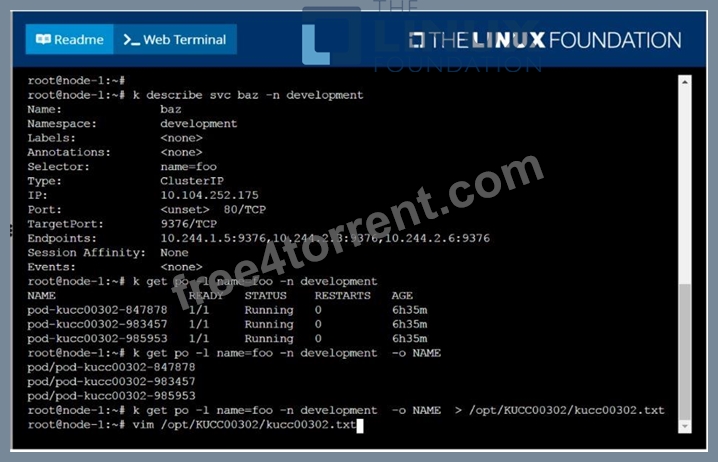
F:\Work\Data Entry Work\Data Entry\20200827\CKA\11 C.JPG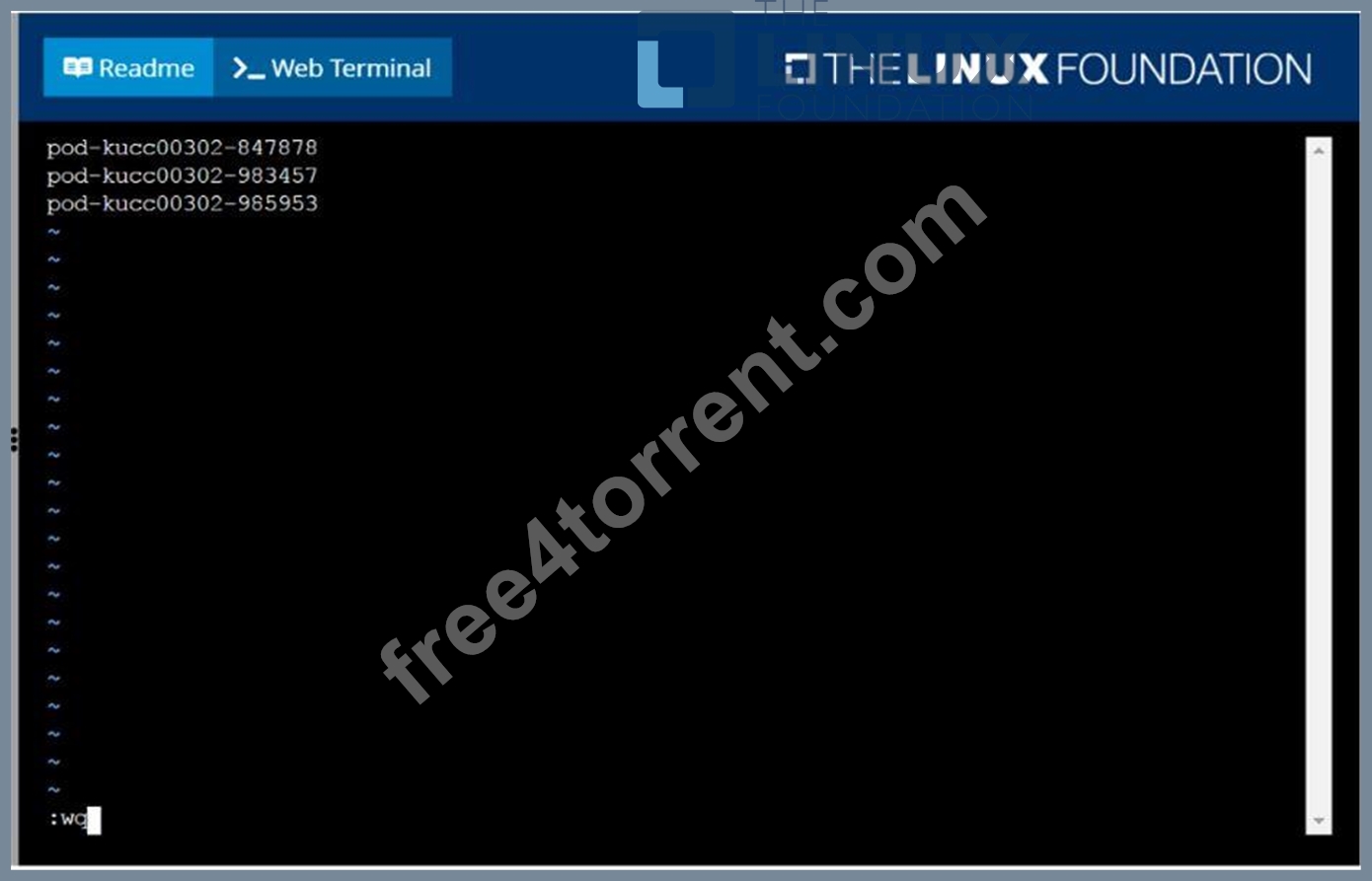
F:\Work\Data Entry Work\Data Entry\20200827\CKA\11 D.JPG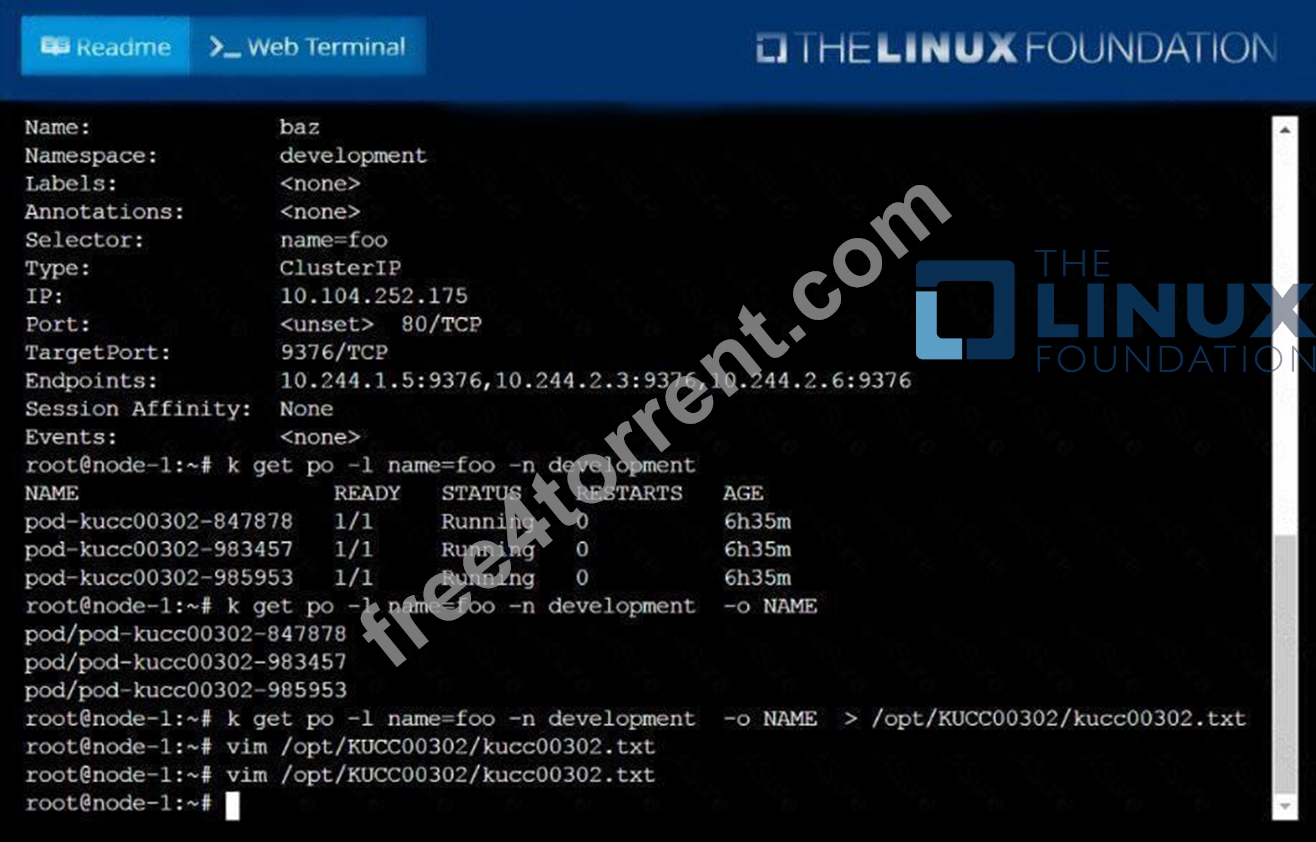
NEW QUESTION 47
Create an nginx pod and load environment values from the above configmap "keyvalcfgmap" and exec into the pod and verify the environment variables and delete the pod
- A. // first run this command to save the pod yaml
kubectl run nginx --image=nginx --restart=Always --dry-run -o
yaml > nginx-pod.yml
// edit the yml to below file and create
vim nginx-pod.yml
apiVersion: v1
kind: Pod
metadata:
labels:
run: nginx
name: nginx
spec:
containers:
- image: nginx
name: nginx
envFrom:
- configMapRef:
name: keyvalcfgmap
restartPolicy: Always
kubectl apply -f nginx-pod.yml
// verify
kubectl exec -it nginx -- env
kubectl delete po nginx - B. // first run this command to save the pod yaml
kubectl run nginx --image=nginx --restart=Always --dry-run -o
yaml > nginx-pod.yml
// edit the yml to below file and create
vim nginx-pod.yml
apiVersion: v1
name: nginx
envFrom:
- configMapRef:
name: keyvalcfgmap
restartPolicy: Always
kubectl apply -f nginx-pod.yml
// verify
kubectl exec -it nginx -- env
kubectl delete po nginx
Answer: A
NEW QUESTION 48
Create a Cronjob with busybox image that prints date and hello from kubernetes cluster message for every minute
- A. CronJob Syntax:
* --> Minute
* --> Hours
* --> Day of The Month
* --> Month
* --> Day of the Week
*/1 * * * * --> Execute a command every one minutes.
vim date-job.yaml
apiVersion: batch/v1beta1
kind: CronJob
metadata:
name: date-job
spec:
schedule: "*/1 * * * *"
jobTemplate:
spec:
template:
spec:
containers:
- name: hello
image: busybox
args:
- /bin/sh
- -c
- date; echo Hello from the Kubernetes cluster
restartPolicy: OnFailure
kubectl apply -f date-job.yaml
//Verify
kubectl get cj date-job -o yaml - B. CronJob Syntax:
* --> Minute
* --> Hours
* --> Day of The Month
* --> Month
* --> Day of the Week
*/1 * * * * --> Execute a command every one minutes.
vim date-job.yaml
apiVersion: batch/v1beta1
kind: CronJob
metadata:
name: date-job
spec:
schedule: "*/1 * * * *"
jobTemplate:
spec:
template:
- /bin/sh
- -c
- date; echo Hello from the Kubernetes cluster
restartPolicy: OnFailure
kubectl apply -f date-job.yaml
//Verify
kubectl get cj date-job -o yaml
Answer: A
NEW QUESTION 49
What is the maximum number of samples that can be submitted to WildFire manually per day?
- A. 15,000
- B. 5,000
- C. 2,000
- D. 1,000
Answer: D
NEW QUESTION 50
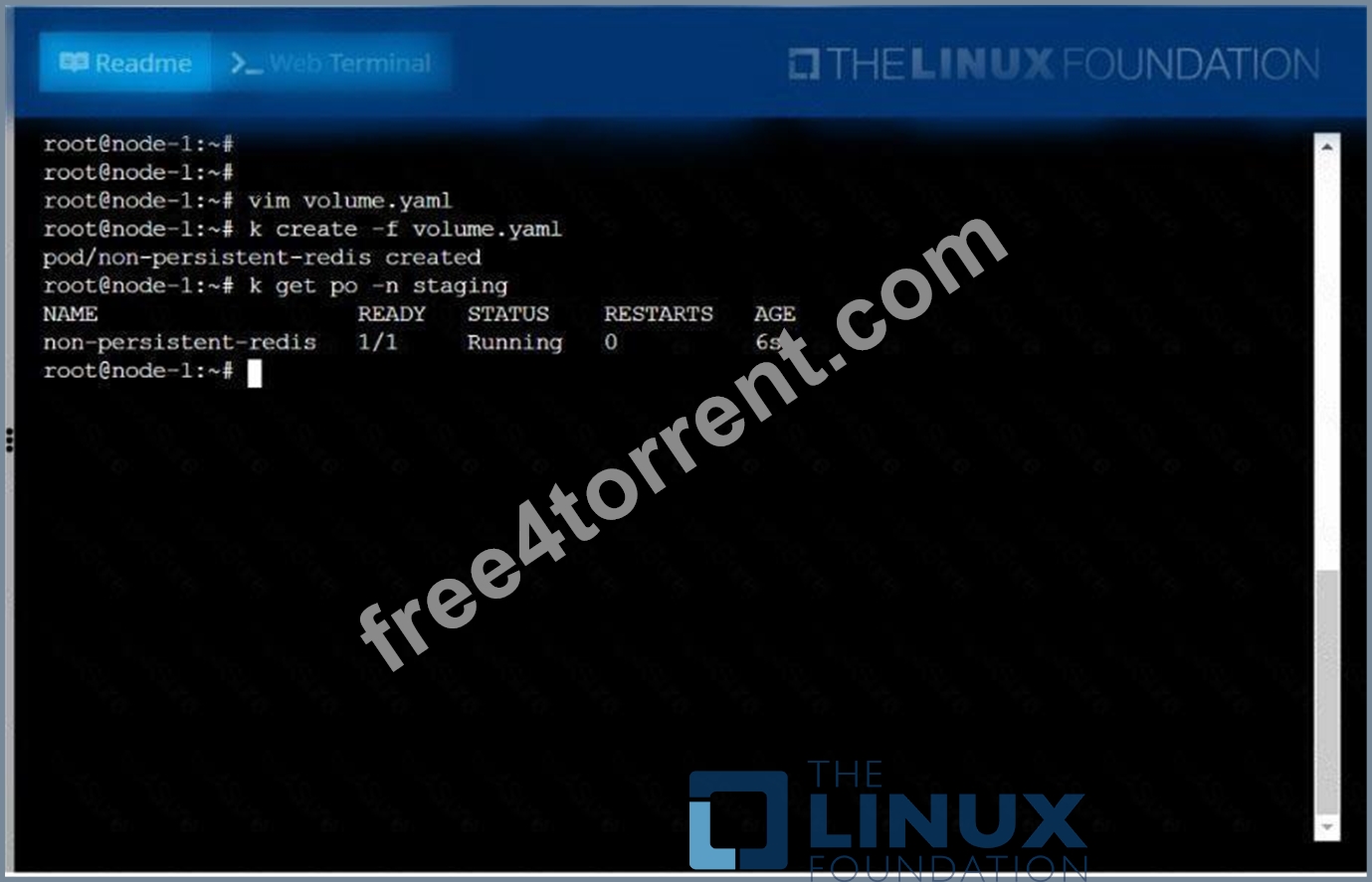
Create a pod as follows:
* Name:non-persistent-redis
* container Image:redis
* Volume with name:cache-control
* Mount path:/data/redis
The pod should launch in thestagingnamespace and the volumemust notbe persistent.
Answer:
Explanation:
See the solution below.
Explanation
solution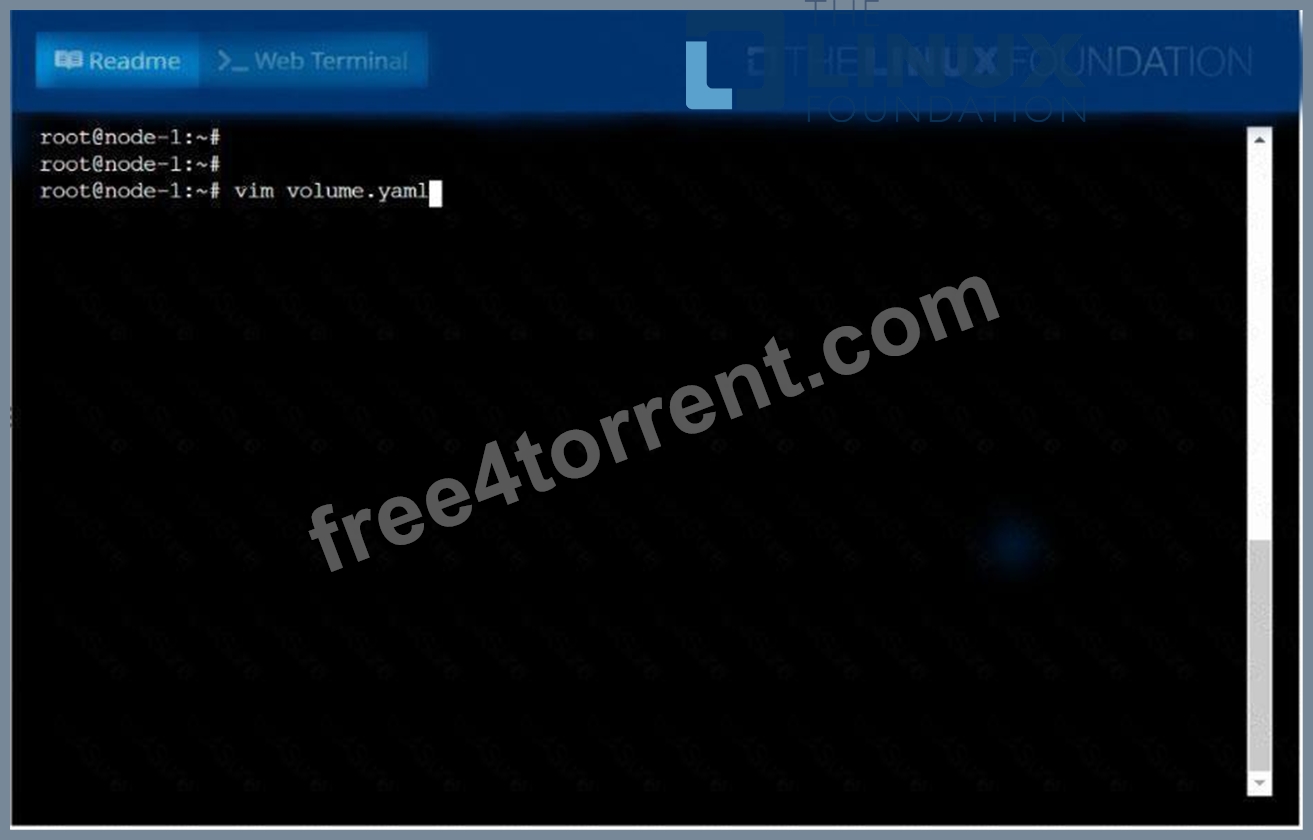
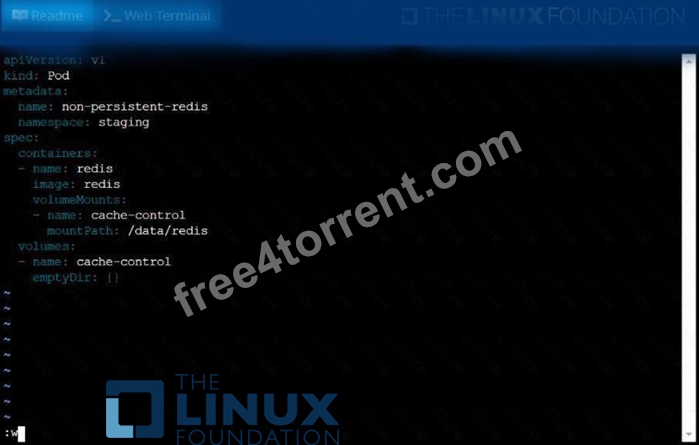
NEW QUESTION 51
Create an nginx pod which reads username as the environment variable
- A. // create a yml file
kubectl run nginx --image=nginx --restart=Never --dry-run -o
yaml > nginx.yml
// add env section below and create
apiVersion: v1
kind: Pod
metadata:
labels:
run: nginx
name: nginx
spec:
containers:
- image: nginx
name: nginx
env:
- name: USER_NAME
restartPolicy: Never
kubectl create -f nginx.yml
//Verify
kubectl exec -it nginx - env - B. // create a yml file
kubectl run nginx --image=nginx --restart=Never --dry-run -o
yaml > nginx.yml
// add env section below and create
apiVersion: v1
kind: Pod
metadata:
labels:
run: nginx
name: nginx
spec:
containers:
- image: nginx
name: nginx
env:
- name: USER_NAME
valueFrom:
secretKeyRef:
name: my-secret
key: username
restartPolicy: Never
kubectl create -f nginx.yml
//Verify
kubectl exec -it nginx - env
Answer: B
NEW QUESTION 52
Get the memory and CPU usage of all the pods and find out top 3 pods which have the highest usage and put them into the cpuusage.txt file
- A. // Get the top 3 pods
kubectl top pod --all-namespaces | sort --reverse --key 3 --
numeric | head -3
// putting into file
kubectl top pod --all-namespaces | sort --reverse --key 3 --
numeric | head -3 > cpu-usage.txt
// verify
cat cpu-usage.txt - B. // Get the top 3 pods
kubectl top pod --all-namespaces | sort --reverse --key 3 --
numeric | head -8
// putting into file
kubectl top pod --all-namespaces | sort --reverse --key 6 --
numeric | head -6 > cpu-usage.txt
// verify
cat cpu-usage.txt
Answer: A
NEW QUESTION 53
......
Try 100% Updated CKA Exam Questions [2022]: https://validdumps.free4torrent.com/CKA-valid-dumps-torrent.html